{"title":"Formation of Environmentally Persistent Free Radicals from the Irradiation of Polycyclic Aromatic Hydrocarbons","authors":"Desiree J. Sarmiento, and , Brian J. Majestic*, ","doi":"10.1021/acs.jpca.3c01405","DOIUrl":null,"url":null,"abstract":"<p >Polycyclic aromatic hydrocarbons (PAHs) provide a complex matrix for environmentally persistent free radicals (EPFRs) to stabilize in particulate matter, allowing them to be transported over long distances in the atmosphere while participating in light-driven reactions and causing various cardiopulmonary diseases. In this study, four PAHs ranging from three to five rings (anthracene, phenanthrene, pyrene, and benzo[<i>e</i>]pyrene) were investigated for EPFR formation upon photochemical and aqueous-phase aging. Through electron paramagnetic resonance (EPR) spectroscopy, it was found that approximately 10<sup>15</sup> to 10<sup>16</sup> spins g<sup>–1</sup> of EPFRs were formed from the PAH upon aging. EPR analysis also revealed that carbon-centered and monooxygen-centered radicals were predominantly formed by irradiation. However, oxidation and fused-ring matrices have added complexity to the chemical environment of these carbon-centered radicals, as observed by their <i>g</i>-values. This study showed that atmospheric aging results not only in the transformation of PAH-derived EPFR but also in an increase in EPFR concentrations of up to 10<sup>17</sup> spins g<sup>–1</sup>. Therefore, because of their stability and photosensitivity, PAH-derived EPFRs have a major impact on the environment.</p>","PeriodicalId":59,"journal":{"name":"The Journal of Physical Chemistry A","volume":"127 25","pages":"5390–5401"},"PeriodicalIF":2.8000,"publicationDate":"2023-06-14","publicationTypes":"Journal Article","fieldsOfStudy":null,"isOpenAccess":false,"openAccessPdf":"","citationCount":"1","resultStr":null,"platform":"Semanticscholar","paperid":null,"PeriodicalName":"The Journal of Physical Chemistry A","FirstCategoryId":"1","ListUrlMain":"https://pubs.acs.org/doi/10.1021/acs.jpca.3c01405","RegionNum":2,"RegionCategory":"化学","ArticlePicture":[],"TitleCN":null,"AbstractTextCN":null,"PMCID":null,"EPubDate":"","PubModel":"","JCR":"Q3","JCRName":"CHEMISTRY, PHYSICAL","Score":null,"Total":0}
引用次数: 1
Abstract
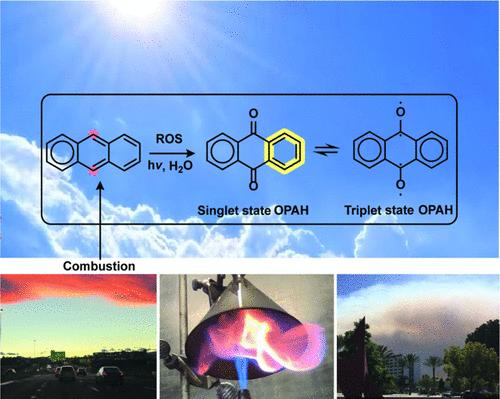
Polycyclic aromatic hydrocarbons (PAHs) provide a complex matrix for environmentally persistent free radicals (EPFRs) to stabilize in particulate matter, allowing them to be transported over long distances in the atmosphere while participating in light-driven reactions and causing various cardiopulmonary diseases. In this study, four PAHs ranging from three to five rings (anthracene, phenanthrene, pyrene, and benzo[e]pyrene) were investigated for EPFR formation upon photochemical and aqueous-phase aging. Through electron paramagnetic resonance (EPR) spectroscopy, it was found that approximately 1015 to 1016 spins g–1 of EPFRs were formed from the PAH upon aging. EPR analysis also revealed that carbon-centered and monooxygen-centered radicals were predominantly formed by irradiation. However, oxidation and fused-ring matrices have added complexity to the chemical environment of these carbon-centered radicals, as observed by their g-values. This study showed that atmospheric aging results not only in the transformation of PAH-derived EPFR but also in an increase in EPFR concentrations of up to 1017 spins g–1. Therefore, because of their stability and photosensitivity, PAH-derived EPFRs have a major impact on the environment.
期刊介绍:
The Journal of Physical Chemistry A is devoted to reporting new and original experimental and theoretical basic research of interest to physical chemists, biophysical chemists, and chemical physicists.



 京公网安备 11010802042870号
京ICP备2023020795号-1
京公网安备 11010802042870号
京ICP备2023020795号-1

 分享
分享
 求助内容:
求助内容: 应助结果提醒方式:
 扫码关注我们
