Jesse Cottrell, Ahlim Al Sanani, Iheanyichukwu Ogu, David Chaffin
{"title":"Triple Positive Antiphospholipid Antibody Syndrome in Pregnancy with High Frequency Plasma Exchange: A Case Report.","authors":"Jesse Cottrell, Ahlim Al Sanani, Iheanyichukwu Ogu, David Chaffin","doi":"10.1159/000526349","DOIUrl":null,"url":null,"abstract":"<p><strong>Introduction: </strong>Triple antibody positive antiphospholipid syndrome during pregnancy carries a poor prognosis. The placental vasculature is particularly vulnerable to these antibodies resulting in a marked increased risk of fetal growth restriction, placental infarction, abruption, stillbirth, and preterm severe preeclampsia.</p><p><strong>Case presentation: </strong>We report a case of a primigravida with triple antibody positive antiphospholipid syndrome that demonstrated placental insufficiency and fetal compromise at a previable gestation. The patient underwent plasma exchange every 48 h for 11 weeks resulting in delivery of a viable infant. Placental blood flow was improved after complete absence of end-diastolic flow in the fetal umbilical artery.</p><p><strong>Conclusion: </strong>Scheduled plasmapheresis every 48 h can be considered in select cases of antiphospholipid antibody syndrome.</p>","PeriodicalId":75241,"journal":{"name":"","volume":"50 2","pages":"154-158"},"PeriodicalIF":0.0,"publicationDate":"2023-04-01","publicationTypes":"Journal Article","fieldsOfStudy":null,"isOpenAccess":false,"openAccessPdf":"https://ftp.ncbi.nlm.nih.gov/pub/pmc/oa_pdf/8e/2b/tmh-0050-0154.PMC10091001.pdf","citationCount":"0","resultStr":null,"platform":"Semanticscholar","paperid":null,"PeriodicalName":"","FirstCategoryId":"3","ListUrlMain":"https://doi.org/10.1159/000526349","RegionNum":0,"RegionCategory":null,"ArticlePicture":[],"TitleCN":null,"AbstractTextCN":null,"PMCID":null,"EPubDate":"","PubModel":"","JCR":"","JCRName":"","Score":null,"Total":0}
引用次数: 0
Abstract
Introduction: Triple antibody positive antiphospholipid syndrome during pregnancy carries a poor prognosis. The placental vasculature is particularly vulnerable to these antibodies resulting in a marked increased risk of fetal growth restriction, placental infarction, abruption, stillbirth, and preterm severe preeclampsia.
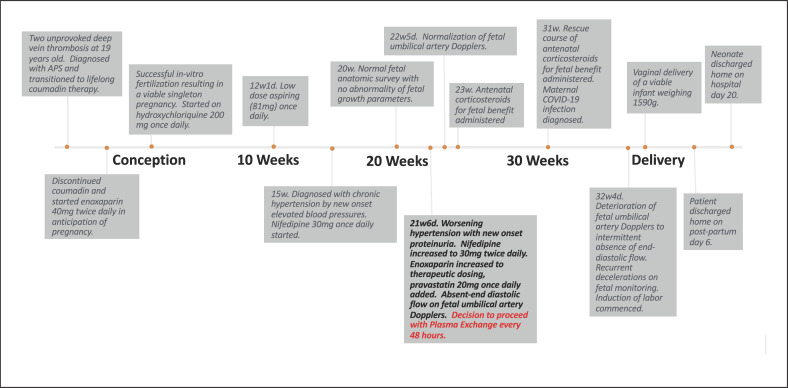
Case presentation: We report a case of a primigravida with triple antibody positive antiphospholipid syndrome that demonstrated placental insufficiency and fetal compromise at a previable gestation. The patient underwent plasma exchange every 48 h for 11 weeks resulting in delivery of a viable infant. Placental blood flow was improved after complete absence of end-diastolic flow in the fetal umbilical artery.
Conclusion: Scheduled plasmapheresis every 48 h can be considered in select cases of antiphospholipid antibody syndrome.



 京公网安备 11010802042870号
京ICP备2023020795号-1
京公网安备 11010802042870号
京ICP备2023020795号-1

 分享
分享
 求助内容:
求助内容: 应助结果提醒方式:
 扫码关注我们
