{"title":"Students' perception on immersive learning through 2D and 3D metaverse platforms.","authors":"Yohan Hwang, Dongkwang Shin, Hyejin Lee","doi":"10.1007/s11423-023-10238-9","DOIUrl":null,"url":null,"abstract":"<p><p>The main purpose of this paper is to add empirical data to the nascent field of metaverse learning and teaching by examining factors affecting student participation and their perceived experiences of different metaverse platforms. For data collection, 57 Korean undergraduates participated in a self-administered questionnaire and a short reflective essay regarding their experiences on three metaverse platforms (ifland, Gather Town, & Frame VR). For data analysis, exploratory factor analysis was first executed to derive the underlying factors that can explain student participation in metaverse platforms. The social and interactive learning as well as individualized and behavioral learning were identified as two main contributing factors. While the three platforms had no statistical difference in terms of social presence, students' sentimentally perceived differences among them. The sentiment analysis shows that 60.00% of <i>ifland</i> users were positive, followed by 53.66% of <i>Frame VR</i> users and 51.22% of <i>Gather Town</i> users. Furthermore, the additional keyword analysis shows why students expressed the perceived experiences of each platform in a different way. Given that the success of metaverse instruction can be dependent upon whether students regard it as beneficial, such measurements of student perception on the effectiveness of learning on metaverse platforms can offer meaningful recommendations for tech-savvy educators.</p>","PeriodicalId":72876,"journal":{"name":"","volume":" ","pages":"1-22"},"PeriodicalIF":0.0,"publicationDate":"2023-05-17","publicationTypes":"Journal Article","fieldsOfStudy":null,"isOpenAccess":false,"openAccessPdf":"https://www.ncbi.nlm.nih.gov/pmc/articles/PMC10191398/pdf/","citationCount":"5","resultStr":null,"platform":"Semanticscholar","paperid":null,"PeriodicalName":"","FirstCategoryId":"95","ListUrlMain":"https://doi.org/10.1007/s11423-023-10238-9","RegionNum":0,"RegionCategory":null,"ArticlePicture":[],"TitleCN":null,"AbstractTextCN":null,"PMCID":null,"EPubDate":"","PubModel":"","JCR":"","JCRName":"","Score":null,"Total":0}
引用次数: 5
Abstract
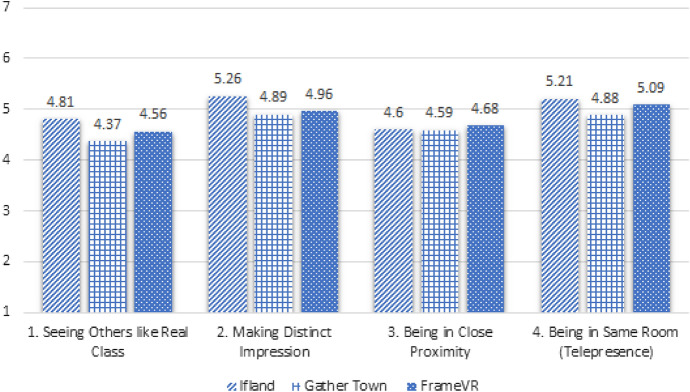
The main purpose of this paper is to add empirical data to the nascent field of metaverse learning and teaching by examining factors affecting student participation and their perceived experiences of different metaverse platforms. For data collection, 57 Korean undergraduates participated in a self-administered questionnaire and a short reflective essay regarding their experiences on three metaverse platforms (ifland, Gather Town, & Frame VR). For data analysis, exploratory factor analysis was first executed to derive the underlying factors that can explain student participation in metaverse platforms. The social and interactive learning as well as individualized and behavioral learning were identified as two main contributing factors. While the three platforms had no statistical difference in terms of social presence, students' sentimentally perceived differences among them. The sentiment analysis shows that 60.00% of ifland users were positive, followed by 53.66% of Frame VR users and 51.22% of Gather Town users. Furthermore, the additional keyword analysis shows why students expressed the perceived experiences of each platform in a different way. Given that the success of metaverse instruction can be dependent upon whether students regard it as beneficial, such measurements of student perception on the effectiveness of learning on metaverse platforms can offer meaningful recommendations for tech-savvy educators.





 京公网安备 11010802042870号
京ICP备2023020795号-1
京公网安备 11010802042870号
京ICP备2023020795号-1

 分享
分享
 求助内容:
求助内容: 应助结果提醒方式:
 扫码关注我们
