{"title":"Algorithm for multimodal medication therapy in patients with complex regional pain syndrome.","authors":"Min Cheol Chang, Donghwi Park","doi":"10.12701/jyms.2023.00360","DOIUrl":null,"url":null,"abstract":"<p><p>Complex regional pain syndrome (CRPS), previously known as reflex sympathetic dystrophy and causalgia, is a clinical entity characterized by classic neuropathic pain, autonomic involvement, motor symptoms, and trophic changes in the skin, nails, and hair. Although various therapeutic modalities are used to control CRPS-related pain, severe pain due to CRPS often persists and progresses to the chronic phase. In this study, we constructed an algorithm for multimodal medication therapy for CRPS based on the established pathology of CRPS. Oral steroid pulse therapy is recommended for initial pain management in patients with CRPS. Oral steroid therapy can reduce peripheral and central neuroinflammation, contributing to the development of neuropathic pain during the acute and chronic phases. If steroid pulse therapy offers poor relief or is ineffective, treatment to control central sensitization in the chronic phase should be initiated. If pain persists despite all drug adjustments, ketamine with midazolam 2 mg before and after ketamine injection can be administered intravenously to inhibit the N-methyl D-aspartate receptor. If this treatment fails to achieve sufficient efficacy, intravenous lidocaine can be administered for 2 weeks. We hope that our proposed drug treatment algorithm to control CRPS pain will help clinicians appropriately treat patients with CRPS. Further clinical studies assessing patients with CRPS are warranted to establish this treatment algorithm in clinical practice.</p>","PeriodicalId":74020,"journal":{"name":"Journal of Yeungnam medical science","volume":" ","pages":"S125-S128"},"PeriodicalIF":1.4000,"publicationDate":"2023-11-01","publicationTypes":"Journal Article","fieldsOfStudy":null,"isOpenAccess":false,"openAccessPdf":"https://www.ncbi.nlm.nih.gov/pmc/articles/PMC10718613/pdf/","citationCount":"1","resultStr":null,"platform":"Semanticscholar","paperid":null,"PeriodicalName":"Journal of Yeungnam medical science","FirstCategoryId":"1085","ListUrlMain":"https://doi.org/10.12701/jyms.2023.00360","RegionNum":0,"RegionCategory":null,"ArticlePicture":[],"TitleCN":null,"AbstractTextCN":null,"PMCID":null,"EPubDate":"2023/7/12 0:00:00","PubModel":"Epub","JCR":"Q3","JCRName":"MEDICINE, GENERAL & INTERNAL","Score":null,"Total":0}
引用次数: 1
Abstract
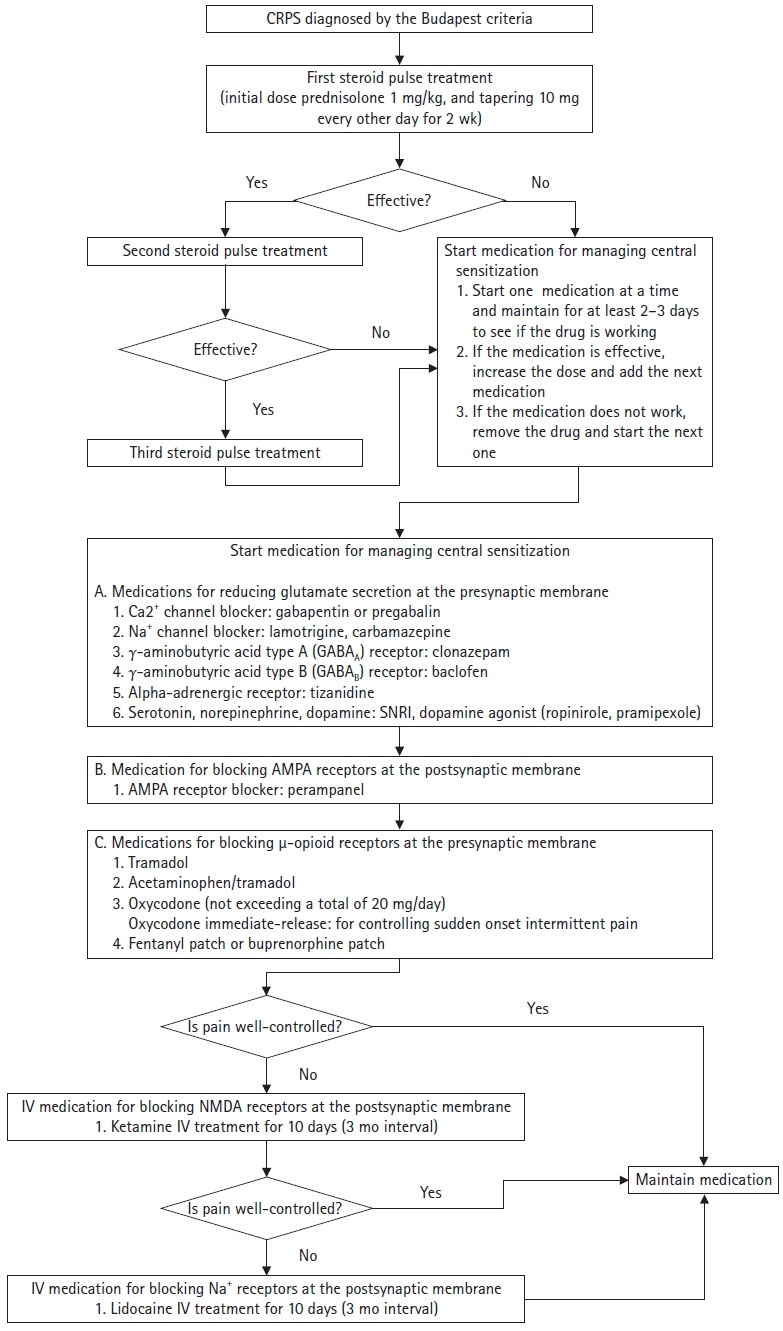
Complex regional pain syndrome (CRPS), previously known as reflex sympathetic dystrophy and causalgia, is a clinical entity characterized by classic neuropathic pain, autonomic involvement, motor symptoms, and trophic changes in the skin, nails, and hair. Although various therapeutic modalities are used to control CRPS-related pain, severe pain due to CRPS often persists and progresses to the chronic phase. In this study, we constructed an algorithm for multimodal medication therapy for CRPS based on the established pathology of CRPS. Oral steroid pulse therapy is recommended for initial pain management in patients with CRPS. Oral steroid therapy can reduce peripheral and central neuroinflammation, contributing to the development of neuropathic pain during the acute and chronic phases. If steroid pulse therapy offers poor relief or is ineffective, treatment to control central sensitization in the chronic phase should be initiated. If pain persists despite all drug adjustments, ketamine with midazolam 2 mg before and after ketamine injection can be administered intravenously to inhibit the N-methyl D-aspartate receptor. If this treatment fails to achieve sufficient efficacy, intravenous lidocaine can be administered for 2 weeks. We hope that our proposed drug treatment algorithm to control CRPS pain will help clinicians appropriately treat patients with CRPS. Further clinical studies assessing patients with CRPS are warranted to establish this treatment algorithm in clinical practice.



 京公网安备 11010802042870号
京ICP备2023020795号-1
京公网安备 11010802042870号
京ICP备2023020795号-1

 分享
分享

 求助内容:
求助内容: 应助结果提醒方式:
 扫码关注我们
