{"title":"Effect of Treadmill Backward Walking Training on Motor Capacity in Cerebral Palsy: A Randomized Controlled Study.","authors":"Halis Doğan, Fatma Mutluay","doi":"10.5535/arm.22154","DOIUrl":null,"url":null,"abstract":"<p><strong>Objective: </strong>To evaluate treadmill backward walking training (BWT) effects on walking speed, balance, mobility, and walking endurance in children with cerebral palsy (CP).</p><p><strong>Methods: </strong>The study evaluated 41 children with CP (age, 6-18; Gross Motor Function Classification System levels I and II). They were randomly allocated into control and BWT groups. BWT was applied (two sessions/week, 15 min/session for 8-week) to BWT group after the neurodevelopmental-based physiotherapy program routinely followed by all participants while the control group did not receive BWT. 10-Meter Walk Test (10MWT), Pediatric Balance Scale (PBS), Timed Up and Go Test (TUG), and Two-Minute Walk Test (2MWT) were selected as outcome measures for assessing walking speed, balance, mobility and endurance respectively.</p><p><strong>Results: </strong>In BWG, 2MWT distance (3.5%), PBS (3.5%) increased significantly, and TUG decreased by 5.1% (all p<0.001) after training, 10MWT was shorter by 6.1% for BWG, corresponding to 7.4% faster walking speed (p<0.01). Control group assessment variations were stationary and not statistically significant.</p><p><strong>Conclusion: </strong>Backward treadmill walking training induces small but statistically significant motor capacity improvements in children with CP.</p>","PeriodicalId":47738,"journal":{"name":"Annals of Rehabilitation Medicine-ARM","volume":"47 2","pages":"89-97"},"PeriodicalIF":2.9000,"publicationDate":"2023-04-01","publicationTypes":"Journal Article","fieldsOfStudy":null,"isOpenAccess":false,"openAccessPdf":"https://ftp.ncbi.nlm.nih.gov/pub/pmc/oa_pdf/80/27/arm-22154.PMC10164516.pdf","citationCount":"0","resultStr":null,"platform":"Semanticscholar","paperid":null,"PeriodicalName":"Annals of Rehabilitation Medicine-ARM","FirstCategoryId":"1085","ListUrlMain":"https://doi.org/10.5535/arm.22154","RegionNum":0,"RegionCategory":null,"ArticlePicture":[],"TitleCN":null,"AbstractTextCN":null,"PMCID":null,"EPubDate":"","PubModel":"","JCR":"Q1","JCRName":"REHABILITATION","Score":null,"Total":0}
引用次数: 0
Abstract
Objective: To evaluate treadmill backward walking training (BWT) effects on walking speed, balance, mobility, and walking endurance in children with cerebral palsy (CP).
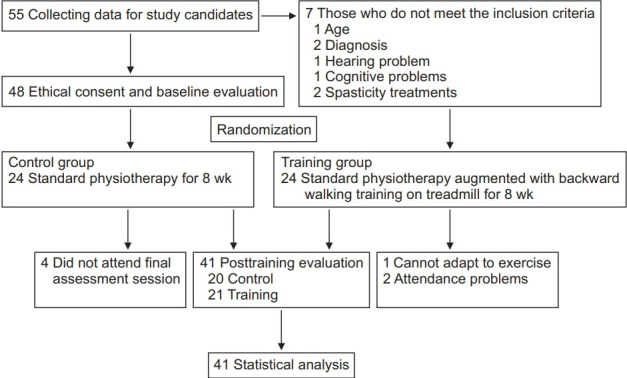
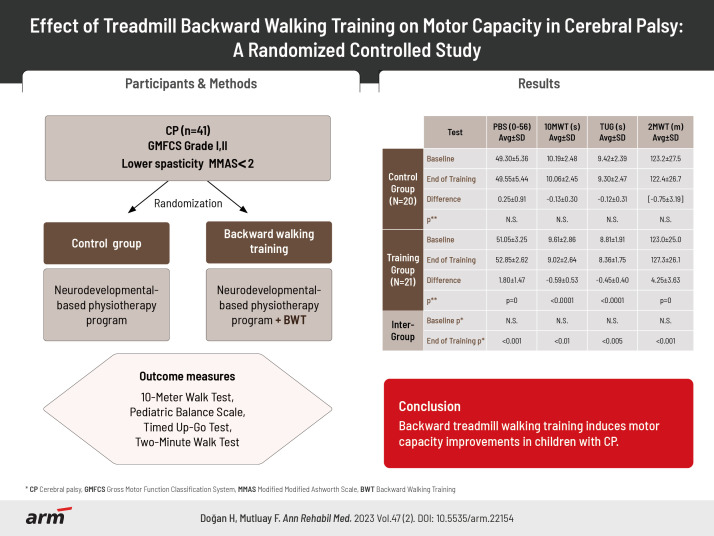
Methods: The study evaluated 41 children with CP (age, 6-18; Gross Motor Function Classification System levels I and II). They were randomly allocated into control and BWT groups. BWT was applied (two sessions/week, 15 min/session for 8-week) to BWT group after the neurodevelopmental-based physiotherapy program routinely followed by all participants while the control group did not receive BWT. 10-Meter Walk Test (10MWT), Pediatric Balance Scale (PBS), Timed Up and Go Test (TUG), and Two-Minute Walk Test (2MWT) were selected as outcome measures for assessing walking speed, balance, mobility and endurance respectively.
Results: In BWG, 2MWT distance (3.5%), PBS (3.5%) increased significantly, and TUG decreased by 5.1% (all p<0.001) after training, 10MWT was shorter by 6.1% for BWG, corresponding to 7.4% faster walking speed (p<0.01). Control group assessment variations were stationary and not statistically significant.
Conclusion: Backward treadmill walking training induces small but statistically significant motor capacity improvements in children with CP.




 京公网安备 11010802042870号
京ICP备2023020795号-1
京公网安备 11010802042870号
京ICP备2023020795号-1

 分享
分享
 求助内容:
求助内容: 应助结果提醒方式:
 扫码关注我们
