{"title":"Revisiting the mark test for mirror self-recognition.","authors":"Tony Calmette, Hélène Meunier","doi":"10.1007/s10329-023-01065-w","DOIUrl":null,"url":null,"abstract":"<p><p>Despite half a century of research, few species have exhibited convincing evidence of mirror self-recognition. Several methodological objections to Gallup's mark test have been raised, but empirical studies have shown that methodology does not adequately explain why most species fail to recognize themselves in mirrors. However, a potential issue was constantly overlooked: mirror ecological relevance. Although reflective surfaces in nature are horizontal, previous studies indeed used vertical mirrors. The present study revisited the mark test to address this issue in an experiment with capuchin monkeys (Sapajus apella). Additionally, a new procedure based on sticker exchange was designed to maximize mark attractiveness. Subjects were first trained to exchange stickers, habituated to being head-touched, and exposed to a horizontal mirror. Then, their mirror self-recognition was tested by surreptitiously placing a sticker on their forehead before requesting them to exchange stickers. None of the monkeys removed the sticker from their forehead in the presence of the mirror. In line with previous studies, this result suggests that capuchin monkeys lack the ability to recognize themselves in mirrors. Nonetheless, this modified mark test could prove useful in future studies, including investigation of interindividual variability of mirror self-recognition in self-recognizing species.</p>","PeriodicalId":20468,"journal":{"name":"Primates","volume":"64 4","pages":"421-427"},"PeriodicalIF":1.5000,"publicationDate":"2023-07-01","publicationTypes":"Journal Article","fieldsOfStudy":null,"isOpenAccess":false,"openAccessPdf":"","citationCount":"1","resultStr":null,"platform":"Semanticscholar","paperid":null,"PeriodicalName":"Primates","FirstCategoryId":"99","ListUrlMain":"https://doi.org/10.1007/s10329-023-01065-w","RegionNum":4,"RegionCategory":"生物学","ArticlePicture":[],"TitleCN":null,"AbstractTextCN":null,"PMCID":null,"EPubDate":"","PubModel":"","JCR":"Q2","JCRName":"ZOOLOGY","Score":null,"Total":0}
引用次数: 1
Abstract
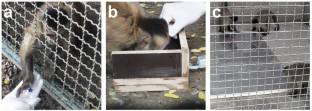
Despite half a century of research, few species have exhibited convincing evidence of mirror self-recognition. Several methodological objections to Gallup's mark test have been raised, but empirical studies have shown that methodology does not adequately explain why most species fail to recognize themselves in mirrors. However, a potential issue was constantly overlooked: mirror ecological relevance. Although reflective surfaces in nature are horizontal, previous studies indeed used vertical mirrors. The present study revisited the mark test to address this issue in an experiment with capuchin monkeys (Sapajus apella). Additionally, a new procedure based on sticker exchange was designed to maximize mark attractiveness. Subjects were first trained to exchange stickers, habituated to being head-touched, and exposed to a horizontal mirror. Then, their mirror self-recognition was tested by surreptitiously placing a sticker on their forehead before requesting them to exchange stickers. None of the monkeys removed the sticker from their forehead in the presence of the mirror. In line with previous studies, this result suggests that capuchin monkeys lack the ability to recognize themselves in mirrors. Nonetheless, this modified mark test could prove useful in future studies, including investigation of interindividual variability of mirror self-recognition in self-recognizing species.
期刊介绍:
Primates is an international journal of primatology whose aim is to provide a forum for the elucidation of all aspects of primates. The oldest primatological journal, Primates publishes original papers that advance the scientific study of primates, and its scope embraces work in diverse fields covering biological bases of behavior, socio-ecology, learning and cognition, social processes, systematics, evolution, and medicine. Contributions relevant to conservation of natural populations and welfare of captive primates are welcome. Studies focusing on nonprimate species may be considered if their relevance to primatology is clear. Original Articles as well as Review Articles, News and Perspectives, and Book Reviews are included. All manuscripts received are initially screened for suitability by members of the Editorial Board, taking into account style and ethical issues, leading to a swift decision about whether to send the manuscript for external review.



 京公网安备 11010802042870号
京ICP备2023020795号-1
京公网安备 11010802042870号
京ICP备2023020795号-1

 分享
分享
 求助内容:
求助内容: 应助结果提醒方式:
 扫码关注我们
