Lauren Savannah Dewberry, Ken Porche, Travis Koenig, Kyle D Allen, Kevin J Otto
{"title":"High frequency alternating current neurostimulation decreases nocifensive behavior in a disc herniation model of lumbar radiculopathy.","authors":"Lauren Savannah Dewberry, Ken Porche, Travis Koenig, Kyle D Allen, Kevin J Otto","doi":"10.1186/s42234-023-00119-0","DOIUrl":null,"url":null,"abstract":"<p><strong>Background: </strong>The purpose of this study was to evaluate if kilohertz frequency alternating current (KHFAC) stimulation of peripheral nerve could serve as a treatment for lumbar radiculopathy. Prior work shows that KHFAC stimulation can treat sciatica resulting from chronic sciatic nerve constriction. Here, we evaluate if KHFAC stimulation is also beneficial in a more physiologic model of low back pain which mimics nucleus pulposus (NP) impingement of a lumbar dorsal root ganglion (DRG).</p><p><strong>Methods: </strong>To mimic a lumbar radiculopathy, autologous tail NP was harvested and placed upon the right L5 nerve root and DRG. During the same surgery, a cuff electrode was implanted around the sciatic nerve with wires routed to a headcap for delivery of KHFAC stimulation. Male Lewis rats (3 mo., n = 18) were separated into 3 groups: NP injury + KHFAC stimulation (n = 7), NP injury + sham cuff (n = 6), and sham injury + sham cuff (n = 5). Prior to surgery and for 2 weeks following surgery, animal tactile sensitivity, gait, and static weight bearing were evaluated.</p><p><strong>Results: </strong>KHFAC stimulation of the sciatic nerve decreased behavioral evidence of pain and disability. Without KHFAC stimulation, injured animals had heightened tactile sensitivity compared to baseline (p < 0.05), with tactile allodynia reversed during KHFAC stimulation (p < 0.01). Midfoot flexion during locomotion was decreased after injury but improved with KHFAC stimulation (p < 0.05). Animals also placed more weight on their injured limb when KHFAC stimulation was applied (p < 0.05). Electrophysiology measurements at end point showed decreased, but not blocked, compound nerve action potentials with KHFAC stimulation (p < 0.05).</p><p><strong>Conclusions: </strong>KHFAC stimulation decreases hypersensitivity but does not cause additional gait compensations. This supports the idea that KHFAC stimulation applied to a peripheral nerve may be able to treat chronic pain resulting from sciatic nerve root inflammation.</p>","PeriodicalId":72363,"journal":{"name":"Bioelectronic medicine","volume":"9 1","pages":"15"},"PeriodicalIF":0.0000,"publicationDate":"2023-07-12","publicationTypes":"Journal Article","fieldsOfStudy":null,"isOpenAccess":false,"openAccessPdf":"https://www.ncbi.nlm.nih.gov/pmc/articles/PMC10337121/pdf/","citationCount":"0","resultStr":null,"platform":"Semanticscholar","paperid":null,"PeriodicalName":"Bioelectronic medicine","FirstCategoryId":"1085","ListUrlMain":"https://doi.org/10.1186/s42234-023-00119-0","RegionNum":0,"RegionCategory":null,"ArticlePicture":[],"TitleCN":null,"AbstractTextCN":null,"PMCID":null,"EPubDate":"","PubModel":"","JCR":"","JCRName":"","Score":null,"Total":0}
引用次数: 0
Abstract
Background: The purpose of this study was to evaluate if kilohertz frequency alternating current (KHFAC) stimulation of peripheral nerve could serve as a treatment for lumbar radiculopathy. Prior work shows that KHFAC stimulation can treat sciatica resulting from chronic sciatic nerve constriction. Here, we evaluate if KHFAC stimulation is also beneficial in a more physiologic model of low back pain which mimics nucleus pulposus (NP) impingement of a lumbar dorsal root ganglion (DRG).
Methods: To mimic a lumbar radiculopathy, autologous tail NP was harvested and placed upon the right L5 nerve root and DRG. During the same surgery, a cuff electrode was implanted around the sciatic nerve with wires routed to a headcap for delivery of KHFAC stimulation. Male Lewis rats (3 mo., n = 18) were separated into 3 groups: NP injury + KHFAC stimulation (n = 7), NP injury + sham cuff (n = 6), and sham injury + sham cuff (n = 5). Prior to surgery and for 2 weeks following surgery, animal tactile sensitivity, gait, and static weight bearing were evaluated.
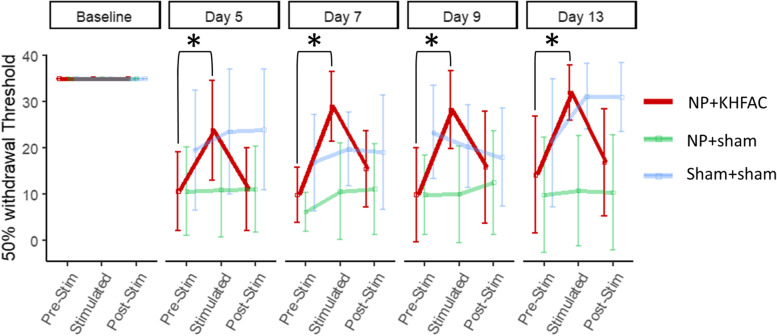
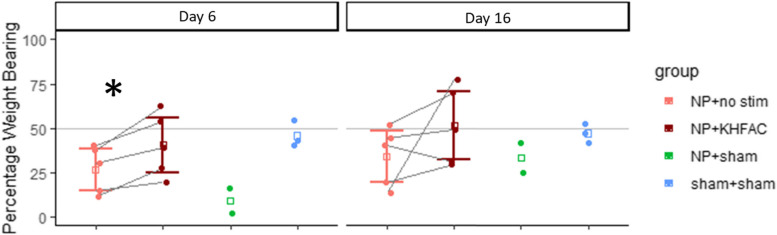
Results: KHFAC stimulation of the sciatic nerve decreased behavioral evidence of pain and disability. Without KHFAC stimulation, injured animals had heightened tactile sensitivity compared to baseline (p < 0.05), with tactile allodynia reversed during KHFAC stimulation (p < 0.01). Midfoot flexion during locomotion was decreased after injury but improved with KHFAC stimulation (p < 0.05). Animals also placed more weight on their injured limb when KHFAC stimulation was applied (p < 0.05). Electrophysiology measurements at end point showed decreased, but not blocked, compound nerve action potentials with KHFAC stimulation (p < 0.05).
Conclusions: KHFAC stimulation decreases hypersensitivity but does not cause additional gait compensations. This supports the idea that KHFAC stimulation applied to a peripheral nerve may be able to treat chronic pain resulting from sciatic nerve root inflammation.




 京公网安备 11010802042870号
京ICP备2023020795号-1
京公网安备 11010802042870号
京ICP备2023020795号-1

 分享
分享

 求助内容:
求助内容: 应助结果提醒方式:
 扫码关注我们
