{"title":"Primary Mouse Invariant Natural Killer T (iNKT) Cell Purification and Transduction.","authors":"Gloria Delfanti, Paolo Dellabona, Giulia Casorati","doi":"10.21769/BioProtoc.4707","DOIUrl":null,"url":null,"abstract":"<p><p>Invariant natural killer T (iNKT) cells are a non-conventional T-cell population expressing a conserved semi-invariant T-cell receptor (TCR) that reacts to lipid antigens, such as α-galactosyl ceramide (α-GalCer), presented by the monomorphic molecule CD1d. iNKT cells play a central role in tumor immunosurveillance and represent a powerful tool for anti-cancer treatment, notably because they can be efficiently redirected against hematological or solid malignancies by engineering with tumor-specific chimeric antigen receptors (CARs) or TCRs. However, iNKT cells are rare and require specific ex vivo pre-selection and substantial in vitro expansion to be exploited for adoptive cell therapy (ACT). This protocol describes a robust method to obtain a large number of mouse iNKT cells that can be effectually engineered by retroviral (RV) transduction. A major advantage of this protocol is that it requires neither particular instrumentation nor a high number of mice. iNKT cells are enriched from the spleens of iVα14-Jα18 transgenic mice; the rapid purification protocol yields a highly enriched iNKT cell population that is activated by anti-CD3/CD28 beads, which is more reproducible and less time consuming than using bone marrow-derived dendritic cells loaded with α-GalCer, without risks of expanding contaminant T cells. Forty-eight hours after activation, iNKT cells are transduced with the selected RV by spin inoculation. This protocol allows to obtain, in 15 days, millions of ready-to-use, highly pure, and stably transduced iNKT cells that might be exploited for in vitro assays and ACT experiments in preclinical studies.</p>","PeriodicalId":8938,"journal":{"name":"Bio-protocol","volume":"13 13","pages":"e4707"},"PeriodicalIF":0.0000,"publicationDate":"2023-07-05","publicationTypes":"Journal Article","fieldsOfStudy":null,"isOpenAccess":false,"openAccessPdf":"https://ftp.ncbi.nlm.nih.gov/pub/pmc/oa_pdf/66/42/BioProtoc-13-13-4707.PMC10336563.pdf","citationCount":"0","resultStr":null,"platform":"Semanticscholar","paperid":null,"PeriodicalName":"Bio-protocol","FirstCategoryId":"1085","ListUrlMain":"https://doi.org/10.21769/BioProtoc.4707","RegionNum":0,"RegionCategory":null,"ArticlePicture":[],"TitleCN":null,"AbstractTextCN":null,"PMCID":null,"EPubDate":"","PubModel":"","JCR":"","JCRName":"","Score":null,"Total":0}
引用次数: 0
Abstract
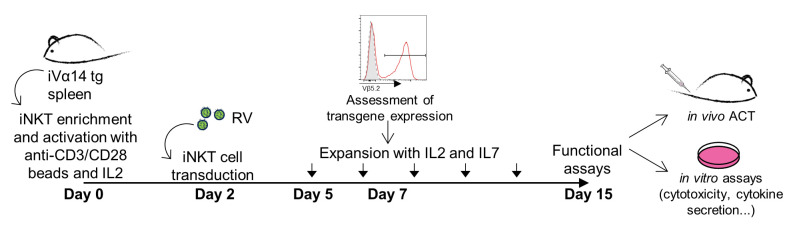
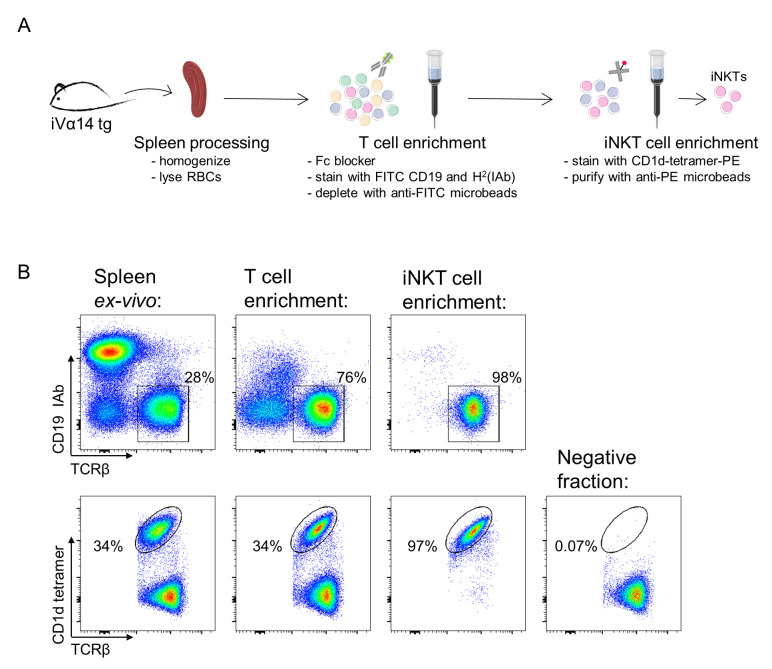
Invariant natural killer T (iNKT) cells are a non-conventional T-cell population expressing a conserved semi-invariant T-cell receptor (TCR) that reacts to lipid antigens, such as α-galactosyl ceramide (α-GalCer), presented by the monomorphic molecule CD1d. iNKT cells play a central role in tumor immunosurveillance and represent a powerful tool for anti-cancer treatment, notably because they can be efficiently redirected against hematological or solid malignancies by engineering with tumor-specific chimeric antigen receptors (CARs) or TCRs. However, iNKT cells are rare and require specific ex vivo pre-selection and substantial in vitro expansion to be exploited for adoptive cell therapy (ACT). This protocol describes a robust method to obtain a large number of mouse iNKT cells that can be effectually engineered by retroviral (RV) transduction. A major advantage of this protocol is that it requires neither particular instrumentation nor a high number of mice. iNKT cells are enriched from the spleens of iVα14-Jα18 transgenic mice; the rapid purification protocol yields a highly enriched iNKT cell population that is activated by anti-CD3/CD28 beads, which is more reproducible and less time consuming than using bone marrow-derived dendritic cells loaded with α-GalCer, without risks of expanding contaminant T cells. Forty-eight hours after activation, iNKT cells are transduced with the selected RV by spin inoculation. This protocol allows to obtain, in 15 days, millions of ready-to-use, highly pure, and stably transduced iNKT cells that might be exploited for in vitro assays and ACT experiments in preclinical studies.



 京公网安备 11010802042870号
京ICP备2023020795号-1
京公网安备 11010802042870号
京ICP备2023020795号-1

 分享
分享

 求助内容:
求助内容: 应助结果提醒方式:
 扫码关注我们
