David Lewis, M Feisal Rahman, Revocatus Twinomuhangi, Shababa Haque, Nazmul Huq, Saleemul Huq, Lars Ribbe, Asif Ishtiaque
{"title":"University-Based Researchers as Knowledge Brokers for Climate Policies and Action.","authors":"David Lewis, M Feisal Rahman, Revocatus Twinomuhangi, Shababa Haque, Nazmul Huq, Saleemul Huq, Lars Ribbe, Asif Ishtiaque","doi":"10.1057/s41287-022-00526-0","DOIUrl":null,"url":null,"abstract":"<p><p>Responding effectively to climate crisis requires strong science-policy links to be put in place. Past research on the research-policy interface indicates longstanding challenges that have become more acute in the case of climate science, since this requires multi-disciplinary approaches and faces distinctive political challenges in linking knowledge with policy. What can be learned from the experiences of university-based researchers seeking to influence policy as they try to operate in the brokering space? With this in mind, an empirical study was designed to capture the detailed views and experiences of forty researchers in four universities across four countries-Bangladesh, Germany, Uganda and UK. It found a wide range of different researcher attitudes to policy engagement, diverse methods of engaging, a preference for working with government and civil society over private sector policy actors, and a perceived need for more university support. The findings suggest a need to rethink conditions for engagement to create spaces for knowledge exchange and cooperation that can contribute to policies for societal transformation. More attention also needs to be paid to interdisciplinary research approaches, improving research connections with private sector actors, and strengthening university research links with local communities. Finally, the position of university based researchers in the Global South will require strengthening to improve North-South knowledge exchange, capacity development, and incentives for policy engagement.</p>","PeriodicalId":75001,"journal":{"name":"","volume":"35 3","pages":"656-683"},"PeriodicalIF":0.0,"publicationDate":"2023-01-01","publicationTypes":"Journal Article","fieldsOfStudy":null,"isOpenAccess":false,"openAccessPdf":"https://www.ncbi.nlm.nih.gov/pmc/articles/PMC9112648/pdf/","citationCount":"0","resultStr":null,"platform":"Semanticscholar","paperid":null,"PeriodicalName":"","FirstCategoryId":"90","ListUrlMain":"https://doi.org/10.1057/s41287-022-00526-0","RegionNum":0,"RegionCategory":null,"ArticlePicture":[],"TitleCN":null,"AbstractTextCN":null,"PMCID":null,"EPubDate":"2022/5/17 0:00:00","PubModel":"Epub","JCR":"","JCRName":"","Score":null,"Total":0}
引用次数: 0
Abstract
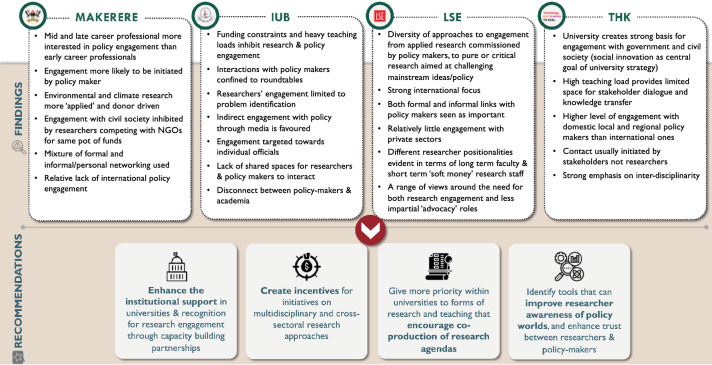
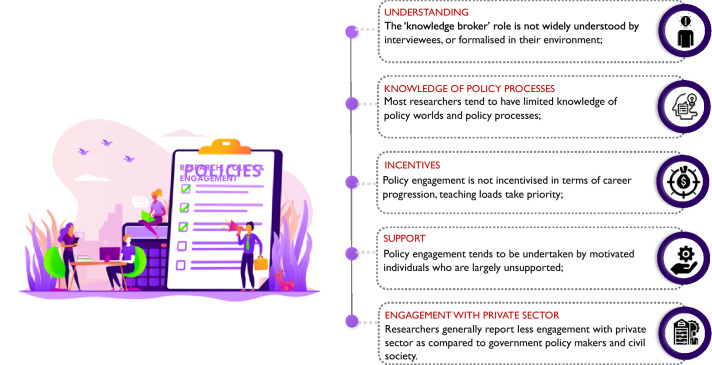
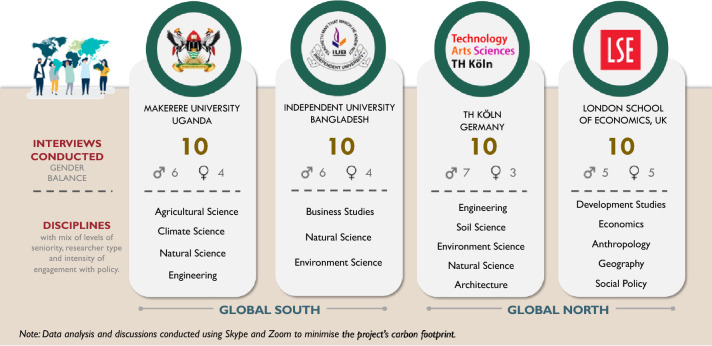
Responding effectively to climate crisis requires strong science-policy links to be put in place. Past research on the research-policy interface indicates longstanding challenges that have become more acute in the case of climate science, since this requires multi-disciplinary approaches and faces distinctive political challenges in linking knowledge with policy. What can be learned from the experiences of university-based researchers seeking to influence policy as they try to operate in the brokering space? With this in mind, an empirical study was designed to capture the detailed views and experiences of forty researchers in four universities across four countries-Bangladesh, Germany, Uganda and UK. It found a wide range of different researcher attitudes to policy engagement, diverse methods of engaging, a preference for working with government and civil society over private sector policy actors, and a perceived need for more university support. The findings suggest a need to rethink conditions for engagement to create spaces for knowledge exchange and cooperation that can contribute to policies for societal transformation. More attention also needs to be paid to interdisciplinary research approaches, improving research connections with private sector actors, and strengthening university research links with local communities. Finally, the position of university based researchers in the Global South will require strengthening to improve North-South knowledge exchange, capacity development, and incentives for policy engagement.



 京公网安备 11010802042870号
京ICP备2023020795号-1
京公网安备 11010802042870号
京ICP备2023020795号-1

 分享
分享
 求助内容:
求助内容: 应助结果提醒方式:
 扫码关注我们
