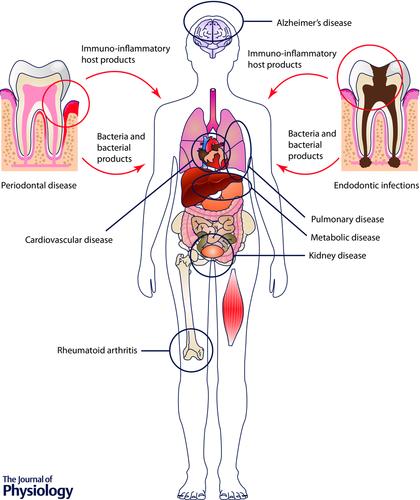
{"title":"From focal sepsis to periodontal medicine: a century of exploring the role of the oral microbiome in systemic disease","authors":"Purnima S. Kumar","doi":"10.1113/JP272427","DOIUrl":null,"url":null,"abstract":"<p>The oral microbiome is established within a few minutes after birth and consists of stable multi-species communities that engage in a dynamic equilibrium with the host immune system. Dental caries, endodontic infections and periodontal diseases are bacterially driven diseases that are caused by dysbiotic microbiomes. Over a century ago, the focal infection theory implicated these infections in the aetiology of several systemic diseases, ranging from arthritis to neurodegenerative diseases. However, a lack of concrete evidence, combined with the urgency with which clinicians embraced this approach without regard for appropriate case selection, led to its demise within 30 years. In the last decade of the 20th century, the concept of periodontal medicine was introduced to explain the correlations that were being observed between periodontitis and cardiovascular disease, rheumatoid arthritis, Alzheimer's disease, pulmonary disease, pre-term delivery of low birth weight infants and metabolic disease. It was proposed that periodontal pathobionts played a causal role in the initiating or exacerbating certain diseases either by direct invasion or by stimulating a florid immune-inflammatory response that extended into the systemic circulation. This review will examine the strength of current evidence in establishing a causal link between oral pathobionts and systemic disease.\n\n <figure>\n <div><picture>\n <source></source></picture><p></p>\n </div>\n </figure>\n </p>","PeriodicalId":50088,"journal":{"name":"Journal of Physiology-London","volume":"595 2","pages":"465-476"},"PeriodicalIF":4.4000,"publicationDate":"2016-07-18","publicationTypes":"Journal Article","fieldsOfStudy":null,"isOpenAccess":false,"openAccessPdf":"https://sci-hub-pdf.com/10.1113/JP272427","citationCount":"156","resultStr":null,"platform":"Semanticscholar","paperid":null,"PeriodicalName":"Journal of Physiology-London","FirstCategoryId":"3","ListUrlMain":"https://onlinelibrary.wiley.com/doi/10.1113/JP272427","RegionNum":2,"RegionCategory":"医学","ArticlePicture":[],"TitleCN":null,"AbstractTextCN":null,"PMCID":null,"EPubDate":"","PubModel":"","JCR":"Q1","JCRName":"NEUROSCIENCES","Score":null,"Total":0}
引用次数: 156
Abstract
The oral microbiome is established within a few minutes after birth and consists of stable multi-species communities that engage in a dynamic equilibrium with the host immune system. Dental caries, endodontic infections and periodontal diseases are bacterially driven diseases that are caused by dysbiotic microbiomes. Over a century ago, the focal infection theory implicated these infections in the aetiology of several systemic diseases, ranging from arthritis to neurodegenerative diseases. However, a lack of concrete evidence, combined with the urgency with which clinicians embraced this approach without regard for appropriate case selection, led to its demise within 30 years. In the last decade of the 20th century, the concept of periodontal medicine was introduced to explain the correlations that were being observed between periodontitis and cardiovascular disease, rheumatoid arthritis, Alzheimer's disease, pulmonary disease, pre-term delivery of low birth weight infants and metabolic disease. It was proposed that periodontal pathobionts played a causal role in the initiating or exacerbating certain diseases either by direct invasion or by stimulating a florid immune-inflammatory response that extended into the systemic circulation. This review will examine the strength of current evidence in establishing a causal link between oral pathobionts and systemic disease.
期刊介绍:
The Journal of Physiology publishes full-length original Research Papers and Techniques for Physiology, which are short papers aimed at disseminating new techniques for physiological research. Articles solicited by the Editorial Board include Perspectives, Symposium Reports and Topical Reviews, which highlight areas of special physiological interest. CrossTalk articles are short editorial-style invited articles framing a debate between experts in the field on controversial topics. Letters to the Editor and Journal Club articles are also published. All categories of papers are subjected to peer reivew.
The Journal of Physiology welcomes submitted research papers in all areas of physiology. Authors should present original work that illustrates new physiological principles or mechanisms. Papers on work at the molecular level, at the level of the cell membrane, single cells, tissues or organs and on systems physiology are all acceptable. Theoretical papers and papers that use computational models to further our understanding of physiological processes will be considered if based on experimentally derived data and if the hypothesis advanced is directly amenable to experimental testing. While emphasis is on human and mammalian physiology, work on lower vertebrate or invertebrate preparations may be suitable if it furthers the understanding of the functioning of other organisms including mammals.



 京公网安备 11010802042870号
京ICP备2023020795号-1
京公网安备 11010802042870号
京ICP备2023020795号-1

 分享
分享
 求助内容:
求助内容: 应助结果提醒方式:
 扫码关注我们
