{"title":"Hyperglycemia Associated With Raynaud Phenomenon and Liver Dysfunction After COVID-19 Vaccination in Type 1 Diabetes Mellitus","authors":"Zhanna Zavgorodneva MD , Calvin Jialin Zhang , Maksym Bondiuk MD , Tooraj Zahedi MD","doi":"10.1016/j.aace.2023.05.006","DOIUrl":null,"url":null,"abstract":"<div><h3>Background/Objective</h3><p>The association of COVID-19 vaccinations and the changes in glycemic control remains debatable. We report a case of a patient with type 1 diabetes mellitus (DM) with previously well-controlled glucose on a hybrid closed-loop insulin pump who developed significant glucose variation, new onset Raynaud phenomenon, and liver dysfunction after the vaccination.</p></div><div><h3>Case Report</h3><p>A 33-year-old man with type 1 DM since the age of 5 years was on an insulin pump for 17 years. He had a reasonable controlled glucose level with a hemoglobin A1c level of 6.8% (51 mmol/mol). Three days after he received the COVID-19 vaccination, his glucose level started to fluctuate in the range of 46 to 378 mg/dL with 3.5 times higher total daily insulin requirement. The patient developed white-pale cold hands, weight gain, fatigue, and liver dysfunction. Computed tomography of the abdomen revealed mild hepatomegaly, and laboratory workup was negative for hepatitis. One month later, his glucose level became better controlled, and his liver function improved. Continuous glucose monitoring revealed that his glucose profile returned to baseline after 6 weeks.</p></div><div><h3>Discussion</h3><p>COVID-19 vaccination resulted in significant glucose variation and fluctuations in this patient. It could be explained by the vaccine-induced immune response causing an increase in insulin resistance, such as in adipose tissue and muscle cells. Immune stimulation could have also caused the abnormal liver function and explain his new onset Raynaud phenomenon.</p></div><div><h3>Conclusion</h3><p>We described, for the first time, the long-term continuous glucose monitoring glucose profile with a hybrid closed-loop system in type 1 DM after COVID-19 vaccination. Clinicians need to keep alert to glycemic excursion and side effects after immunization in type 1 DM.</p></div>","PeriodicalId":7051,"journal":{"name":"AACE Clinical Case Reports","volume":"9 4","pages":"Pages 131-135"},"PeriodicalIF":1.2000,"publicationDate":"2023-07-01","publicationTypes":"Journal Article","fieldsOfStudy":null,"isOpenAccess":false,"openAccessPdf":"https://www.ncbi.nlm.nih.gov/pmc/articles/PMC10236902/pdf/","citationCount":"1","resultStr":null,"platform":"Semanticscholar","paperid":null,"PeriodicalName":"AACE Clinical Case Reports","FirstCategoryId":"1085","ListUrlMain":"https://www.sciencedirect.com/science/article/pii/S2376060523001128","RegionNum":0,"RegionCategory":null,"ArticlePicture":[],"TitleCN":null,"AbstractTextCN":null,"PMCID":null,"EPubDate":"","PubModel":"","JCR":"Q3","JCRName":"Medicine","Score":null,"Total":0}
引用次数: 1
Abstract
Background/Objective
The association of COVID-19 vaccinations and the changes in glycemic control remains debatable. We report a case of a patient with type 1 diabetes mellitus (DM) with previously well-controlled glucose on a hybrid closed-loop insulin pump who developed significant glucose variation, new onset Raynaud phenomenon, and liver dysfunction after the vaccination.
Case Report
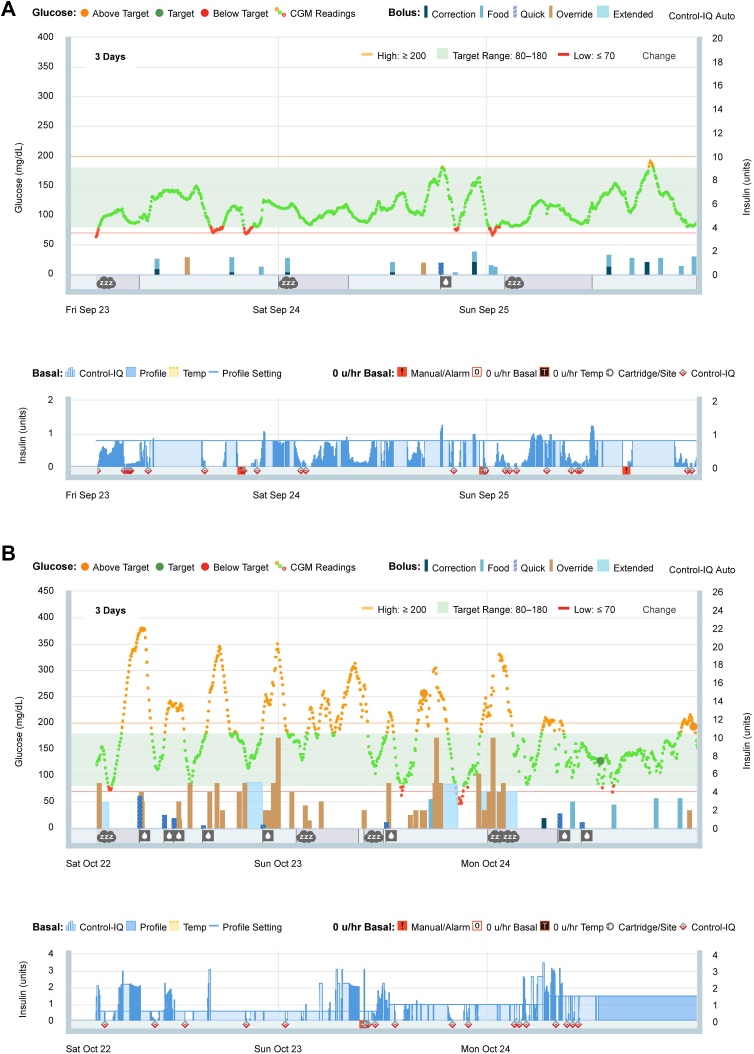
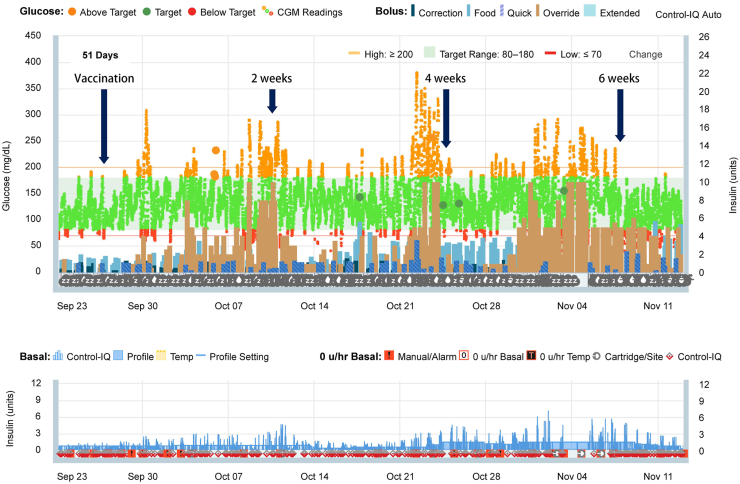
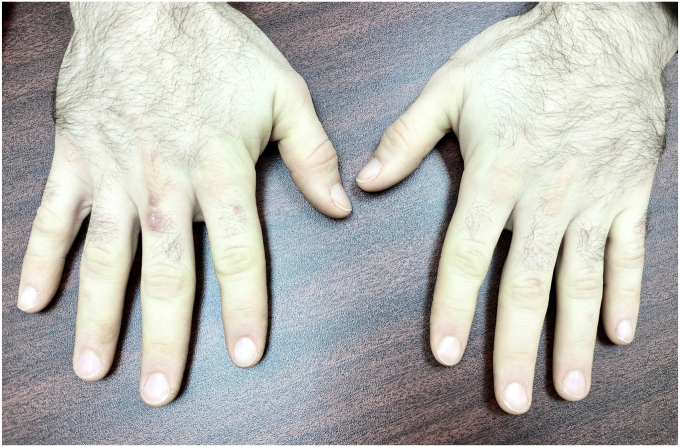
A 33-year-old man with type 1 DM since the age of 5 years was on an insulin pump for 17 years. He had a reasonable controlled glucose level with a hemoglobin A1c level of 6.8% (51 mmol/mol). Three days after he received the COVID-19 vaccination, his glucose level started to fluctuate in the range of 46 to 378 mg/dL with 3.5 times higher total daily insulin requirement. The patient developed white-pale cold hands, weight gain, fatigue, and liver dysfunction. Computed tomography of the abdomen revealed mild hepatomegaly, and laboratory workup was negative for hepatitis. One month later, his glucose level became better controlled, and his liver function improved. Continuous glucose monitoring revealed that his glucose profile returned to baseline after 6 weeks.
Discussion
COVID-19 vaccination resulted in significant glucose variation and fluctuations in this patient. It could be explained by the vaccine-induced immune response causing an increase in insulin resistance, such as in adipose tissue and muscle cells. Immune stimulation could have also caused the abnormal liver function and explain his new onset Raynaud phenomenon.
Conclusion
We described, for the first time, the long-term continuous glucose monitoring glucose profile with a hybrid closed-loop system in type 1 DM after COVID-19 vaccination. Clinicians need to keep alert to glycemic excursion and side effects after immunization in type 1 DM.



 京公网安备 11010802042870号
京ICP备2023020795号-1
京公网安备 11010802042870号
京ICP备2023020795号-1

 分享
分享
 求助内容:
求助内容: 应助结果提醒方式:
 扫码关注我们
