Heena Satam, Kandarp Joshi, Upasana Mangrolia, Sanober Waghoo, Gulnaz Zaidi, Shravani Rawool, Ritesh P Thakare, Shahid Banday, Alok K Mishra, Gautam Das, Sunil K Malonia
{"title":"Next-Generation Sequencing Technology: Current Trends and Advancements.","authors":"Heena Satam, Kandarp Joshi, Upasana Mangrolia, Sanober Waghoo, Gulnaz Zaidi, Shravani Rawool, Ritesh P Thakare, Shahid Banday, Alok K Mishra, Gautam Das, Sunil K Malonia","doi":"10.3390/biology12070997","DOIUrl":null,"url":null,"abstract":"<p><p>The advent of next-generation sequencing (NGS) has brought about a paradigm shift in genomics research, offering unparalleled capabilities for analyzing DNA and RNA molecules in a high-throughput and cost-effective manner. This transformative technology has swiftly propelled genomics advancements across diverse domains. NGS allows for the rapid sequencing of millions of DNA fragments simultaneously, providing comprehensive insights into genome structure, genetic variations, gene expression profiles, and epigenetic modifications. The versatility of NGS platforms has expanded the scope of genomics research, facilitating studies on rare genetic diseases, cancer genomics, microbiome analysis, infectious diseases, and population genetics. Moreover, NGS has enabled the development of targeted therapies, precision medicine approaches, and improved diagnostic methods. This review provides an insightful overview of the current trends and recent advancements in NGS technology, highlighting its potential impact on diverse areas of genomic research. Moreover, the review delves into the challenges encountered and future directions of NGS technology, including endeavors to enhance the accuracy and sensitivity of sequencing data, the development of novel algorithms for data analysis, and the pursuit of more efficient, scalable, and cost-effective solutions that lie ahead.</p>","PeriodicalId":48624,"journal":{"name":"Biology-Basel","volume":"12 7","pages":""},"PeriodicalIF":3.5000,"publicationDate":"2023-07-13","publicationTypes":"Journal Article","fieldsOfStudy":null,"isOpenAccess":false,"openAccessPdf":"https://www.ncbi.nlm.nih.gov/pmc/articles/PMC10376292/pdf/","citationCount":"0","resultStr":null,"platform":"Semanticscholar","paperid":null,"PeriodicalName":"Biology-Basel","FirstCategoryId":"99","ListUrlMain":"https://doi.org/10.3390/biology12070997","RegionNum":3,"RegionCategory":"生物学","ArticlePicture":[],"TitleCN":null,"AbstractTextCN":null,"PMCID":null,"EPubDate":"","PubModel":"","JCR":"Q1","JCRName":"BIOLOGY","Score":null,"Total":0}
引用次数: 0
Abstract
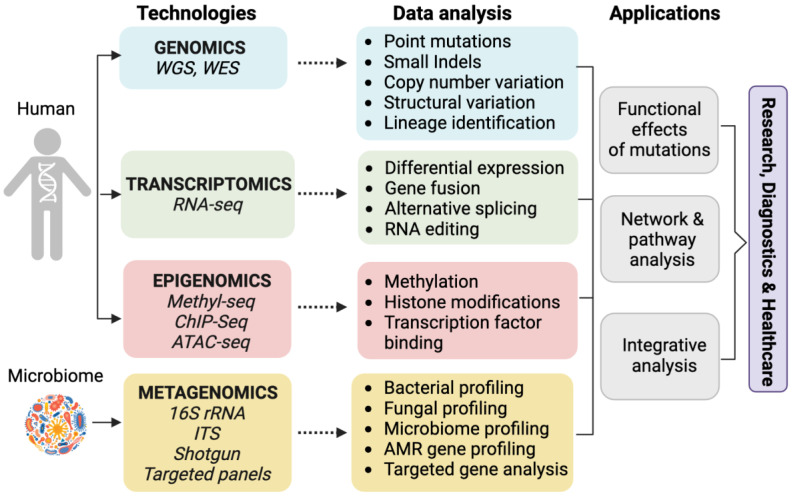
The advent of next-generation sequencing (NGS) has brought about a paradigm shift in genomics research, offering unparalleled capabilities for analyzing DNA and RNA molecules in a high-throughput and cost-effective manner. This transformative technology has swiftly propelled genomics advancements across diverse domains. NGS allows for the rapid sequencing of millions of DNA fragments simultaneously, providing comprehensive insights into genome structure, genetic variations, gene expression profiles, and epigenetic modifications. The versatility of NGS platforms has expanded the scope of genomics research, facilitating studies on rare genetic diseases, cancer genomics, microbiome analysis, infectious diseases, and population genetics. Moreover, NGS has enabled the development of targeted therapies, precision medicine approaches, and improved diagnostic methods. This review provides an insightful overview of the current trends and recent advancements in NGS technology, highlighting its potential impact on diverse areas of genomic research. Moreover, the review delves into the challenges encountered and future directions of NGS technology, including endeavors to enhance the accuracy and sensitivity of sequencing data, the development of novel algorithms for data analysis, and the pursuit of more efficient, scalable, and cost-effective solutions that lie ahead.
期刊介绍:
Biology (ISSN 2079-7737) is an international, peer-reviewed, quick-refereeing open access journal of Biological Science published by MDPI online. It publishes reviews, research papers and communications in all areas of biology and at the interface of related disciplines. Our aim is to encourage scientists to publish their experimental and theoretical results in as much detail as possible. There is no restriction on the length of the papers. The full experimental details must be provided so that the results can be reproduced. Electronic files regarding the full details of the experimental procedure, if unable to be published in a normal way, can be deposited as supplementary material.





 京公网安备 11010802042870号
京ICP备2023020795号-1
京公网安备 11010802042870号
京ICP备2023020795号-1

 分享
分享
 求助内容:
求助内容: 应助结果提醒方式:
 扫码关注我们
