Leanne P M van Leeuwen, Marloes Grobben, Corine H GeurtsvanKessel, Pauline M Ellerbroek, Godelieve J de Bree, Judith Potjewijd, Abraham Rutgers, Hetty Jolink, Frank L van de Veerdonk, Marit J van Gils, Rory D de Vries, Virgil A S H Dalm
{"title":"Immune Responses 6 Months After mRNA-1273 COVID-19 Vaccination and the Effect of a Third Vaccination in Patients with Inborn Errors of Immunity.","authors":"Leanne P M van Leeuwen, Marloes Grobben, Corine H GeurtsvanKessel, Pauline M Ellerbroek, Godelieve J de Bree, Judith Potjewijd, Abraham Rutgers, Hetty Jolink, Frank L van de Veerdonk, Marit J van Gils, Rory D de Vries, Virgil A S H Dalm","doi":"10.1007/s10875-023-01514-7","DOIUrl":null,"url":null,"abstract":"<p><strong>Purpose: </strong>Patients with inborn errors of immunity (IEI) are at increased risk of severe coronavirus disease-2019 (COVID-19). Effective long-term protection against COVID-19 is therefore of great importance in these patients, but little is known about the decay of the immune response after primary vaccination. We studied the immune responses 6 months after two mRNA-1273 COVID-19 vaccines in 473 IEI patients and subsequently the response to a third mRNA COVID-19 vaccine in 50 patients with common variable immunodeficiency (CVID).</p><p><strong>Methods: </strong>In a prospective multicenter study, 473 IEI patients (including X-linked agammaglobulinemia (XLA) (N = 18), combined immunodeficiency (CID) (N = 22), CVID (N = 203), isolated or undefined antibody deficiencies (N = 204), and phagocyte defects (N = 16)), and 179 controls were included and followed up to 6 months after two doses of the mRNA-1273 COVID-19 vaccine. Additionally, samples were collected from 50 CVID patients who received a third vaccine 6 months after primary vaccination through the national vaccination program. SARS-CoV-2-specific IgG titers, neutralizing antibodies, and T cell responses were assessed.</p><p><strong>Results: </strong>At 6 months after vaccination, the geometric mean antibody titers (GMT) declined in both IEI patients and healthy controls, when compared to GMT 28 days after vaccination. The trajectory of this decline did not differ between controls and most IEI cohorts; however, antibody titers in CID, CVID, and isolated antibody deficiency patients more often dropped to below the responder cut-off compared to controls. Specific T cell responses were still detectable in 77% of controls and 68% of IEI patients at 6 months post vaccination. A third mRNA vaccine resulted in an antibody response in only two out of 30 CVID patients that did not seroconvert after two mRNA vaccines.</p><p><strong>Conclusion: </strong>A similar decline in IgG titers and T cell responses was observed in patients with IEI when compared to healthy controls 6 months after mRNA-1273 COVID-19 vaccination. The limited beneficial benefit of a third mRNA COVID-19 vaccine in previous non-responder CVID patients implicates that other protective strategies are needed for these vulnerable patients.</p>","PeriodicalId":15531,"journal":{"name":"Journal of Clinical Immunology","volume":"43 6","pages":"1104-1117"},"PeriodicalIF":5.7000,"publicationDate":"2023-08-01","publicationTypes":"Journal Article","fieldsOfStudy":null,"isOpenAccess":false,"openAccessPdf":"https://www.ncbi.nlm.nih.gov/pmc/articles/PMC10212732/pdf/","citationCount":"2","resultStr":null,"platform":"Semanticscholar","paperid":null,"PeriodicalName":"Journal of Clinical Immunology","FirstCategoryId":"3","ListUrlMain":"https://doi.org/10.1007/s10875-023-01514-7","RegionNum":2,"RegionCategory":"医学","ArticlePicture":[],"TitleCN":null,"AbstractTextCN":null,"PMCID":null,"EPubDate":"","PubModel":"","JCR":"Q1","JCRName":"IMMUNOLOGY","Score":null,"Total":0}
引用次数: 2
Abstract
Purpose: Patients with inborn errors of immunity (IEI) are at increased risk of severe coronavirus disease-2019 (COVID-19). Effective long-term protection against COVID-19 is therefore of great importance in these patients, but little is known about the decay of the immune response after primary vaccination. We studied the immune responses 6 months after two mRNA-1273 COVID-19 vaccines in 473 IEI patients and subsequently the response to a third mRNA COVID-19 vaccine in 50 patients with common variable immunodeficiency (CVID).
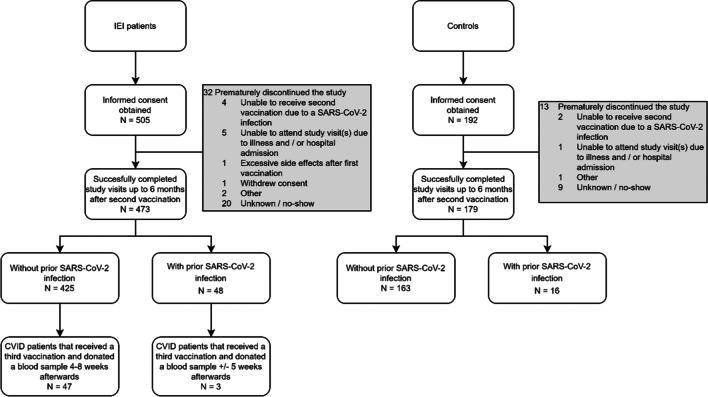
Methods: In a prospective multicenter study, 473 IEI patients (including X-linked agammaglobulinemia (XLA) (N = 18), combined immunodeficiency (CID) (N = 22), CVID (N = 203), isolated or undefined antibody deficiencies (N = 204), and phagocyte defects (N = 16)), and 179 controls were included and followed up to 6 months after two doses of the mRNA-1273 COVID-19 vaccine. Additionally, samples were collected from 50 CVID patients who received a third vaccine 6 months after primary vaccination through the national vaccination program. SARS-CoV-2-specific IgG titers, neutralizing antibodies, and T cell responses were assessed.
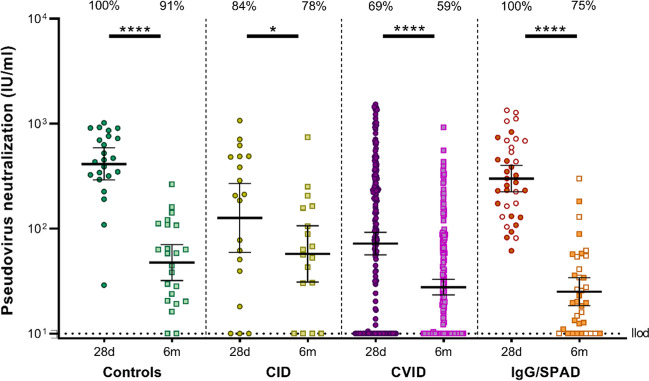
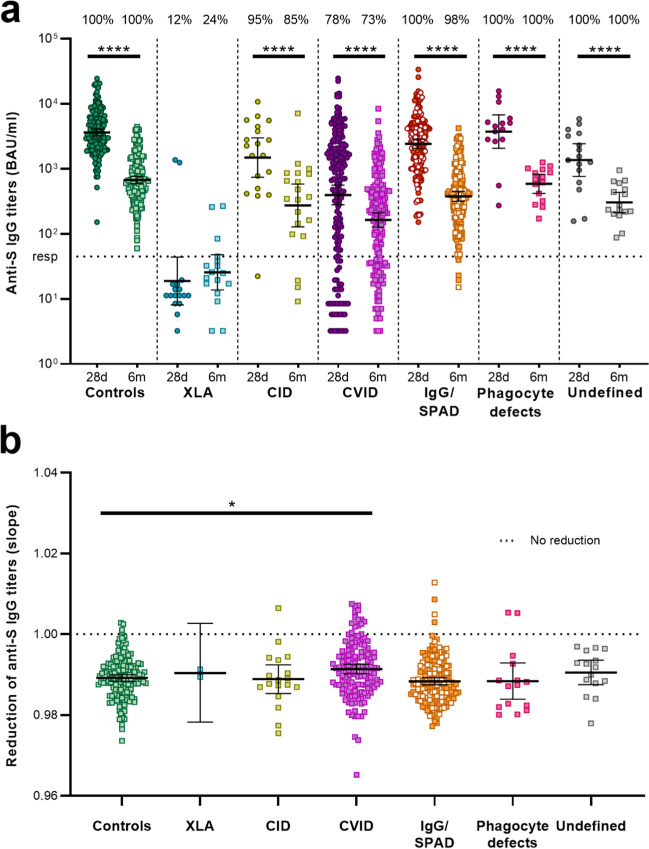
Results: At 6 months after vaccination, the geometric mean antibody titers (GMT) declined in both IEI patients and healthy controls, when compared to GMT 28 days after vaccination. The trajectory of this decline did not differ between controls and most IEI cohorts; however, antibody titers in CID, CVID, and isolated antibody deficiency patients more often dropped to below the responder cut-off compared to controls. Specific T cell responses were still detectable in 77% of controls and 68% of IEI patients at 6 months post vaccination. A third mRNA vaccine resulted in an antibody response in only two out of 30 CVID patients that did not seroconvert after two mRNA vaccines.
Conclusion: A similar decline in IgG titers and T cell responses was observed in patients with IEI when compared to healthy controls 6 months after mRNA-1273 COVID-19 vaccination. The limited beneficial benefit of a third mRNA COVID-19 vaccine in previous non-responder CVID patients implicates that other protective strategies are needed for these vulnerable patients.
期刊介绍:
The Journal of Clinical Immunology publishes impactful papers in the realm of human immunology, delving into the diagnosis, pathogenesis, prognosis, or treatment of human diseases. The journal places particular emphasis on primary immunodeficiencies and related diseases, encompassing inborn errors of immunity in a broad sense, their underlying genotypes, and diverse phenotypes. These phenotypes include infection, malignancy, allergy, auto-inflammation, and autoimmunity. We welcome a broad spectrum of studies in this domain, spanning genetic discovery, clinical description, immunologic assessment, diagnostic approaches, prognosis evaluation, and treatment interventions. Case reports are considered if they are genuinely original and accompanied by a concise review of the relevant medical literature, illustrating how the novel case study advances the field. The instructions to authors provide detailed guidance on the four categories of papers accepted by the journal.



 京公网安备 11010802042870号
京ICP备2023020795号-1
京公网安备 11010802042870号
京ICP备2023020795号-1

 分享
分享
 求助内容:
求助内容: 应助结果提醒方式:
 扫码关注我们
