Fan Jia, Zhitao Wei, Xiangrui Kong, Yinhui Mao, Yong Yang
{"title":"Causal Associations Between Lifestyle Habits and Risk of Benign Prostatic Hyperplasia: A Two-Sample Mendelian Randomization Study.","authors":"Fan Jia, Zhitao Wei, Xiangrui Kong, Yinhui Mao, Yong Yang","doi":"10.1093/gerona/glad187","DOIUrl":null,"url":null,"abstract":"<p><strong>Background: </strong>Benign prostatic hyperplasia (BPH) most often occurs in older men; previous studies and clinical experience suggest a potential link between lifestyle habits such as sleep habits, sedentary behavior, exercise levels, and BPH, but whether they have a clear causal relationship and the direction of that causality is unclear. We aimed to investigate the causal relationship between lifestyle habits and BPH using 2-sample Mendelian randomization (MR) analysis.</p><p><strong>Methods: </strong>Instrumental genetic independent variables strongly associated with the selected exposure factors were filtered from published genome-wide association studies (GWAS) consisting primarily of European ancestry samples. GWAS from BPH was analyzed as an MR outcome with the inverse-variance weighted method, maximum likelihood, weighted median method, MR-Egger regression, and several sensitivity analyses, including Cochran's Q test, intercept of MR-Egger, and MR pleiotropy residual sum and outlier test.</p><p><strong>Results: </strong>MR analysis showed a significant causal risk relationship between sleep duration and BPH, with an odds ratio of 0.42 (95% confidence interval, 0.25-0.69, p = .001) for BPH when sleep duration was increased by 1 standard deviation, but we did not find a causal relationship between the 2 when we performed a reverse analysis. However, sedentary behavior and different levels of exercise did not significantly affect the risk of BPH.</p><p><strong>Conclusions: </strong>This study showed a strong causal relationship between sleep levels and BPH, with adequate sleep duration being a protective factor for BPH.</p>","PeriodicalId":49953,"journal":{"name":"Journals of Gerontology Series A-Biological Sciences and Medical Sciences","volume":" ","pages":""},"PeriodicalIF":3.8000,"publicationDate":"2024-01-01","publicationTypes":"Journal Article","fieldsOfStudy":null,"isOpenAccess":false,"openAccessPdf":"https://www.ncbi.nlm.nih.gov/pmc/articles/PMC10733171/pdf/","citationCount":"0","resultStr":null,"platform":"Semanticscholar","paperid":null,"PeriodicalName":"Journals of Gerontology Series A-Biological Sciences and Medical Sciences","FirstCategoryId":"3","ListUrlMain":"https://doi.org/10.1093/gerona/glad187","RegionNum":2,"RegionCategory":"医学","ArticlePicture":[],"TitleCN":null,"AbstractTextCN":null,"PMCID":null,"EPubDate":"","PubModel":"","JCR":"Q1","JCRName":"GERIATRICS & GERONTOLOGY","Score":null,"Total":0}
引用次数: 0
Abstract
Background: Benign prostatic hyperplasia (BPH) most often occurs in older men; previous studies and clinical experience suggest a potential link between lifestyle habits such as sleep habits, sedentary behavior, exercise levels, and BPH, but whether they have a clear causal relationship and the direction of that causality is unclear. We aimed to investigate the causal relationship between lifestyle habits and BPH using 2-sample Mendelian randomization (MR) analysis.
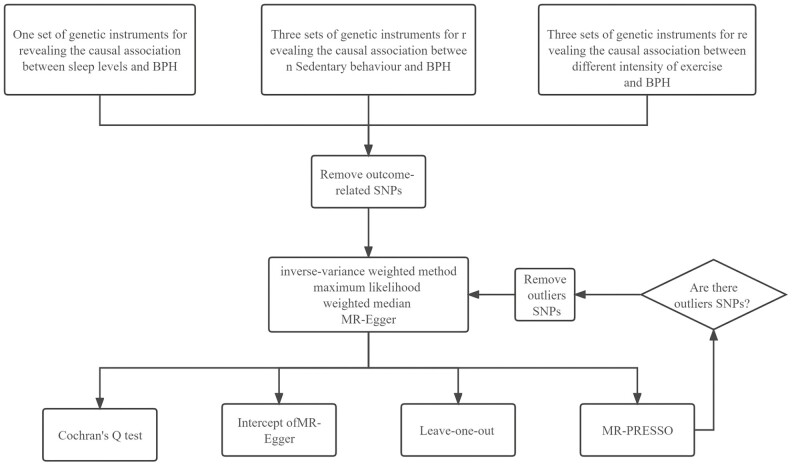
Methods: Instrumental genetic independent variables strongly associated with the selected exposure factors were filtered from published genome-wide association studies (GWAS) consisting primarily of European ancestry samples. GWAS from BPH was analyzed as an MR outcome with the inverse-variance weighted method, maximum likelihood, weighted median method, MR-Egger regression, and several sensitivity analyses, including Cochran's Q test, intercept of MR-Egger, and MR pleiotropy residual sum and outlier test.
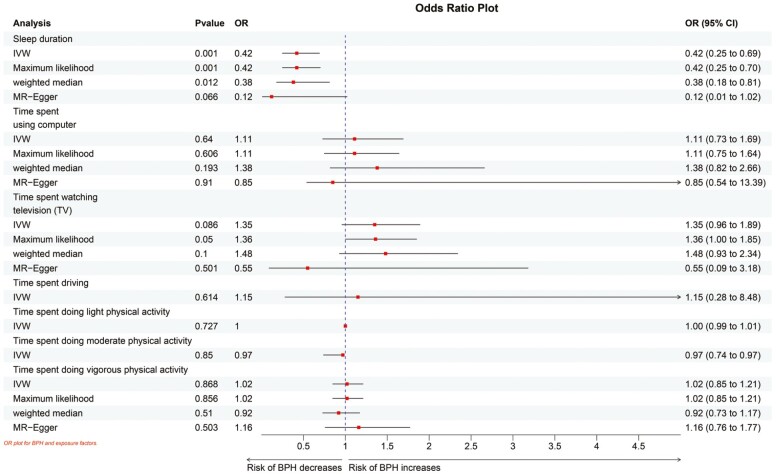
Results: MR analysis showed a significant causal risk relationship between sleep duration and BPH, with an odds ratio of 0.42 (95% confidence interval, 0.25-0.69, p = .001) for BPH when sleep duration was increased by 1 standard deviation, but we did not find a causal relationship between the 2 when we performed a reverse analysis. However, sedentary behavior and different levels of exercise did not significantly affect the risk of BPH.
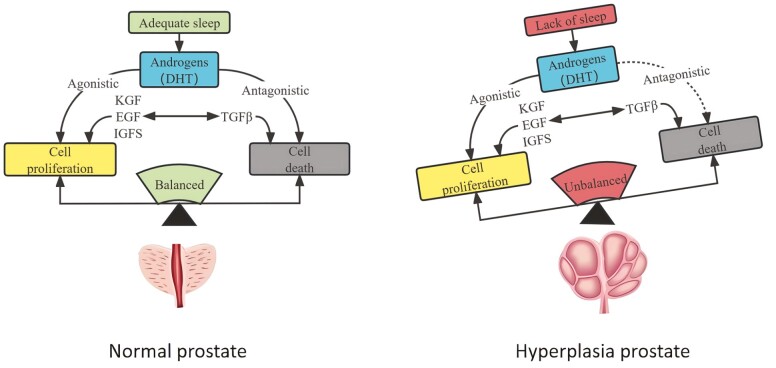
Conclusions: This study showed a strong causal relationship between sleep levels and BPH, with adequate sleep duration being a protective factor for BPH.
期刊介绍:
Publishes articles representing the full range of medical sciences pertaining to aging. Appropriate areas include, but are not limited to, basic medical science, clinical epidemiology, clinical research, and health services research for professions such as medicine, dentistry, allied health sciences, and nursing. It publishes articles on research pertinent to human biology and disease.



 京公网安备 11010802042870号
京ICP备2023020795号-1
京公网安备 11010802042870号
京ICP备2023020795号-1

 分享
分享
 求助内容:
求助内容: 应助结果提醒方式:
 扫码关注我们
