Luigi Barbato, Raffaele Cavalcanti, Cosimo Rupe, Daniele Scartabelli, Lapo Serni, Leandro Chambrone, Francesco Cairo
{"title":"Clinical efficacy of adjunctive methods for the non-surgical treatment of peri-implantitis: a systematic review and meta-analysis.","authors":"Luigi Barbato, Raffaele Cavalcanti, Cosimo Rupe, Daniele Scartabelli, Lapo Serni, Leandro Chambrone, Francesco Cairo","doi":"10.1186/s12903-023-03058-z","DOIUrl":null,"url":null,"abstract":"<p><strong>Background: </strong>The aim of this systematic review (SR) was to evaluate the clinical efficacy of different adjunctive methods/therapies to the non-surgical treatment (NST) of peri-implantitis.</p><p><strong>Materials and methods: </strong>The protocol of the review was registered in PROSPERO database (CRD42022339709) and was designed according to PRISMA statement. Electronic and hand searches were performed to identify randomized clinical trials (RCTs) comparing non-surgical treatment of peri-implantitis alone versus NST plus any adjunctive method/treatment. The primary outcome was probing pocket depth (PPD) reduction.</p><p><strong>Results: </strong>Sixteen RCTs were included. Only 2 out of 1189 implants were lost and follow-up ranged from 3 to 12 months. PPD reduction across the studies varied from 0.17 to 3.1 mm, while defect resolution from 5.3% to 57.1%. Systemic antimicrobials were associated to higher PPD reduction (1.56 mm; [95% CI 0.24 to 2.89]; p = 0.02) with high heterogeneity, and treatment success (OR = 3.23; [95% CI 1.17 to 8.94]; p = 0.02), compared to NST alone. No differences were found with adjunctive local antimicrobials and lasers for PPD and bleeding on probing (BoP) reduction.</p><p><strong>Conclusions: </strong>Non-surgical treatment with or without adjunctive methods may reduce PPD and BoP even if complete resolution of the pocket is unpredictable. Among possible adjunctive methods, only systemic antibiotics seems to provide further benefits, but their usage should be considered with caution.</p>","PeriodicalId":9072,"journal":{"name":"BMC Oral Health","volume":"23 1","pages":"375"},"PeriodicalIF":3.1000,"publicationDate":"2023-06-09","publicationTypes":"Journal Article","fieldsOfStudy":null,"isOpenAccess":false,"openAccessPdf":"https://www.ncbi.nlm.nih.gov/pmc/articles/PMC10251565/pdf/","citationCount":"0","resultStr":null,"platform":"Semanticscholar","paperid":null,"PeriodicalName":"BMC Oral Health","FirstCategoryId":"3","ListUrlMain":"https://doi.org/10.1186/s12903-023-03058-z","RegionNum":2,"RegionCategory":"医学","ArticlePicture":[],"TitleCN":null,"AbstractTextCN":null,"PMCID":null,"EPubDate":"","PubModel":"","JCR":"Q1","JCRName":"DENTISTRY, ORAL SURGERY & MEDICINE","Score":null,"Total":0}
引用次数: 0
Abstract
Background: The aim of this systematic review (SR) was to evaluate the clinical efficacy of different adjunctive methods/therapies to the non-surgical treatment (NST) of peri-implantitis.
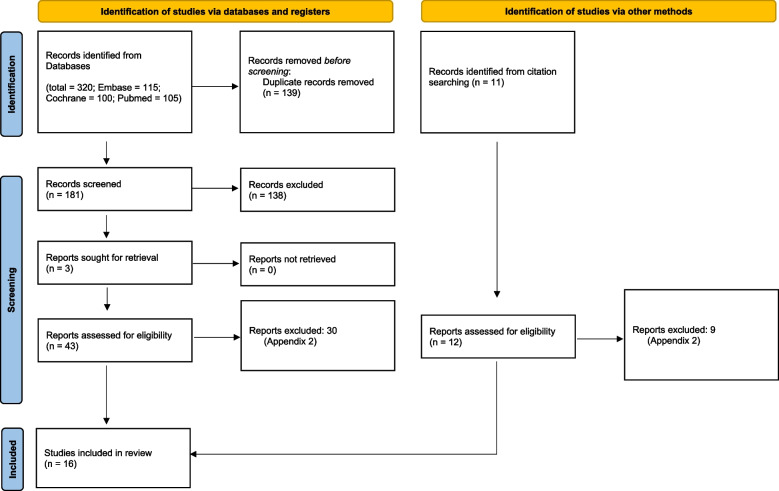
Materials and methods: The protocol of the review was registered in PROSPERO database (CRD42022339709) and was designed according to PRISMA statement. Electronic and hand searches were performed to identify randomized clinical trials (RCTs) comparing non-surgical treatment of peri-implantitis alone versus NST plus any adjunctive method/treatment. The primary outcome was probing pocket depth (PPD) reduction.
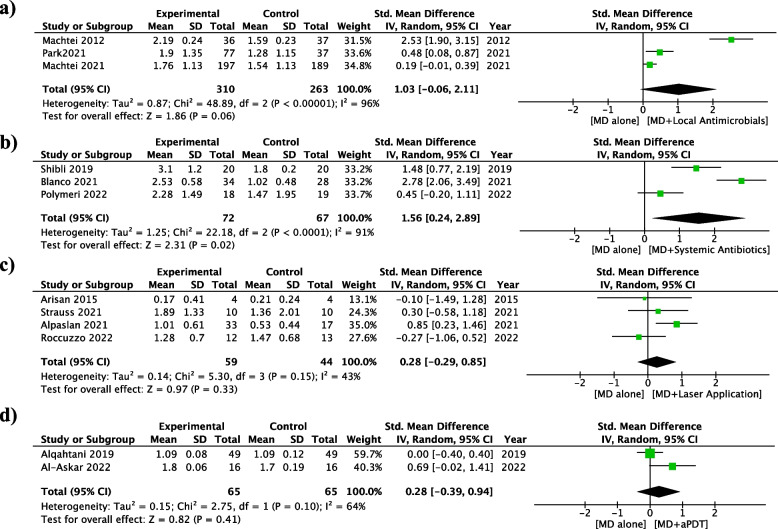
Results: Sixteen RCTs were included. Only 2 out of 1189 implants were lost and follow-up ranged from 3 to 12 months. PPD reduction across the studies varied from 0.17 to 3.1 mm, while defect resolution from 5.3% to 57.1%. Systemic antimicrobials were associated to higher PPD reduction (1.56 mm; [95% CI 0.24 to 2.89]; p = 0.02) with high heterogeneity, and treatment success (OR = 3.23; [95% CI 1.17 to 8.94]; p = 0.02), compared to NST alone. No differences were found with adjunctive local antimicrobials and lasers for PPD and bleeding on probing (BoP) reduction.
Conclusions: Non-surgical treatment with or without adjunctive methods may reduce PPD and BoP even if complete resolution of the pocket is unpredictable. Among possible adjunctive methods, only systemic antibiotics seems to provide further benefits, but their usage should be considered with caution.
期刊介绍:
BMC Oral Health is an open access, peer-reviewed journal that considers articles on all aspects of the prevention, diagnosis and management of disorders of the mouth, teeth and gums, as well as related molecular genetics, pathophysiology, and epidemiology.



 京公网安备 11010802042870号
京ICP备2023020795号-1
京公网安备 11010802042870号
京ICP备2023020795号-1

 分享
分享
 求助内容:
求助内容: 应助结果提醒方式:
 扫码关注我们
