{"title":"小肠上皮和大肠上皮之间IL-23/ il -22依赖基因表达对微生物群的差异依赖性","authors":"Ayaka Nakatani, Ryu Okumura, Airi Ishibashi, Shota Okamoto, Kei Sakaki, Yuki Ito, Daisuke Okuzaki, Hidenori Inohara, Kiyoshi Takeda","doi":"10.1111/gtc.13065","DOIUrl":null,"url":null,"abstract":"<p>In the intestine, interleukin (IL)-23 and IL-22 from immune cells in the lamina propria contribute to maintenance of the gut epithelial barrier through the induction of antimicrobial production and the promotion of epithelial cell proliferation. Several previous studies suggested that some of the functions of the IL-23/IL-22 axis on intestinal epithelial cells are shared between the small and large intestines. However, the similarities and differences of the IL-23/IL-22 axis on epithelial cells between these two anatomical sites remain unclear. Here, we comprehensively analyzed the gene expression of intestinal epithelial cells in the ileum and colon of germ-free, <i>Il23</i><sup>−/−</sup>, and <i>Il22</i><sup>−/−</sup> mice by RNA-sequencing. We found that while the IL-23/IL-22 axis is largely dependent on gut microbiota in the small intestine, it is much less dependent on it in the large intestine. In addition, the negative regulation of lipid metabolism in the epithelial cells by IL-23 and IL-22 in the small intestine was revealed, whereas the positive regulation of epithelial cell proliferation by IL-23 and IL-22 in the large intestine was highlighted. These findings shed light on the intestinal site-specific role of the IL-23/IL-22 axis in maintaining the physiological functions of intestinal epithelial cells.</p>","PeriodicalId":12742,"journal":{"name":"Genes to Cells","volume":"28 11","pages":"776-788"},"PeriodicalIF":1.4000,"publicationDate":"2023-09-07","publicationTypes":"Journal Article","fieldsOfStudy":null,"isOpenAccess":false,"openAccessPdf":"","citationCount":"0","resultStr":"{\"title\":\"Differential dependence on microbiota of IL-23/IL-22-dependent gene expression between the small- and large-intestinal epithelia\",\"authors\":\"Ayaka Nakatani, Ryu Okumura, Airi Ishibashi, Shota Okamoto, Kei Sakaki, Yuki Ito, Daisuke Okuzaki, Hidenori Inohara, Kiyoshi Takeda\",\"doi\":\"10.1111/gtc.13065\",\"DOIUrl\":null,\"url\":null,\"abstract\":\"<p>In the intestine, interleukin (IL)-23 and IL-22 from immune cells in the lamina propria contribute to maintenance of the gut epithelial barrier through the induction of antimicrobial production and the promotion of epithelial cell proliferation. Several previous studies suggested that some of the functions of the IL-23/IL-22 axis on intestinal epithelial cells are shared between the small and large intestines. However, the similarities and differences of the IL-23/IL-22 axis on epithelial cells between these two anatomical sites remain unclear. Here, we comprehensively analyzed the gene expression of intestinal epithelial cells in the ileum and colon of germ-free, <i>Il23</i><sup>−/−</sup>, and <i>Il22</i><sup>−/−</sup> mice by RNA-sequencing. We found that while the IL-23/IL-22 axis is largely dependent on gut microbiota in the small intestine, it is much less dependent on it in the large intestine. In addition, the negative regulation of lipid metabolism in the epithelial cells by IL-23 and IL-22 in the small intestine was revealed, whereas the positive regulation of epithelial cell proliferation by IL-23 and IL-22 in the large intestine was highlighted. These findings shed light on the intestinal site-specific role of the IL-23/IL-22 axis in maintaining the physiological functions of intestinal epithelial cells.</p>\",\"PeriodicalId\":12742,\"journal\":{\"name\":\"Genes to Cells\",\"volume\":\"28 11\",\"pages\":\"776-788\"},\"PeriodicalIF\":1.4000,\"publicationDate\":\"2023-09-07\",\"publicationTypes\":\"Journal Article\",\"fieldsOfStudy\":null,\"isOpenAccess\":false,\"openAccessPdf\":\"\",\"citationCount\":\"0\",\"resultStr\":null,\"platform\":\"Semanticscholar\",\"paperid\":null,\"PeriodicalName\":\"Genes to Cells\",\"FirstCategoryId\":\"99\",\"ListUrlMain\":\"https://onlinelibrary.wiley.com/doi/10.1111/gtc.13065\",\"RegionNum\":4,\"RegionCategory\":\"生物学\",\"ArticlePicture\":[],\"TitleCN\":null,\"AbstractTextCN\":null,\"PMCID\":null,\"EPubDate\":\"\",\"PubModel\":\"\",\"JCR\":\"Q4\",\"JCRName\":\"CELL BIOLOGY\",\"Score\":null,\"Total\":0}","platform":"Semanticscholar","paperid":null,"PeriodicalName":"Genes to Cells","FirstCategoryId":"99","ListUrlMain":"https://onlinelibrary.wiley.com/doi/10.1111/gtc.13065","RegionNum":4,"RegionCategory":"生物学","ArticlePicture":[],"TitleCN":null,"AbstractTextCN":null,"PMCID":null,"EPubDate":"","PubModel":"","JCR":"Q4","JCRName":"CELL BIOLOGY","Score":null,"Total":0}
Differential dependence on microbiota of IL-23/IL-22-dependent gene expression between the small- and large-intestinal epithelia
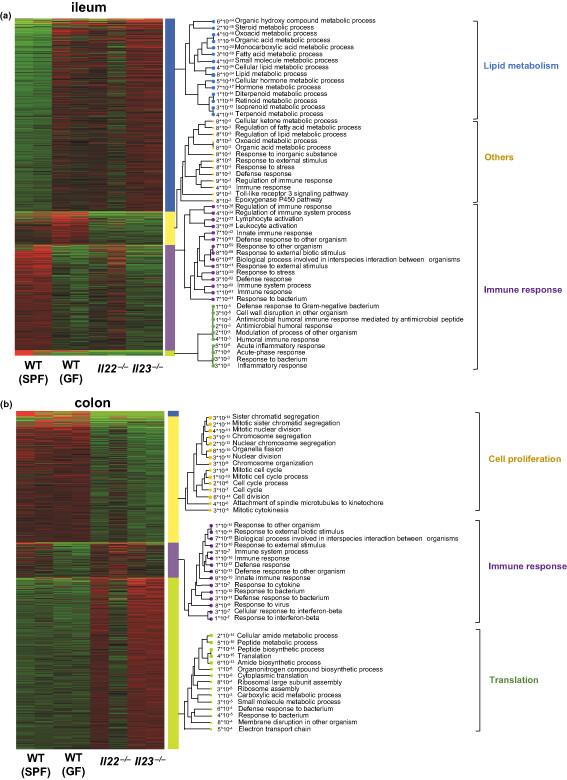
In the intestine, interleukin (IL)-23 and IL-22 from immune cells in the lamina propria contribute to maintenance of the gut epithelial barrier through the induction of antimicrobial production and the promotion of epithelial cell proliferation. Several previous studies suggested that some of the functions of the IL-23/IL-22 axis on intestinal epithelial cells are shared between the small and large intestines. However, the similarities and differences of the IL-23/IL-22 axis on epithelial cells between these two anatomical sites remain unclear. Here, we comprehensively analyzed the gene expression of intestinal epithelial cells in the ileum and colon of germ-free, Il23−/−, and Il22−/− mice by RNA-sequencing. We found that while the IL-23/IL-22 axis is largely dependent on gut microbiota in the small intestine, it is much less dependent on it in the large intestine. In addition, the negative regulation of lipid metabolism in the epithelial cells by IL-23 and IL-22 in the small intestine was revealed, whereas the positive regulation of epithelial cell proliferation by IL-23 and IL-22 in the large intestine was highlighted. These findings shed light on the intestinal site-specific role of the IL-23/IL-22 axis in maintaining the physiological functions of intestinal epithelial cells.
期刊介绍:
Genes to Cells provides an international forum for the publication of papers describing important aspects of molecular and cellular biology. The journal aims to present papers that provide conceptual advance in the relevant field. Particular emphasis will be placed on work aimed at understanding the basic mechanisms underlying biological events.





 京公网安备 11010802042870号
京ICP备2023020795号-1
京公网安备 11010802042870号
京ICP备2023020795号-1

 分享
分享
 求助内容:
求助内容: 应助结果提醒方式:
 扫码关注我们
