Adrián López-Francés , Xabier del Corte , Zuriñe Serna-Burgos , Jesús M. de los Santos , Abel de Cózar , Javier Vicario
{"title":"偶氮二烯†双周环环二聚化反应的手性自我识别","authors":"Adrián López-Francés , Xabier del Corte , Zuriñe Serna-Burgos , Jesús M. de los Santos , Abel de Cózar , Javier Vicario","doi":"10.1039/d3qo01562a","DOIUrl":null,"url":null,"abstract":"<div><div>Hermaphroditism of molecules: as in nature some species behave as male or female depending on the environment, herein we report a bispericyclic dimerisation of cyclic 1-azadienes where a molecule can behave as either diene or dienophile, depending on its location at the transition state. In a symmetrical reactive complex, here represented by an arbitrary reference system, a molecule that is positioned on top acts as the diene unit, while the dienophile partner is the one situated at the bottom. In addition, a strong chiral self-recognition phenomenon is observed, where each enantiomer within a racemic mixture of chiral 1-azadienes exclusively recognises itself. In order to shed some light into the understanding of the chiral self-recognition effect, an extensive DFT study of the reaction pathway is provided, concluding that a combination of attractive π-stacking forces and repulsive steric interactions is at the origin of the high stereospecificity of the reaction.</div></div>","PeriodicalId":94379,"journal":{"name":"Organic chemistry frontiers : an international journal of organic chemistry","volume":"10 24","pages":"Pages 6103-6111"},"PeriodicalIF":0.0000,"publicationDate":"2023-12-05","publicationTypes":"Journal Article","fieldsOfStudy":null,"isOpenAccess":false,"openAccessPdf":"","citationCount":"0","resultStr":"{\"title\":\"Chiral self-recognition in a bispericyclic cyclodimerisation reaction of 1-azadienes†\",\"authors\":\"Adrián López-Francés , Xabier del Corte , Zuriñe Serna-Burgos , Jesús M. de los Santos , Abel de Cózar , Javier Vicario\",\"doi\":\"10.1039/d3qo01562a\",\"DOIUrl\":null,\"url\":null,\"abstract\":\"<div><div>Hermaphroditism of molecules: as in nature some species behave as male or female depending on the environment, herein we report a bispericyclic dimerisation of cyclic 1-azadienes where a molecule can behave as either diene or dienophile, depending on its location at the transition state. In a symmetrical reactive complex, here represented by an arbitrary reference system, a molecule that is positioned on top acts as the diene unit, while the dienophile partner is the one situated at the bottom. In addition, a strong chiral self-recognition phenomenon is observed, where each enantiomer within a racemic mixture of chiral 1-azadienes exclusively recognises itself. In order to shed some light into the understanding of the chiral self-recognition effect, an extensive DFT study of the reaction pathway is provided, concluding that a combination of attractive π-stacking forces and repulsive steric interactions is at the origin of the high stereospecificity of the reaction.</div></div>\",\"PeriodicalId\":94379,\"journal\":{\"name\":\"Organic chemistry frontiers : an international journal of organic chemistry\",\"volume\":\"10 24\",\"pages\":\"Pages 6103-6111\"},\"PeriodicalIF\":0.0000,\"publicationDate\":\"2023-12-05\",\"publicationTypes\":\"Journal Article\",\"fieldsOfStudy\":null,\"isOpenAccess\":false,\"openAccessPdf\":\"\",\"citationCount\":\"0\",\"resultStr\":null,\"platform\":\"Semanticscholar\",\"paperid\":null,\"PeriodicalName\":\"Organic chemistry frontiers : an international journal of organic chemistry\",\"FirstCategoryId\":\"1085\",\"ListUrlMain\":\"https://www.sciencedirect.com/org/science/article/pii/S205241292300150X\",\"RegionNum\":0,\"RegionCategory\":null,\"ArticlePicture\":[],\"TitleCN\":null,\"AbstractTextCN\":null,\"PMCID\":null,\"EPubDate\":\"2023/10/16 0:00:00\",\"PubModel\":\"Epub\",\"JCR\":\"\",\"JCRName\":\"\",\"Score\":null,\"Total\":0}","platform":"Semanticscholar","paperid":null,"PeriodicalName":"Organic chemistry frontiers : an international journal of organic chemistry","FirstCategoryId":"1085","ListUrlMain":"https://www.sciencedirect.com/org/science/article/pii/S205241292300150X","RegionNum":0,"RegionCategory":null,"ArticlePicture":[],"TitleCN":null,"AbstractTextCN":null,"PMCID":null,"EPubDate":"2023/10/16 0:00:00","PubModel":"Epub","JCR":"","JCRName":"","Score":null,"Total":0}
Chiral self-recognition in a bispericyclic cyclodimerisation reaction of 1-azadienes†
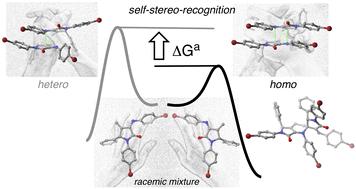
Hermaphroditism of molecules: as in nature some species behave as male or female depending on the environment, herein we report a bispericyclic dimerisation of cyclic 1-azadienes where a molecule can behave as either diene or dienophile, depending on its location at the transition state. In a symmetrical reactive complex, here represented by an arbitrary reference system, a molecule that is positioned on top acts as the diene unit, while the dienophile partner is the one situated at the bottom. In addition, a strong chiral self-recognition phenomenon is observed, where each enantiomer within a racemic mixture of chiral 1-azadienes exclusively recognises itself. In order to shed some light into the understanding of the chiral self-recognition effect, an extensive DFT study of the reaction pathway is provided, concluding that a combination of attractive π-stacking forces and repulsive steric interactions is at the origin of the high stereospecificity of the reaction.




 京公网安备 11010802042870号
京ICP备2023020795号-1
京公网安备 11010802042870号
京ICP备2023020795号-1

 分享
分享

 求助内容:
求助内容: 应助结果提醒方式:
 扫码关注我们
