S. M. Dmitriev, T. D. Demkina, A. A. Dobrov, D. V. Doronkov, D. S. Doronkova, D. D. Kuritsyn, M. A. Legchanov, A. N. Pronin, A. V. Ryazanov, D. N. Solntsev, D. L. Shipov
{"title":"Ritm Snpp 反应堆燃料导管入口处的流动形成特征","authors":"S. M. Dmitriev, T. D. Demkina, A. A. Dobrov, D. V. Doronkov, D. S. Doronkova, D. D. Kuritsyn, M. A. Legchanov, A. N. Pronin, A. V. Ryazanov, D. N. Solntsev, D. L. Shipov","doi":"10.1007/s10512-023-01023-1","DOIUrl":null,"url":null,"abstract":"<div><p>The article presents the results of an experimental study investigating features of coolant flow formation in the inlet section of a fuel assembly (FA) located in the cartridge core of a RITM SNPP reactor. The work aims to investigate the effect of various inlet design elements on the redistribution of the axial flow velocity. To this end, a series of experiments were carried out using a scale model, including structural elements of the inlet section between the calibration washer and the attachment of fuel rods to the diffuser, as well as the section of the fuel rod bundle between the absorbing and spacer grids. The studies were carried out using the pneumometric method in characteristic sections along the length of the model. Features of the coolant flow are visualized by cartograms of the axial velocity for the working medium flow. The results of the experiments were used to perform a hydraulic profiling of the FA inlet section. The obtained experimental database can be used to validate the LOGOS CFD program and clarify methods for the thermal-hydraulic calculation of cores in a cell approximation.</p></div>","PeriodicalId":480,"journal":{"name":"Atomic Energy","volume":"134 1-2","pages":"21 - 26"},"PeriodicalIF":0.3000,"publicationDate":"2023-12-22","publicationTypes":"Journal Article","fieldsOfStudy":null,"isOpenAccess":false,"openAccessPdf":"","citationCount":"0","resultStr":"{\"title\":\"Flow formation features at the inlet to the fuel catridge of a ritm snpp reactor\",\"authors\":\"S. M. Dmitriev, T. D. Demkina, A. A. Dobrov, D. V. Doronkov, D. S. Doronkova, D. D. Kuritsyn, M. A. Legchanov, A. N. Pronin, A. V. Ryazanov, D. N. Solntsev, D. L. Shipov\",\"doi\":\"10.1007/s10512-023-01023-1\",\"DOIUrl\":null,\"url\":null,\"abstract\":\"<div><p>The article presents the results of an experimental study investigating features of coolant flow formation in the inlet section of a fuel assembly (FA) located in the cartridge core of a RITM SNPP reactor. The work aims to investigate the effect of various inlet design elements on the redistribution of the axial flow velocity. To this end, a series of experiments were carried out using a scale model, including structural elements of the inlet section between the calibration washer and the attachment of fuel rods to the diffuser, as well as the section of the fuel rod bundle between the absorbing and spacer grids. The studies were carried out using the pneumometric method in characteristic sections along the length of the model. Features of the coolant flow are visualized by cartograms of the axial velocity for the working medium flow. The results of the experiments were used to perform a hydraulic profiling of the FA inlet section. The obtained experimental database can be used to validate the LOGOS CFD program and clarify methods for the thermal-hydraulic calculation of cores in a cell approximation.</p></div>\",\"PeriodicalId\":480,\"journal\":{\"name\":\"Atomic Energy\",\"volume\":\"134 1-2\",\"pages\":\"21 - 26\"},\"PeriodicalIF\":0.3000,\"publicationDate\":\"2023-12-22\",\"publicationTypes\":\"Journal Article\",\"fieldsOfStudy\":null,\"isOpenAccess\":false,\"openAccessPdf\":\"\",\"citationCount\":\"0\",\"resultStr\":null,\"platform\":\"Semanticscholar\",\"paperid\":null,\"PeriodicalName\":\"Atomic Energy\",\"FirstCategoryId\":\"5\",\"ListUrlMain\":\"https://link.springer.com/article/10.1007/s10512-023-01023-1\",\"RegionNum\":4,\"RegionCategory\":\"工程技术\",\"ArticlePicture\":[],\"TitleCN\":null,\"AbstractTextCN\":null,\"PMCID\":null,\"EPubDate\":\"\",\"PubModel\":\"\",\"JCR\":\"Q4\",\"JCRName\":\"NUCLEAR SCIENCE & TECHNOLOGY\",\"Score\":null,\"Total\":0}","platform":"Semanticscholar","paperid":null,"PeriodicalName":"Atomic Energy","FirstCategoryId":"5","ListUrlMain":"https://link.springer.com/article/10.1007/s10512-023-01023-1","RegionNum":4,"RegionCategory":"工程技术","ArticlePicture":[],"TitleCN":null,"AbstractTextCN":null,"PMCID":null,"EPubDate":"","PubModel":"","JCR":"Q4","JCRName":"NUCLEAR SCIENCE & TECHNOLOGY","Score":null,"Total":0}
引用次数: 0
摘要
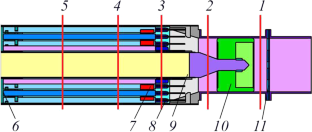
文章介绍了一项实验研究的结果,该研究调查了位于 RITM SNPP 反应堆筒式堆芯中的燃料组件(FA)入口段冷却剂流形成的特征。这项工作旨在研究各种入口设计元素对轴向流速再分布的影响。为此,使用一个比例模型进行了一系列实验,包括校准垫圈和扩散器燃料棒附件之间的入口部分的结构元素,以及吸收栅和间隔栅之间的燃料棒束部分。研究采用气压法在模型长度方向的特征截面上进行。冷却剂流动的特征通过工作介质流动的轴向速度制图可视化显示。实验结果用于对 FA 入口部分进行水力剖面分析。所获得的实验数据库可用于验证 LOGOS CFD 程序,并阐明以单元近似方式进行堆芯热-水力计算的方法。
Flow formation features at the inlet to the fuel catridge of a ritm snpp reactor
The article presents the results of an experimental study investigating features of coolant flow formation in the inlet section of a fuel assembly (FA) located in the cartridge core of a RITM SNPP reactor. The work aims to investigate the effect of various inlet design elements on the redistribution of the axial flow velocity. To this end, a series of experiments were carried out using a scale model, including structural elements of the inlet section between the calibration washer and the attachment of fuel rods to the diffuser, as well as the section of the fuel rod bundle between the absorbing and spacer grids. The studies were carried out using the pneumometric method in characteristic sections along the length of the model. Features of the coolant flow are visualized by cartograms of the axial velocity for the working medium flow. The results of the experiments were used to perform a hydraulic profiling of the FA inlet section. The obtained experimental database can be used to validate the LOGOS CFD program and clarify methods for the thermal-hydraulic calculation of cores in a cell approximation.
期刊介绍:
Atomic Energy publishes papers and review articles dealing with the latest developments in the peaceful uses of atomic energy. Topics include nuclear chemistry and physics, plasma physics, accelerator characteristics, reactor economics and engineering, applications of isotopes, and radiation monitoring and safety.




 京公网安备 11010802042870号
京ICP备2023020795号-1
京公网安备 11010802042870号
京ICP备2023020795号-1

 分享
分享
 求助内容:
求助内容: 应助结果提醒方式:
 扫码关注我们
