Dalila Touhami, Adedayo O Mofikoya, Robbie D Girling, Ben Langford, Pawel K Misztal, Christian Pfrang
{"title":"具有生态重要性的生物挥发物在大气中的降解:研究 (E)-β-Ocimene 、α 和 β-法呢烯、α-萜品烯和 6-甲基-5-庚烯-2-酮的异构体及其气相产物的臭氧分解。","authors":"Dalila Touhami, Adedayo O Mofikoya, Robbie D Girling, Ben Langford, Pawel K Misztal, Christian Pfrang","doi":"10.1007/s10886-023-01467-6","DOIUrl":null,"url":null,"abstract":"<p><p>Biogenic volatile organic compounds (bVOCs), synthesised by plants, are important mediators of ecological interactions that can also undergo a series of reactions in the atmosphere. Ground-level ozone is a secondary pollutant generated through sunlight-driven reactions between nitrogen oxides (NO<sub>x</sub>) and VOCs. Its levels have increased since the industrial revolution and reactions involving ozone drive many chemical processes in the troposphere. While ozone precursors often originate in urban areas, winds may carry these hundreds of kilometres, causing ozone formation to also occur in less populated rural regions. Under elevated ozone conditions, ozonolysis of bVOCs can result in quantitative and qualitative changes in the gas phase, reducing the concentrations of certain bVOCs and resulting in the formation of other compounds. Such changes can result in disruption of bVOC-mediated behavioural or ecological interactions. Through a series of gas-phase experiments using Gas Chromatography Mass Spectrometry (GC-MS) and Proton Transfer Reaction Mass Spectrometry (PTR-MS), we investigated the products and their yields from the ozonolysis of a range of ubiquitous bVOCs, which were selected because of their importance in mediating ecological interactions such as pollinator and natural enemy attraction and plant-to-plant communication, namely: (E)-β-ocimene, isomers of α and β-farnesene, α-terpinene and 6-methyl-5-hepten-2-one. New products from the ozonolysis of these compounds were identified, and the formation of these compounds is consistent with terpene-ozone oxidation mechanisms. We present the degradation mechanism of our model bVOCs and identify their reaction products. We discuss the potential ecological implications of the degradation of each bVOC and of the formation of reaction products.</p>","PeriodicalId":15346,"journal":{"name":"Journal of Chemical Ecology","volume":" ","pages":"129-142"},"PeriodicalIF":2.1000,"publicationDate":"2024-04-01","publicationTypes":"Journal Article","fieldsOfStudy":null,"isOpenAccess":false,"openAccessPdf":"https://www.ncbi.nlm.nih.gov/pmc/articles/PMC11043181/pdf/","citationCount":"0","resultStr":"{\"title\":\"Atmospheric Degradation of Ecologically Important Biogenic Volatiles: Investigating the Ozonolysis of (E)-β-Ocimene, Isomers of α and β-Farnesene, α-Terpinene and 6-Methyl-5-Hepten-2-One, and Their Gas-Phase Products.\",\"authors\":\"Dalila Touhami, Adedayo O Mofikoya, Robbie D Girling, Ben Langford, Pawel K Misztal, Christian Pfrang\",\"doi\":\"10.1007/s10886-023-01467-6\",\"DOIUrl\":null,\"url\":null,\"abstract\":\"<p><p>Biogenic volatile organic compounds (bVOCs), synthesised by plants, are important mediators of ecological interactions that can also undergo a series of reactions in the atmosphere. Ground-level ozone is a secondary pollutant generated through sunlight-driven reactions between nitrogen oxides (NO<sub>x</sub>) and VOCs. Its levels have increased since the industrial revolution and reactions involving ozone drive many chemical processes in the troposphere. While ozone precursors often originate in urban areas, winds may carry these hundreds of kilometres, causing ozone formation to also occur in less populated rural regions. Under elevated ozone conditions, ozonolysis of bVOCs can result in quantitative and qualitative changes in the gas phase, reducing the concentrations of certain bVOCs and resulting in the formation of other compounds. Such changes can result in disruption of bVOC-mediated behavioural or ecological interactions. Through a series of gas-phase experiments using Gas Chromatography Mass Spectrometry (GC-MS) and Proton Transfer Reaction Mass Spectrometry (PTR-MS), we investigated the products and their yields from the ozonolysis of a range of ubiquitous bVOCs, which were selected because of their importance in mediating ecological interactions such as pollinator and natural enemy attraction and plant-to-plant communication, namely: (E)-β-ocimene, isomers of α and β-farnesene, α-terpinene and 6-methyl-5-hepten-2-one. New products from the ozonolysis of these compounds were identified, and the formation of these compounds is consistent with terpene-ozone oxidation mechanisms. We present the degradation mechanism of our model bVOCs and identify their reaction products. We discuss the potential ecological implications of the degradation of each bVOC and of the formation of reaction products.</p>\",\"PeriodicalId\":15346,\"journal\":{\"name\":\"Journal of Chemical Ecology\",\"volume\":\" \",\"pages\":\"129-142\"},\"PeriodicalIF\":2.1000,\"publicationDate\":\"2024-04-01\",\"publicationTypes\":\"Journal Article\",\"fieldsOfStudy\":null,\"isOpenAccess\":false,\"openAccessPdf\":\"https://www.ncbi.nlm.nih.gov/pmc/articles/PMC11043181/pdf/\",\"citationCount\":\"0\",\"resultStr\":null,\"platform\":\"Semanticscholar\",\"paperid\":null,\"PeriodicalName\":\"Journal of Chemical Ecology\",\"FirstCategoryId\":\"93\",\"ListUrlMain\":\"https://doi.org/10.1007/s10886-023-01467-6\",\"RegionNum\":3,\"RegionCategory\":\"环境科学与生态学\",\"ArticlePicture\":[],\"TitleCN\":null,\"AbstractTextCN\":null,\"PMCID\":null,\"EPubDate\":\"2024/1/9 0:00:00\",\"PubModel\":\"Epub\",\"JCR\":\"Q4\",\"JCRName\":\"BIOCHEMISTRY & MOLECULAR BIOLOGY\",\"Score\":null,\"Total\":0}","platform":"Semanticscholar","paperid":null,"PeriodicalName":"Journal of Chemical Ecology","FirstCategoryId":"93","ListUrlMain":"https://doi.org/10.1007/s10886-023-01467-6","RegionNum":3,"RegionCategory":"环境科学与生态学","ArticlePicture":[],"TitleCN":null,"AbstractTextCN":null,"PMCID":null,"EPubDate":"2024/1/9 0:00:00","PubModel":"Epub","JCR":"Q4","JCRName":"BIOCHEMISTRY & MOLECULAR BIOLOGY","Score":null,"Total":0}
Atmospheric Degradation of Ecologically Important Biogenic Volatiles: Investigating the Ozonolysis of (E)-β-Ocimene, Isomers of α and β-Farnesene, α-Terpinene and 6-Methyl-5-Hepten-2-One, and Their Gas-Phase Products.
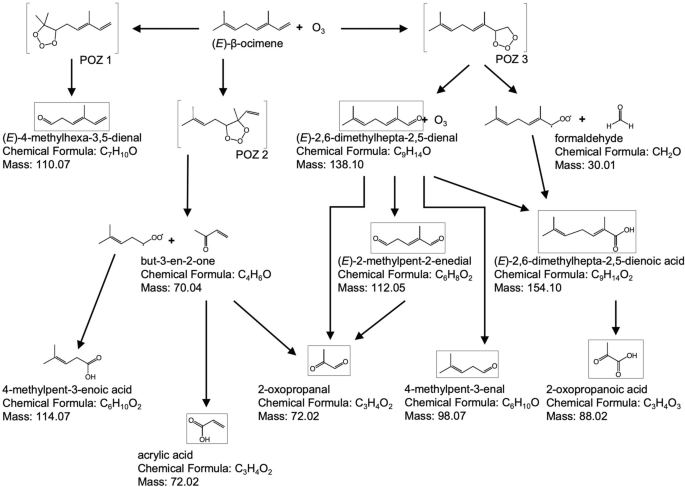
Biogenic volatile organic compounds (bVOCs), synthesised by plants, are important mediators of ecological interactions that can also undergo a series of reactions in the atmosphere. Ground-level ozone is a secondary pollutant generated through sunlight-driven reactions between nitrogen oxides (NOx) and VOCs. Its levels have increased since the industrial revolution and reactions involving ozone drive many chemical processes in the troposphere. While ozone precursors often originate in urban areas, winds may carry these hundreds of kilometres, causing ozone formation to also occur in less populated rural regions. Under elevated ozone conditions, ozonolysis of bVOCs can result in quantitative and qualitative changes in the gas phase, reducing the concentrations of certain bVOCs and resulting in the formation of other compounds. Such changes can result in disruption of bVOC-mediated behavioural or ecological interactions. Through a series of gas-phase experiments using Gas Chromatography Mass Spectrometry (GC-MS) and Proton Transfer Reaction Mass Spectrometry (PTR-MS), we investigated the products and their yields from the ozonolysis of a range of ubiquitous bVOCs, which were selected because of their importance in mediating ecological interactions such as pollinator and natural enemy attraction and plant-to-plant communication, namely: (E)-β-ocimene, isomers of α and β-farnesene, α-terpinene and 6-methyl-5-hepten-2-one. New products from the ozonolysis of these compounds were identified, and the formation of these compounds is consistent with terpene-ozone oxidation mechanisms. We present the degradation mechanism of our model bVOCs and identify their reaction products. We discuss the potential ecological implications of the degradation of each bVOC and of the formation of reaction products.
期刊介绍:
Journal of Chemical Ecology is devoted to promoting an ecological understanding of the origin, function, and significance of natural chemicals that mediate interactions within and between organisms. Such relationships, often adaptively important, comprise the oldest of communication systems in terrestrial and aquatic environments. With recent advances in methodology for elucidating structures of the chemical compounds involved, a strong interdisciplinary association has developed between chemists and biologists which should accelerate understanding of these interactions in nature.
Scientific contributions, including review articles, are welcome from either members or nonmembers of the International Society of Chemical Ecology. Manuscripts must be in English and may include original research in biological and/or chemical aspects of chemical ecology. They may include substantive observations of interactions in nature, the elucidation of the chemical compounds involved, the mechanisms of their production and reception, and the translation of such basic information into survey and control protocols. Sufficient biological and chemical detail should be given to substantiate conclusions and to permit results to be evaluated and reproduced.





 京公网安备 11010802042870号
京ICP备2023020795号-1
京公网安备 11010802042870号
京ICP备2023020795号-1

 分享
分享
 求助内容:
求助内容: 应助结果提醒方式:
 扫码关注我们
