Cole E. Sousa, Richard E. Kennedy, Rudolph A. King, Brett F. Bathel, Joshua M. Weisberger, Stuart J. Laurence
{"title":"从高速离层数据对马赫-6边界层中的非线性第二模式发展进行全局分析","authors":"Cole E. Sousa, Richard E. Kennedy, Rudolph A. King, Brett F. Bathel, Joshua M. Weisberger, Stuart J. Laurence","doi":"10.1007/s00348-023-03758-w","DOIUrl":null,"url":null,"abstract":"<div><p>The second-mode instability on a 7° half-angle sharp cone at Mach 6 is analyzed using high-speed calibrated schlieren imagery at a frame rate near the expected fundamental frequency. Experiments were conducted in the NASA Langley 20-Inch Mach 6 facility at unit Reynolds numbers between <span>\\(6.56 \\; \\times \\; 10^{6}\\)</span> and <span>\\(9.71 \\;\\times \\; 10^{6} \\text {m}^{-1}\\)</span>. Time-resolved pixel intensity signals throughout the boundary layer are reconstructed using spatially available data in the schlieren images to recover an effective sampling rate of over 10 MHz; these are then converted to quantitative density gradients using a thin-lens-based calibration technique. A global analysis is performed on the schlieren data to investigate the nonlinear growth of the second-mode fundamental and harmonic content. Pointwise measures of the autobicoherence are used to identify specific triadic interactions and the locations of their highest levels of quadratic phase coupling. Significant resonance interactions between the second-mode fundamental and harmonic instabilities were found along with interactions between these and the mean flow. Bispectral mode decomposition is employed to educe the flow structures associated with these interactions. A similar analysis is performed for the power spectrum, with power spectral densities computed for each pixel’s time-series and spectral proper orthogonal decomposition employed to derive the modal structure and energy of the flow at specific frequencies. Comparisons between the bispectral quantities and second-mode power show that nonlinear interactions, particularly resonance interactions, are closely correlated with spatiotemporal modulation of disturbances during the nonlinear stage of transition.</p></div>","PeriodicalId":554,"journal":{"name":"Experiments in Fluids","volume":"65 2","pages":""},"PeriodicalIF":2.5000,"publicationDate":"2024-01-31","publicationTypes":"Journal Article","fieldsOfStudy":null,"isOpenAccess":false,"openAccessPdf":"","citationCount":"0","resultStr":"{\"title\":\"Global analysis of nonlinear second-mode development in a Mach-6 boundary layer from high-speed schlieren data\",\"authors\":\"Cole E. Sousa, Richard E. Kennedy, Rudolph A. King, Brett F. Bathel, Joshua M. Weisberger, Stuart J. Laurence\",\"doi\":\"10.1007/s00348-023-03758-w\",\"DOIUrl\":null,\"url\":null,\"abstract\":\"<div><p>The second-mode instability on a 7° half-angle sharp cone at Mach 6 is analyzed using high-speed calibrated schlieren imagery at a frame rate near the expected fundamental frequency. Experiments were conducted in the NASA Langley 20-Inch Mach 6 facility at unit Reynolds numbers between <span>\\\\(6.56 \\\\; \\\\times \\\\; 10^{6}\\\\)</span> and <span>\\\\(9.71 \\\\;\\\\times \\\\; 10^{6} \\\\text {m}^{-1}\\\\)</span>. Time-resolved pixel intensity signals throughout the boundary layer are reconstructed using spatially available data in the schlieren images to recover an effective sampling rate of over 10 MHz; these are then converted to quantitative density gradients using a thin-lens-based calibration technique. A global analysis is performed on the schlieren data to investigate the nonlinear growth of the second-mode fundamental and harmonic content. Pointwise measures of the autobicoherence are used to identify specific triadic interactions and the locations of their highest levels of quadratic phase coupling. Significant resonance interactions between the second-mode fundamental and harmonic instabilities were found along with interactions between these and the mean flow. Bispectral mode decomposition is employed to educe the flow structures associated with these interactions. A similar analysis is performed for the power spectrum, with power spectral densities computed for each pixel’s time-series and spectral proper orthogonal decomposition employed to derive the modal structure and energy of the flow at specific frequencies. Comparisons between the bispectral quantities and second-mode power show that nonlinear interactions, particularly resonance interactions, are closely correlated with spatiotemporal modulation of disturbances during the nonlinear stage of transition.</p></div>\",\"PeriodicalId\":554,\"journal\":{\"name\":\"Experiments in Fluids\",\"volume\":\"65 2\",\"pages\":\"\"},\"PeriodicalIF\":2.5000,\"publicationDate\":\"2024-01-31\",\"publicationTypes\":\"Journal Article\",\"fieldsOfStudy\":null,\"isOpenAccess\":false,\"openAccessPdf\":\"\",\"citationCount\":\"0\",\"resultStr\":null,\"platform\":\"Semanticscholar\",\"paperid\":null,\"PeriodicalName\":\"Experiments in Fluids\",\"FirstCategoryId\":\"5\",\"ListUrlMain\":\"https://link.springer.com/article/10.1007/s00348-023-03758-w\",\"RegionNum\":3,\"RegionCategory\":\"工程技术\",\"ArticlePicture\":[],\"TitleCN\":null,\"AbstractTextCN\":null,\"PMCID\":null,\"EPubDate\":\"\",\"PubModel\":\"\",\"JCR\":\"Q2\",\"JCRName\":\"ENGINEERING, MECHANICAL\",\"Score\":null,\"Total\":0}","platform":"Semanticscholar","paperid":null,"PeriodicalName":"Experiments in Fluids","FirstCategoryId":"5","ListUrlMain":"https://link.springer.com/article/10.1007/s00348-023-03758-w","RegionNum":3,"RegionCategory":"工程技术","ArticlePicture":[],"TitleCN":null,"AbstractTextCN":null,"PMCID":null,"EPubDate":"","PubModel":"","JCR":"Q2","JCRName":"ENGINEERING, MECHANICAL","Score":null,"Total":0}
Global analysis of nonlinear second-mode development in a Mach-6 boundary layer from high-speed schlieren data
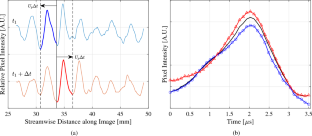
The second-mode instability on a 7° half-angle sharp cone at Mach 6 is analyzed using high-speed calibrated schlieren imagery at a frame rate near the expected fundamental frequency. Experiments were conducted in the NASA Langley 20-Inch Mach 6 facility at unit Reynolds numbers between \(6.56 \; \times \; 10^{6}\) and \(9.71 \;\times \; 10^{6} \text {m}^{-1}\). Time-resolved pixel intensity signals throughout the boundary layer are reconstructed using spatially available data in the schlieren images to recover an effective sampling rate of over 10 MHz; these are then converted to quantitative density gradients using a thin-lens-based calibration technique. A global analysis is performed on the schlieren data to investigate the nonlinear growth of the second-mode fundamental and harmonic content. Pointwise measures of the autobicoherence are used to identify specific triadic interactions and the locations of their highest levels of quadratic phase coupling. Significant resonance interactions between the second-mode fundamental and harmonic instabilities were found along with interactions between these and the mean flow. Bispectral mode decomposition is employed to educe the flow structures associated with these interactions. A similar analysis is performed for the power spectrum, with power spectral densities computed for each pixel’s time-series and spectral proper orthogonal decomposition employed to derive the modal structure and energy of the flow at specific frequencies. Comparisons between the bispectral quantities and second-mode power show that nonlinear interactions, particularly resonance interactions, are closely correlated with spatiotemporal modulation of disturbances during the nonlinear stage of transition.
期刊介绍:
Experiments in Fluids examines the advancement, extension, and improvement of new techniques of flow measurement. The journal also publishes contributions that employ existing experimental techniques to gain an understanding of the underlying flow physics in the areas of turbulence, aerodynamics, hydrodynamics, convective heat transfer, combustion, turbomachinery, multi-phase flows, and chemical, biological and geological flows. In addition, readers will find papers that report on investigations combining experimental and analytical/numerical approaches.





 京公网安备 11010802042870号
京ICP备2023020795号-1
京公网安备 11010802042870号
京ICP备2023020795号-1

 分享
分享
 求助内容:
求助内容: 应助结果提醒方式:
 扫码关注我们
