Chandramohan Dhasaratha, Mohammad Kamrul Hasan, S. Islam, S. Khapre, Salwani Abdullah, Taher M. Ghazal, A. Alzahrani, Nasser Alalwan, Nguyen Vo, Md Akhtaruzzaman
{"title":"利用区块链强化联合学习方法为可扩展的医疗物联网建立数据隐私模型","authors":"Chandramohan Dhasaratha, Mohammad Kamrul Hasan, S. Islam, S. Khapre, Salwani Abdullah, Taher M. Ghazal, A. Alzahrani, Nasser Alalwan, Nguyen Vo, Md Akhtaruzzaman","doi":"10.1049/cit2.12287","DOIUrl":null,"url":null,"abstract":"Internet of Medical Things (IoMT) has typical advancements in the healthcare sector with rapid potential proof for decentralised communication systems that have been applied for collecting and monitoring COVID‐19 patient data. Machine Learning algorithms typically use the risk score of each patient based on risk factors, which could help healthcare providers decide about post‐COVID‐19 care and follow‐up where the data privacy is another severe concern. The authors investigate the applicability of a distributed reinforcement learning approach in a Federated Learning (FL) multi‐disciplinary reinforcement system and explores the potential benefits of incorporating Blockchain Technology (BT) in the distributed system. Intermediate dependency features and transactions are avoided by applying Blockchain‐enabled reinforcement FL for the post‐COVID‐19 patient data of IoMT applications. The proposed approach helps to improvise clinical monitoring and ensure secure communication and data privacy in a decentralised manner. The main objective is to improve the efficiency and scalability of the reinforcement FL process in a distributed environment while ensuring data privacy and security through BT for IoMT applications. Results show that proposed approach achieve comparatively high reliability and outperforms the existing approaches.","PeriodicalId":8,"journal":{"name":"ACS Biomaterials Science & Engineering","volume":"179 2","pages":""},"PeriodicalIF":5.5000,"publicationDate":"2024-02-06","publicationTypes":"Journal Article","fieldsOfStudy":null,"isOpenAccess":false,"openAccessPdf":"","citationCount":"0","resultStr":"{\"title\":\"Data privacy model using blockchain reinforcement federated learning approach for scalable internet of medical things\",\"authors\":\"Chandramohan Dhasaratha, Mohammad Kamrul Hasan, S. Islam, S. Khapre, Salwani Abdullah, Taher M. Ghazal, A. Alzahrani, Nasser Alalwan, Nguyen Vo, Md Akhtaruzzaman\",\"doi\":\"10.1049/cit2.12287\",\"DOIUrl\":null,\"url\":null,\"abstract\":\"Internet of Medical Things (IoMT) has typical advancements in the healthcare sector with rapid potential proof for decentralised communication systems that have been applied for collecting and monitoring COVID‐19 patient data. Machine Learning algorithms typically use the risk score of each patient based on risk factors, which could help healthcare providers decide about post‐COVID‐19 care and follow‐up where the data privacy is another severe concern. The authors investigate the applicability of a distributed reinforcement learning approach in a Federated Learning (FL) multi‐disciplinary reinforcement system and explores the potential benefits of incorporating Blockchain Technology (BT) in the distributed system. Intermediate dependency features and transactions are avoided by applying Blockchain‐enabled reinforcement FL for the post‐COVID‐19 patient data of IoMT applications. The proposed approach helps to improvise clinical monitoring and ensure secure communication and data privacy in a decentralised manner. The main objective is to improve the efficiency and scalability of the reinforcement FL process in a distributed environment while ensuring data privacy and security through BT for IoMT applications. Results show that proposed approach achieve comparatively high reliability and outperforms the existing approaches.\",\"PeriodicalId\":8,\"journal\":{\"name\":\"ACS Biomaterials Science & Engineering\",\"volume\":\"179 2\",\"pages\":\"\"},\"PeriodicalIF\":5.5000,\"publicationDate\":\"2024-02-06\",\"publicationTypes\":\"Journal Article\",\"fieldsOfStudy\":null,\"isOpenAccess\":false,\"openAccessPdf\":\"\",\"citationCount\":\"0\",\"resultStr\":null,\"platform\":\"Semanticscholar\",\"paperid\":null,\"PeriodicalName\":\"ACS Biomaterials Science & Engineering\",\"FirstCategoryId\":\"94\",\"ListUrlMain\":\"https://doi.org/10.1049/cit2.12287\",\"RegionNum\":2,\"RegionCategory\":\"医学\",\"ArticlePicture\":[],\"TitleCN\":null,\"AbstractTextCN\":null,\"PMCID\":null,\"EPubDate\":\"\",\"PubModel\":\"\",\"JCR\":\"Q2\",\"JCRName\":\"MATERIALS SCIENCE, BIOMATERIALS\",\"Score\":null,\"Total\":0}","platform":"Semanticscholar","paperid":null,"PeriodicalName":"ACS Biomaterials Science & Engineering","FirstCategoryId":"94","ListUrlMain":"https://doi.org/10.1049/cit2.12287","RegionNum":2,"RegionCategory":"医学","ArticlePicture":[],"TitleCN":null,"AbstractTextCN":null,"PMCID":null,"EPubDate":"","PubModel":"","JCR":"Q2","JCRName":"MATERIALS SCIENCE, BIOMATERIALS","Score":null,"Total":0}
Data privacy model using blockchain reinforcement federated learning approach for scalable internet of medical things
Internet of Medical Things (IoMT) has typical advancements in the healthcare sector with rapid potential proof for decentralised communication systems that have been applied for collecting and monitoring COVID‐19 patient data. Machine Learning algorithms typically use the risk score of each patient based on risk factors, which could help healthcare providers decide about post‐COVID‐19 care and follow‐up where the data privacy is another severe concern. The authors investigate the applicability of a distributed reinforcement learning approach in a Federated Learning (FL) multi‐disciplinary reinforcement system and explores the potential benefits of incorporating Blockchain Technology (BT) in the distributed system. Intermediate dependency features and transactions are avoided by applying Blockchain‐enabled reinforcement FL for the post‐COVID‐19 patient data of IoMT applications. The proposed approach helps to improvise clinical monitoring and ensure secure communication and data privacy in a decentralised manner. The main objective is to improve the efficiency and scalability of the reinforcement FL process in a distributed environment while ensuring data privacy and security through BT for IoMT applications. Results show that proposed approach achieve comparatively high reliability and outperforms the existing approaches.
期刊介绍:
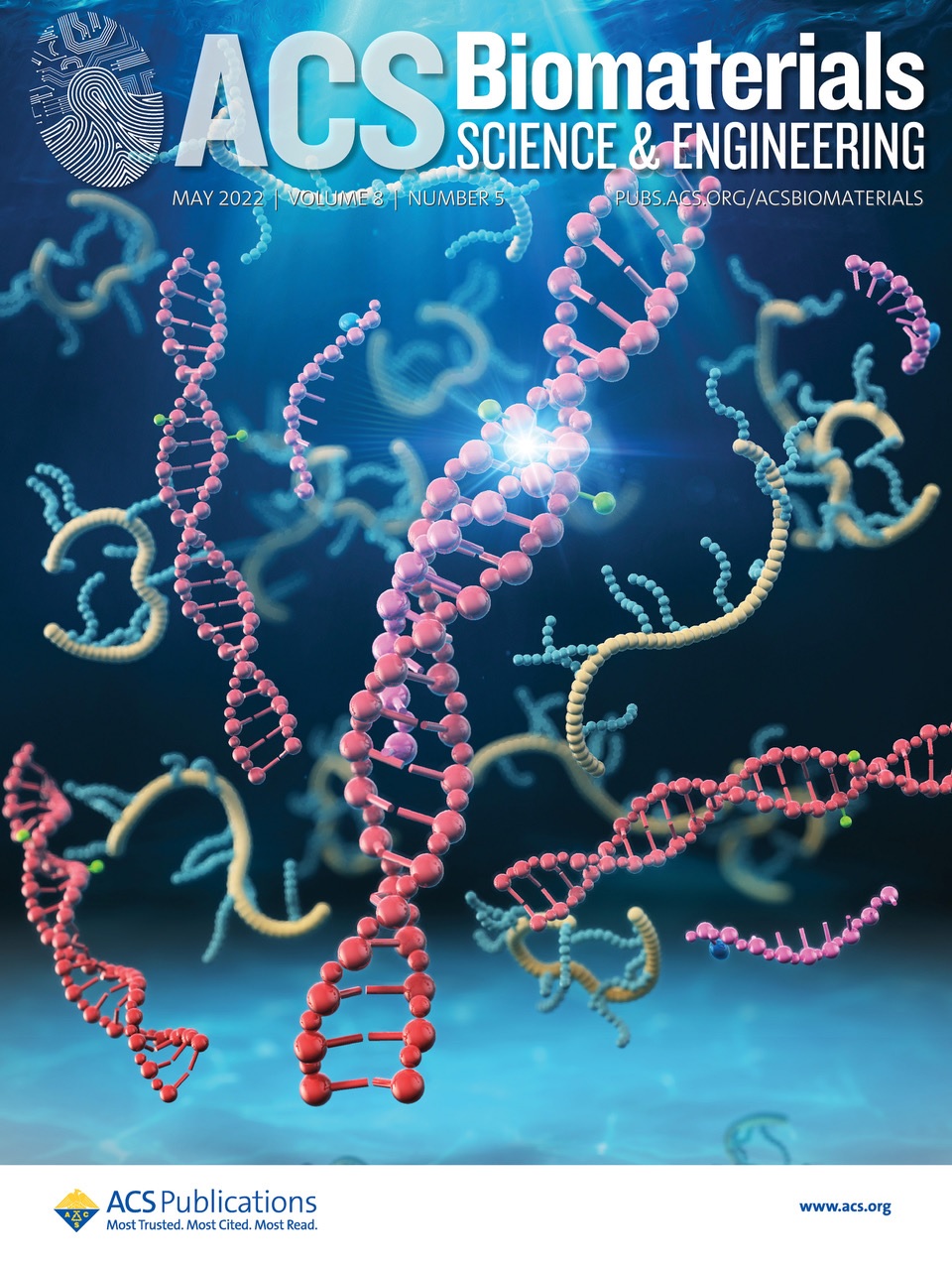
ACS Biomaterials Science & Engineering is the leading journal in the field of biomaterials, serving as an international forum for publishing cutting-edge research and innovative ideas on a broad range of topics:
Applications and Health – implantable tissues and devices, prosthesis, health risks, toxicology
Bio-interactions and Bio-compatibility – material-biology interactions, chemical/morphological/structural communication, mechanobiology, signaling and biological responses, immuno-engineering, calcification, coatings, corrosion and degradation of biomaterials and devices, biophysical regulation of cell functions
Characterization, Synthesis, and Modification – new biomaterials, bioinspired and biomimetic approaches to biomaterials, exploiting structural hierarchy and architectural control, combinatorial strategies for biomaterials discovery, genetic biomaterials design, synthetic biology, new composite systems, bionics, polymer synthesis
Controlled Release and Delivery Systems – biomaterial-based drug and gene delivery, bio-responsive delivery of regulatory molecules, pharmaceutical engineering
Healthcare Advances – clinical translation, regulatory issues, patient safety, emerging trends
Imaging and Diagnostics – imaging agents and probes, theranostics, biosensors, monitoring
Manufacturing and Technology – 3D printing, inks, organ-on-a-chip, bioreactor/perfusion systems, microdevices, BioMEMS, optics and electronics interfaces with biomaterials, systems integration
Modeling and Informatics Tools – scaling methods to guide biomaterial design, predictive algorithms for structure-function, biomechanics, integrating bioinformatics with biomaterials discovery, metabolomics in the context of biomaterials
Tissue Engineering and Regenerative Medicine – basic and applied studies, cell therapies, scaffolds, vascularization, bioartificial organs, transplantation and functionality, cellular agriculture




 京公网安备 11010802042870号
京ICP备2023020795号-1
京公网安备 11010802042870号
京ICP备2023020795号-1

 分享
分享
 求助内容:
求助内容: 应助结果提醒方式:
 扫码关注我们
