{"title":"确定天然有机物含量高的水体中铁的浓度和种类","authors":"Wei Li, Tianming Wang, Stephen Boult","doi":"10.1016/j.apgeochem.2024.105936","DOIUrl":null,"url":null,"abstract":"<div><p>Valency, solubility and size of Fe are important controls on quality of natural waters. Recent recognition of the ubiquitous influence of natural organic matter on these, means that wider monitoring of Fe species in waters containing organic matter is required. We assess and develop methods that explicitly recognize this need. We show that for water samples prepared by acidification and filtration for inductively coupled plasma – atomic emission spectroscopy (I.C.P.-A.E.S.) analysis, only 50%–80% of Fe was recovered. This was because acidification coagulated the natural organic matter; Fe could then attach to its surface and/or be entrained as it deposited, both processes prevent Fe entering the I.C.P.-A.E.S. We show that this discrepancy in analysis of Fe – which could also occur and be more significant in analysis of trace metals - is likely to be undetected as the coagulate is unlikely to be observed prior to analysis. Accurate Fe analysis was possible, by I.C.P.-A.E.S. if H<sub>2</sub>O<sub>2</sub> and U.V. light were used to remove organic carbon (O.C.), or by use of proprietary Fe chelators that produce colored complexes (e.g. Palintest LR, Palintest, UK). We also show that reliable resolution of Fe(II) concentration into free Fe(II) and Fe(II) bound to O.C. can be achieved by monitoring the time taken for ferrozine color development. This occurs within 2 s for free Fe(II) but up to 3 days for Fe(II) bound to O.C.</p></div>","PeriodicalId":8064,"journal":{"name":"Applied Geochemistry","volume":"163 ","pages":"Article 105936"},"PeriodicalIF":3.4000,"publicationDate":"2024-02-01","publicationTypes":"Journal Article","fieldsOfStudy":null,"isOpenAccess":false,"openAccessPdf":"","citationCount":"0","resultStr":"{\"title\":\"Determining Fe concentration and speciation in waters with high natural organic matter content\",\"authors\":\"Wei Li, Tianming Wang, Stephen Boult\",\"doi\":\"10.1016/j.apgeochem.2024.105936\",\"DOIUrl\":null,\"url\":null,\"abstract\":\"<div><p>Valency, solubility and size of Fe are important controls on quality of natural waters. Recent recognition of the ubiquitous influence of natural organic matter on these, means that wider monitoring of Fe species in waters containing organic matter is required. We assess and develop methods that explicitly recognize this need. We show that for water samples prepared by acidification and filtration for inductively coupled plasma – atomic emission spectroscopy (I.C.P.-A.E.S.) analysis, only 50%–80% of Fe was recovered. This was because acidification coagulated the natural organic matter; Fe could then attach to its surface and/or be entrained as it deposited, both processes prevent Fe entering the I.C.P.-A.E.S. We show that this discrepancy in analysis of Fe – which could also occur and be more significant in analysis of trace metals - is likely to be undetected as the coagulate is unlikely to be observed prior to analysis. Accurate Fe analysis was possible, by I.C.P.-A.E.S. if H<sub>2</sub>O<sub>2</sub> and U.V. light were used to remove organic carbon (O.C.), or by use of proprietary Fe chelators that produce colored complexes (e.g. Palintest LR, Palintest, UK). We also show that reliable resolution of Fe(II) concentration into free Fe(II) and Fe(II) bound to O.C. can be achieved by monitoring the time taken for ferrozine color development. This occurs within 2 s for free Fe(II) but up to 3 days for Fe(II) bound to O.C.</p></div>\",\"PeriodicalId\":8064,\"journal\":{\"name\":\"Applied Geochemistry\",\"volume\":\"163 \",\"pages\":\"Article 105936\"},\"PeriodicalIF\":3.4000,\"publicationDate\":\"2024-02-01\",\"publicationTypes\":\"Journal Article\",\"fieldsOfStudy\":null,\"isOpenAccess\":false,\"openAccessPdf\":\"\",\"citationCount\":\"0\",\"resultStr\":null,\"platform\":\"Semanticscholar\",\"paperid\":null,\"PeriodicalName\":\"Applied Geochemistry\",\"FirstCategoryId\":\"89\",\"ListUrlMain\":\"https://www.sciencedirect.com/science/article/pii/S0883292724000416\",\"RegionNum\":3,\"RegionCategory\":\"地球科学\",\"ArticlePicture\":[],\"TitleCN\":null,\"AbstractTextCN\":null,\"PMCID\":null,\"EPubDate\":\"2024/2/20 0:00:00\",\"PubModel\":\"Epub\",\"JCR\":\"Q1\",\"JCRName\":\"GEOCHEMISTRY & GEOPHYSICS\",\"Score\":null,\"Total\":0}","platform":"Semanticscholar","paperid":null,"PeriodicalName":"Applied Geochemistry","FirstCategoryId":"89","ListUrlMain":"https://www.sciencedirect.com/science/article/pii/S0883292724000416","RegionNum":3,"RegionCategory":"地球科学","ArticlePicture":[],"TitleCN":null,"AbstractTextCN":null,"PMCID":null,"EPubDate":"2024/2/20 0:00:00","PubModel":"Epub","JCR":"Q1","JCRName":"GEOCHEMISTRY & GEOPHYSICS","Score":null,"Total":0}
Determining Fe concentration and speciation in waters with high natural organic matter content
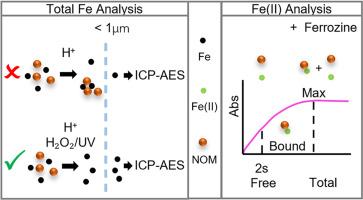
Valency, solubility and size of Fe are important controls on quality of natural waters. Recent recognition of the ubiquitous influence of natural organic matter on these, means that wider monitoring of Fe species in waters containing organic matter is required. We assess and develop methods that explicitly recognize this need. We show that for water samples prepared by acidification and filtration for inductively coupled plasma – atomic emission spectroscopy (I.C.P.-A.E.S.) analysis, only 50%–80% of Fe was recovered. This was because acidification coagulated the natural organic matter; Fe could then attach to its surface and/or be entrained as it deposited, both processes prevent Fe entering the I.C.P.-A.E.S. We show that this discrepancy in analysis of Fe – which could also occur and be more significant in analysis of trace metals - is likely to be undetected as the coagulate is unlikely to be observed prior to analysis. Accurate Fe analysis was possible, by I.C.P.-A.E.S. if H2O2 and U.V. light were used to remove organic carbon (O.C.), or by use of proprietary Fe chelators that produce colored complexes (e.g. Palintest LR, Palintest, UK). We also show that reliable resolution of Fe(II) concentration into free Fe(II) and Fe(II) bound to O.C. can be achieved by monitoring the time taken for ferrozine color development. This occurs within 2 s for free Fe(II) but up to 3 days for Fe(II) bound to O.C.
期刊介绍:
Applied Geochemistry is an international journal devoted to publication of original research papers, rapid research communications and selected review papers in geochemistry and urban geochemistry which have some practical application to an aspect of human endeavour, such as the preservation of the environment, health, waste disposal and the search for resources. Papers on applications of inorganic, organic and isotope geochemistry and geochemical processes are therefore welcome provided they meet the main criterion. Spatial and temporal monitoring case studies are only of interest to our international readership if they present new ideas of broad application.
Topics covered include: (1) Environmental geochemistry (including natural and anthropogenic aspects, and protection and remediation strategies); (2) Hydrogeochemistry (surface and groundwater); (3) Medical (urban) geochemistry; (4) The search for energy resources (in particular unconventional oil and gas or emerging metal resources); (5) Energy exploitation (in particular geothermal energy and CCS); (6) Upgrading of energy and mineral resources where there is a direct geochemical application; and (7) Waste disposal, including nuclear waste disposal.




 京公网安备 11010802042870号
京ICP备2023020795号-1
京公网安备 11010802042870号
京ICP备2023020795号-1

 分享
分享
 求助内容:
求助内容: 应助结果提醒方式:
 扫码关注我们
