{"title":"尼古丁代谢率对尼古丁依赖和奖赏的作用:中国男性吸烟者和雄性小鼠的尼古丁代谢。","authors":"Mingda Liu, Hongjuan Wang, Yaning Fu, Xiangyu Li, Ping Wu, Guanglin Liu, Ruiyan Wang, Yuan Zhang, Huan Chen, Hongwei Hou, Qingyuan Hu","doi":"10.1007/s12035-024-04040-8","DOIUrl":null,"url":null,"abstract":"<p><p>The exact relationship between nicotine metabolism and dependence is not fully understood but is known to be influenced at a molecular level by genetic factors. A sample comprising 274 Chinese adult male smokers was categorized into groups based on their metabolic rates, namely fast, intermediate, and slow metabolizers. We then measured their smoking topography, evaluated their nicotine dependence, and assessed the rewarding effects. Based on these findings, we proposed the hypothesis that the rate of nicotine metabolism could influence the level of dopamine release which in turn had repercussions on the pleasurable and rewarding effects. To test this hypothesis, male mice were selected with different nicotine metabolic rates that closely resembled in the smoker group. We evaluated their nicotine dependence and rewarding effects through conditioned place preference and withdrawal symptom tests, supplemented with dopamine release measurements. In both animal and human, the slow metabolism group (SMG) required less nicotine to maintain a comparable level of dependence than the fast metabolism group (FMG). The SMG could achieve similar rewarding effects to FMG despite consuming less nicotine. Comparable dopamine levels released were therefore critical in setting the nicotine acquisition behavior in this animal model and also for the smokers tested. Our findings suggested that even within the same ethnicity of established smokers (Chinese Han), differences in nicotine metabolism were an important parameter to modulate the degree of nicotine dependence.</p>","PeriodicalId":18762,"journal":{"name":"Molecular Neurobiology","volume":" ","pages":"7692-7706"},"PeriodicalIF":4.3000,"publicationDate":"2024-10-01","publicationTypes":"Journal Article","fieldsOfStudy":null,"isOpenAccess":false,"openAccessPdf":"","citationCount":"0","resultStr":"{\"title\":\"The Role of Nicotine Metabolic Rate on Nicotine Dependence and Rewarding: Nicotine Metabolism in Chinese Male Smokers and Male Mice.\",\"authors\":\"Mingda Liu, Hongjuan Wang, Yaning Fu, Xiangyu Li, Ping Wu, Guanglin Liu, Ruiyan Wang, Yuan Zhang, Huan Chen, Hongwei Hou, Qingyuan Hu\",\"doi\":\"10.1007/s12035-024-04040-8\",\"DOIUrl\":null,\"url\":null,\"abstract\":\"<p><p>The exact relationship between nicotine metabolism and dependence is not fully understood but is known to be influenced at a molecular level by genetic factors. A sample comprising 274 Chinese adult male smokers was categorized into groups based on their metabolic rates, namely fast, intermediate, and slow metabolizers. We then measured their smoking topography, evaluated their nicotine dependence, and assessed the rewarding effects. Based on these findings, we proposed the hypothesis that the rate of nicotine metabolism could influence the level of dopamine release which in turn had repercussions on the pleasurable and rewarding effects. To test this hypothesis, male mice were selected with different nicotine metabolic rates that closely resembled in the smoker group. We evaluated their nicotine dependence and rewarding effects through conditioned place preference and withdrawal symptom tests, supplemented with dopamine release measurements. In both animal and human, the slow metabolism group (SMG) required less nicotine to maintain a comparable level of dependence than the fast metabolism group (FMG). The SMG could achieve similar rewarding effects to FMG despite consuming less nicotine. Comparable dopamine levels released were therefore critical in setting the nicotine acquisition behavior in this animal model and also for the smokers tested. Our findings suggested that even within the same ethnicity of established smokers (Chinese Han), differences in nicotine metabolism were an important parameter to modulate the degree of nicotine dependence.</p>\",\"PeriodicalId\":18762,\"journal\":{\"name\":\"Molecular Neurobiology\",\"volume\":\" \",\"pages\":\"7692-7706\"},\"PeriodicalIF\":4.3000,\"publicationDate\":\"2024-10-01\",\"publicationTypes\":\"Journal Article\",\"fieldsOfStudy\":null,\"isOpenAccess\":false,\"openAccessPdf\":\"\",\"citationCount\":\"0\",\"resultStr\":null,\"platform\":\"Semanticscholar\",\"paperid\":null,\"PeriodicalName\":\"Molecular Neurobiology\",\"FirstCategoryId\":\"3\",\"ListUrlMain\":\"https://doi.org/10.1007/s12035-024-04040-8\",\"RegionNum\":2,\"RegionCategory\":\"医学\",\"ArticlePicture\":[],\"TitleCN\":null,\"AbstractTextCN\":null,\"PMCID\":null,\"EPubDate\":\"2024/3/1 0:00:00\",\"PubModel\":\"Epub\",\"JCR\":\"Q1\",\"JCRName\":\"NEUROSCIENCES\",\"Score\":null,\"Total\":0}","platform":"Semanticscholar","paperid":null,"PeriodicalName":"Molecular Neurobiology","FirstCategoryId":"3","ListUrlMain":"https://doi.org/10.1007/s12035-024-04040-8","RegionNum":2,"RegionCategory":"医学","ArticlePicture":[],"TitleCN":null,"AbstractTextCN":null,"PMCID":null,"EPubDate":"2024/3/1 0:00:00","PubModel":"Epub","JCR":"Q1","JCRName":"NEUROSCIENCES","Score":null,"Total":0}
The Role of Nicotine Metabolic Rate on Nicotine Dependence and Rewarding: Nicotine Metabolism in Chinese Male Smokers and Male Mice.
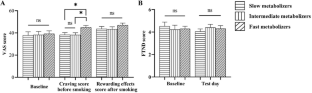
The exact relationship between nicotine metabolism and dependence is not fully understood but is known to be influenced at a molecular level by genetic factors. A sample comprising 274 Chinese adult male smokers was categorized into groups based on their metabolic rates, namely fast, intermediate, and slow metabolizers. We then measured their smoking topography, evaluated their nicotine dependence, and assessed the rewarding effects. Based on these findings, we proposed the hypothesis that the rate of nicotine metabolism could influence the level of dopamine release which in turn had repercussions on the pleasurable and rewarding effects. To test this hypothesis, male mice were selected with different nicotine metabolic rates that closely resembled in the smoker group. We evaluated their nicotine dependence and rewarding effects through conditioned place preference and withdrawal symptom tests, supplemented with dopamine release measurements. In both animal and human, the slow metabolism group (SMG) required less nicotine to maintain a comparable level of dependence than the fast metabolism group (FMG). The SMG could achieve similar rewarding effects to FMG despite consuming less nicotine. Comparable dopamine levels released were therefore critical in setting the nicotine acquisition behavior in this animal model and also for the smokers tested. Our findings suggested that even within the same ethnicity of established smokers (Chinese Han), differences in nicotine metabolism were an important parameter to modulate the degree of nicotine dependence.
期刊介绍:
Molecular Neurobiology is an exciting journal for neuroscientists needing to stay in close touch with progress at the forefront of molecular brain research today. It is an especially important periodical for graduate students and "postdocs," specifically designed to synthesize and critically assess research trends for all neuroscientists hoping to stay active at the cutting edge of this dramatically developing area. This journal has proven to be crucial in departmental libraries, serving as essential reading for every committed neuroscientist who is striving to keep abreast of all rapid developments in a forefront field. Most recent significant advances in experimental and clinical neuroscience have been occurring at the molecular level. Until now, there has been no journal devoted to looking closely at this fragmented literature in a critical, coherent fashion. Each submission is thoroughly analyzed by scientists and clinicians internationally renowned for their special competence in the areas treated.




 京公网安备 11010802042870号
京ICP备2023020795号-1
京公网安备 11010802042870号
京ICP备2023020795号-1

 分享
分享
 求助内容:
求助内容: 应助结果提醒方式:
 扫码关注我们
