Lin-fa Quan, Yan-yan Chi, Yi-Zhi Dong, Shu Xu, Bing-xu Chen, Wen-jing Li
{"title":"中华鳖头部转录组中昼夜节律时钟基因的鉴定和特征描述 Bradley","authors":"Lin-fa Quan, Yan-yan Chi, Yi-Zhi Dong, Shu Xu, Bing-xu Chen, Wen-jing Li","doi":"10.1016/j.cbd.2024.101223","DOIUrl":null,"url":null,"abstract":"<div><p><em>Conopomorpha sinensis</em> Bradley is the most detrimental pest to litchi and longan in China. Adult eclosion, locomotion, mating and oviposition of <em>C. sinensis</em> usually occur at night, regulated by a circadian rhythm. Nevertheless, our understanding of the linkages between adult circadian rhythms and clock genes remains inadequate. To address this gap, transcriptomic analysis was conducted on female and male heads (including antennae) of <em>C. sinensis</em> using the Illumina HiSeq 6000 platform to identify major circadian clock-related genes. The annotated sequences were analyzed by BLASTx, and candidate clock genes were classified based on conservation, predicted domain architectures, and phylogenetic analysis. The analysis revealed a higher conservation of these genes among the compared moths. Further, the expression profile analysis showed a significant spatiotemporal and circadian rhythmic accumulation of some clock genes during development. The candidate clock genes were predominantly expressed in the head, highlighting their crucial function in circadian rhythm regulation. Moreover, <em>CsinPer</em>, <em>CsinTim</em>1, and <em>CsinCry</em>1 displayed similar dynamic expressions with a peak expression level in the 4th age adults, suggesting their involvement in regulation of courtship and mating behaviors. The <em>CsinPer</em> and <em>CsinTim</em>1 mRNA oscillated strongly with a similar phase, containing a peak expression just before the female mating peak. This work will greatly contribute to understanding the circadian clock system of <em>C. sinensis</em> and provide valuable information for further studies of the molecular mechanisms involved in rhythmicity in fruit-boring pests.</p></div>","PeriodicalId":55235,"journal":{"name":"Comparative Biochemistry and Physiology D-Genomics & Proteomics","volume":"50 ","pages":"Article 101223"},"PeriodicalIF":2.9000,"publicationDate":"2024-06-01","publicationTypes":"Journal Article","fieldsOfStudy":null,"isOpenAccess":false,"openAccessPdf":"","citationCount":"0","resultStr":"{\"title\":\"Identification and characterization of circadian clock genes in the head transcriptome of Conopomorpha sinensis Bradley\",\"authors\":\"Lin-fa Quan, Yan-yan Chi, Yi-Zhi Dong, Shu Xu, Bing-xu Chen, Wen-jing Li\",\"doi\":\"10.1016/j.cbd.2024.101223\",\"DOIUrl\":null,\"url\":null,\"abstract\":\"<div><p><em>Conopomorpha sinensis</em> Bradley is the most detrimental pest to litchi and longan in China. Adult eclosion, locomotion, mating and oviposition of <em>C. sinensis</em> usually occur at night, regulated by a circadian rhythm. Nevertheless, our understanding of the linkages between adult circadian rhythms and clock genes remains inadequate. To address this gap, transcriptomic analysis was conducted on female and male heads (including antennae) of <em>C. sinensis</em> using the Illumina HiSeq 6000 platform to identify major circadian clock-related genes. The annotated sequences were analyzed by BLASTx, and candidate clock genes were classified based on conservation, predicted domain architectures, and phylogenetic analysis. The analysis revealed a higher conservation of these genes among the compared moths. Further, the expression profile analysis showed a significant spatiotemporal and circadian rhythmic accumulation of some clock genes during development. The candidate clock genes were predominantly expressed in the head, highlighting their crucial function in circadian rhythm regulation. Moreover, <em>CsinPer</em>, <em>CsinTim</em>1, and <em>CsinCry</em>1 displayed similar dynamic expressions with a peak expression level in the 4th age adults, suggesting their involvement in regulation of courtship and mating behaviors. The <em>CsinPer</em> and <em>CsinTim</em>1 mRNA oscillated strongly with a similar phase, containing a peak expression just before the female mating peak. This work will greatly contribute to understanding the circadian clock system of <em>C. sinensis</em> and provide valuable information for further studies of the molecular mechanisms involved in rhythmicity in fruit-boring pests.</p></div>\",\"PeriodicalId\":55235,\"journal\":{\"name\":\"Comparative Biochemistry and Physiology D-Genomics & Proteomics\",\"volume\":\"50 \",\"pages\":\"Article 101223\"},\"PeriodicalIF\":2.9000,\"publicationDate\":\"2024-06-01\",\"publicationTypes\":\"Journal Article\",\"fieldsOfStudy\":null,\"isOpenAccess\":false,\"openAccessPdf\":\"\",\"citationCount\":\"0\",\"resultStr\":null,\"platform\":\"Semanticscholar\",\"paperid\":null,\"PeriodicalName\":\"Comparative Biochemistry and Physiology D-Genomics & Proteomics\",\"FirstCategoryId\":\"99\",\"ListUrlMain\":\"https://www.sciencedirect.com/science/article/pii/S1744117X24000364\",\"RegionNum\":2,\"RegionCategory\":\"生物学\",\"ArticlePicture\":[],\"TitleCN\":null,\"AbstractTextCN\":null,\"PMCID\":null,\"EPubDate\":\"2024/2/28 0:00:00\",\"PubModel\":\"Epub\",\"JCR\":\"Q4\",\"JCRName\":\"BIOCHEMISTRY & MOLECULAR BIOLOGY\",\"Score\":null,\"Total\":0}","platform":"Semanticscholar","paperid":null,"PeriodicalName":"Comparative Biochemistry and Physiology D-Genomics & Proteomics","FirstCategoryId":"99","ListUrlMain":"https://www.sciencedirect.com/science/article/pii/S1744117X24000364","RegionNum":2,"RegionCategory":"生物学","ArticlePicture":[],"TitleCN":null,"AbstractTextCN":null,"PMCID":null,"EPubDate":"2024/2/28 0:00:00","PubModel":"Epub","JCR":"Q4","JCRName":"BIOCHEMISTRY & MOLECULAR BIOLOGY","Score":null,"Total":0}
Identification and characterization of circadian clock genes in the head transcriptome of Conopomorpha sinensis Bradley
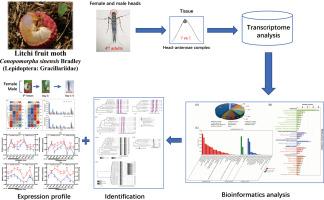
Conopomorpha sinensis Bradley is the most detrimental pest to litchi and longan in China. Adult eclosion, locomotion, mating and oviposition of C. sinensis usually occur at night, regulated by a circadian rhythm. Nevertheless, our understanding of the linkages between adult circadian rhythms and clock genes remains inadequate. To address this gap, transcriptomic analysis was conducted on female and male heads (including antennae) of C. sinensis using the Illumina HiSeq 6000 platform to identify major circadian clock-related genes. The annotated sequences were analyzed by BLASTx, and candidate clock genes were classified based on conservation, predicted domain architectures, and phylogenetic analysis. The analysis revealed a higher conservation of these genes among the compared moths. Further, the expression profile analysis showed a significant spatiotemporal and circadian rhythmic accumulation of some clock genes during development. The candidate clock genes were predominantly expressed in the head, highlighting their crucial function in circadian rhythm regulation. Moreover, CsinPer, CsinTim1, and CsinCry1 displayed similar dynamic expressions with a peak expression level in the 4th age adults, suggesting their involvement in regulation of courtship and mating behaviors. The CsinPer and CsinTim1 mRNA oscillated strongly with a similar phase, containing a peak expression just before the female mating peak. This work will greatly contribute to understanding the circadian clock system of C. sinensis and provide valuable information for further studies of the molecular mechanisms involved in rhythmicity in fruit-boring pests.
期刊介绍:
Comparative Biochemistry & Physiology (CBP) publishes papers in comparative, environmental and evolutionary physiology.
Part D: Genomics and Proteomics (CBPD), focuses on “omics” approaches to physiology, including comparative and functional genomics, metagenomics, transcriptomics, proteomics, metabolomics, and lipidomics. Most studies employ “omics” and/or system biology to test specific hypotheses about molecular and biochemical mechanisms underlying physiological responses to the environment. We encourage papers that address fundamental questions in comparative physiology and biochemistry rather than studies with a focus that is purely technical, methodological or descriptive in nature.




 京公网安备 11010802042870号
京ICP备2023020795号-1
京公网安备 11010802042870号
京ICP备2023020795号-1

 分享
分享
 求助内容:
求助内容: 应助结果提醒方式:
 扫码关注我们
