Jordi Rodón, David Demanse, Hope S Rugo, Howard A Burris, Rafael Simó, Azeez Farooki, Melissa F Wellons, Fabrice André, Huilin Hu, Dragica Vuina, Cornelia Quadt, Dejan Juric
{"title":"晚期实体瘤和乳腺癌患者阿来替尼诱发高血糖的风险分析。","authors":"Jordi Rodón, David Demanse, Hope S Rugo, Howard A Burris, Rafael Simó, Azeez Farooki, Melissa F Wellons, Fabrice André, Huilin Hu, Dragica Vuina, Cornelia Quadt, Dejan Juric","doi":"10.1186/s13058-024-01773-1","DOIUrl":null,"url":null,"abstract":"<p><strong>Background: </strong>Hyperglycemia is an on-target effect of PI3Kα inhibitors. Early identification and intervention of treatment-induced hyperglycemia is important for improving management of patients receiving a PI3Kα inhibitor like alpelisib. Here, we characterize incidence of grade 3/4 alpelisib-related hyperglycemia, along with time to event, management, and outcomes using a machine learning model.</p><p><strong>Methods: </strong>Data for the risk model were pooled from patients receiving alpelisib ± fulvestrant in the open-label, phase 1 X2101 trial and the randomized, double-blind, phase 3 SOLAR-1 trial. The pooled population (n = 505) included patients with advanced solid tumors (X2101, n = 221) or HR+/HER2- advanced breast cancer (SOLAR-1, n = 284). External validation was performed using BYLieve trial patient data (n = 340). Hyperglycemia incidence and management were analyzed for SOLAR-1.</p><p><strong>Results: </strong>A random forest model identified 5 baseline characteristics most associated with risk of developing grade 3/4 hyperglycemia (fasting plasma glucose, body mass index, HbA<sub>1c</sub>, monocytes, age). This model was used to derive a score to classify patients as high or low risk for developing grade 3/4 hyperglycemia. Applying the model to patients treated with alpelisib and fulvestrant in SOLAR-1 showed higher incidence of hyperglycemia (all grade and grade 3/4), increased use of antihyperglycemic medications, and more discontinuations due to hyperglycemia (16.7% vs. 2.6% of discontinuations) in the high- versus low-risk group. Among patients in SOLAR-1 (alpelisib + fulvestrant arm) with PIK3CA mutations, median progression-free survival was similar between the high- and low-risk groups (11.0 vs. 10.9 months). For external validation, the model was applied to the BYLieve trial, for which successful classification into high- and low-risk groups with shorter time to grade 3/4 hyperglycemia in the high-risk group was observed.</p><p><strong>Conclusions: </strong>A risk model using 5 clinically relevant baseline characteristics was able to identify patients at higher or lower probability for developing alpelisib-induced hyperglycemia. Early identification of patients who may be at higher risk for hyperglycemia may improve management (including monitoring and early intervention) and potentially lead to improved outcomes.</p><p><strong>Registration: </strong>ClinicalTrials.gov: NCT01219699 (registration date: October 13, 2010; retrospectively registered), ClinicalTrials.gov: NCT02437318 (registration date: May 7, 2015); ClinicalTrials.gov: NCT03056755 (registration date: February 17, 2017).</p>","PeriodicalId":49227,"journal":{"name":"Breast Cancer Research","volume":"26 1","pages":"36"},"PeriodicalIF":5.6000,"publicationDate":"2024-03-04","publicationTypes":"Journal Article","fieldsOfStudy":null,"isOpenAccess":false,"openAccessPdf":"https://www.ncbi.nlm.nih.gov/pmc/articles/PMC10913434/pdf/","citationCount":"0","resultStr":"{\"title\":\"A risk analysis of alpelisib-induced hyperglycemia in patients with advanced solid tumors and breast cancer.\",\"authors\":\"Jordi Rodón, David Demanse, Hope S Rugo, Howard A Burris, Rafael Simó, Azeez Farooki, Melissa F Wellons, Fabrice André, Huilin Hu, Dragica Vuina, Cornelia Quadt, Dejan Juric\",\"doi\":\"10.1186/s13058-024-01773-1\",\"DOIUrl\":null,\"url\":null,\"abstract\":\"<p><strong>Background: </strong>Hyperglycemia is an on-target effect of PI3Kα inhibitors. Early identification and intervention of treatment-induced hyperglycemia is important for improving management of patients receiving a PI3Kα inhibitor like alpelisib. Here, we characterize incidence of grade 3/4 alpelisib-related hyperglycemia, along with time to event, management, and outcomes using a machine learning model.</p><p><strong>Methods: </strong>Data for the risk model were pooled from patients receiving alpelisib ± fulvestrant in the open-label, phase 1 X2101 trial and the randomized, double-blind, phase 3 SOLAR-1 trial. The pooled population (n = 505) included patients with advanced solid tumors (X2101, n = 221) or HR+/HER2- advanced breast cancer (SOLAR-1, n = 284). External validation was performed using BYLieve trial patient data (n = 340). Hyperglycemia incidence and management were analyzed for SOLAR-1.</p><p><strong>Results: </strong>A random forest model identified 5 baseline characteristics most associated with risk of developing grade 3/4 hyperglycemia (fasting plasma glucose, body mass index, HbA<sub>1c</sub>, monocytes, age). This model was used to derive a score to classify patients as high or low risk for developing grade 3/4 hyperglycemia. Applying the model to patients treated with alpelisib and fulvestrant in SOLAR-1 showed higher incidence of hyperglycemia (all grade and grade 3/4), increased use of antihyperglycemic medications, and more discontinuations due to hyperglycemia (16.7% vs. 2.6% of discontinuations) in the high- versus low-risk group. Among patients in SOLAR-1 (alpelisib + fulvestrant arm) with PIK3CA mutations, median progression-free survival was similar between the high- and low-risk groups (11.0 vs. 10.9 months). For external validation, the model was applied to the BYLieve trial, for which successful classification into high- and low-risk groups with shorter time to grade 3/4 hyperglycemia in the high-risk group was observed.</p><p><strong>Conclusions: </strong>A risk model using 5 clinically relevant baseline characteristics was able to identify patients at higher or lower probability for developing alpelisib-induced hyperglycemia. Early identification of patients who may be at higher risk for hyperglycemia may improve management (including monitoring and early intervention) and potentially lead to improved outcomes.</p><p><strong>Registration: </strong>ClinicalTrials.gov: NCT01219699 (registration date: October 13, 2010; retrospectively registered), ClinicalTrials.gov: NCT02437318 (registration date: May 7, 2015); ClinicalTrials.gov: NCT03056755 (registration date: February 17, 2017).</p>\",\"PeriodicalId\":49227,\"journal\":{\"name\":\"Breast Cancer Research\",\"volume\":\"26 1\",\"pages\":\"36\"},\"PeriodicalIF\":5.6000,\"publicationDate\":\"2024-03-04\",\"publicationTypes\":\"Journal Article\",\"fieldsOfStudy\":null,\"isOpenAccess\":false,\"openAccessPdf\":\"https://www.ncbi.nlm.nih.gov/pmc/articles/PMC10913434/pdf/\",\"citationCount\":\"0\",\"resultStr\":null,\"platform\":\"Semanticscholar\",\"paperid\":null,\"PeriodicalName\":\"Breast Cancer Research\",\"FirstCategoryId\":\"3\",\"ListUrlMain\":\"https://doi.org/10.1186/s13058-024-01773-1\",\"RegionNum\":1,\"RegionCategory\":\"医学\",\"ArticlePicture\":[],\"TitleCN\":null,\"AbstractTextCN\":null,\"PMCID\":null,\"EPubDate\":\"\",\"PubModel\":\"\",\"JCR\":\"Q1\",\"JCRName\":\"Medicine\",\"Score\":null,\"Total\":0}","platform":"Semanticscholar","paperid":null,"PeriodicalName":"Breast Cancer Research","FirstCategoryId":"3","ListUrlMain":"https://doi.org/10.1186/s13058-024-01773-1","RegionNum":1,"RegionCategory":"医学","ArticlePicture":[],"TitleCN":null,"AbstractTextCN":null,"PMCID":null,"EPubDate":"","PubModel":"","JCR":"Q1","JCRName":"Medicine","Score":null,"Total":0}
A risk analysis of alpelisib-induced hyperglycemia in patients with advanced solid tumors and breast cancer.
Background: Hyperglycemia is an on-target effect of PI3Kα inhibitors. Early identification and intervention of treatment-induced hyperglycemia is important for improving management of patients receiving a PI3Kα inhibitor like alpelisib. Here, we characterize incidence of grade 3/4 alpelisib-related hyperglycemia, along with time to event, management, and outcomes using a machine learning model.
Methods: Data for the risk model were pooled from patients receiving alpelisib ± fulvestrant in the open-label, phase 1 X2101 trial and the randomized, double-blind, phase 3 SOLAR-1 trial. The pooled population (n = 505) included patients with advanced solid tumors (X2101, n = 221) or HR+/HER2- advanced breast cancer (SOLAR-1, n = 284). External validation was performed using BYLieve trial patient data (n = 340). Hyperglycemia incidence and management were analyzed for SOLAR-1.
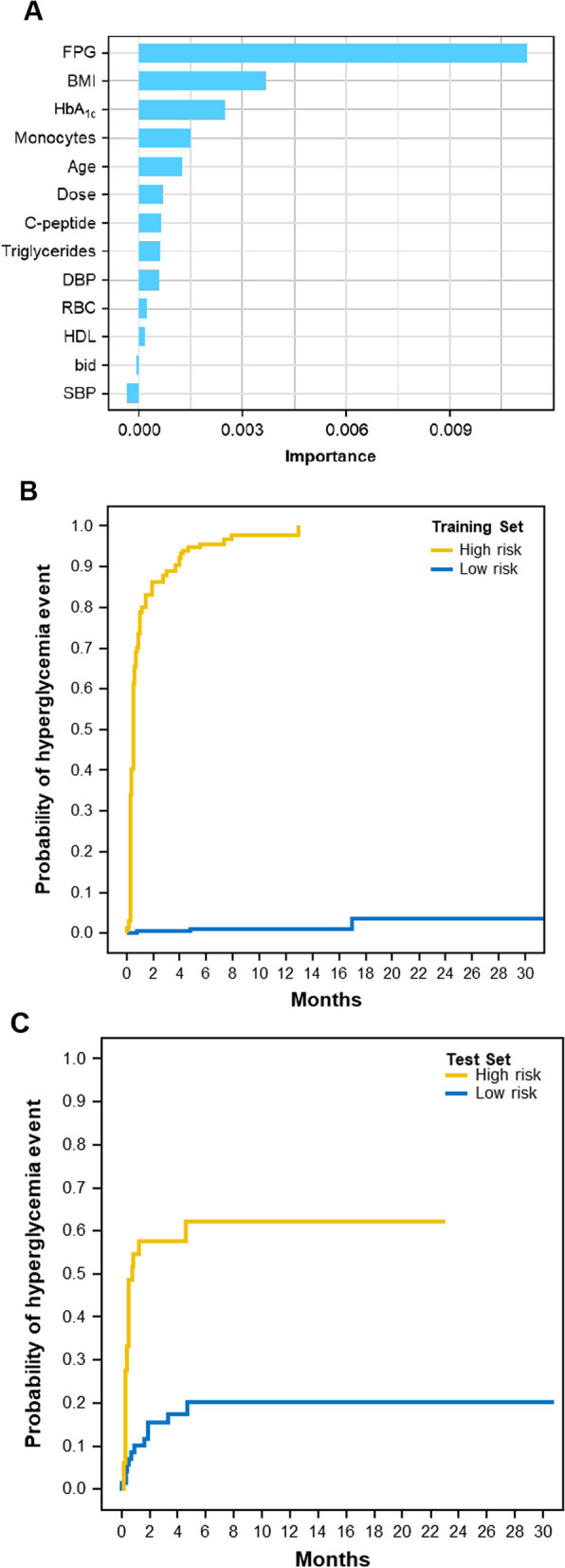
Results: A random forest model identified 5 baseline characteristics most associated with risk of developing grade 3/4 hyperglycemia (fasting plasma glucose, body mass index, HbA1c, monocytes, age). This model was used to derive a score to classify patients as high or low risk for developing grade 3/4 hyperglycemia. Applying the model to patients treated with alpelisib and fulvestrant in SOLAR-1 showed higher incidence of hyperglycemia (all grade and grade 3/4), increased use of antihyperglycemic medications, and more discontinuations due to hyperglycemia (16.7% vs. 2.6% of discontinuations) in the high- versus low-risk group. Among patients in SOLAR-1 (alpelisib + fulvestrant arm) with PIK3CA mutations, median progression-free survival was similar between the high- and low-risk groups (11.0 vs. 10.9 months). For external validation, the model was applied to the BYLieve trial, for which successful classification into high- and low-risk groups with shorter time to grade 3/4 hyperglycemia in the high-risk group was observed.
Conclusions: A risk model using 5 clinically relevant baseline characteristics was able to identify patients at higher or lower probability for developing alpelisib-induced hyperglycemia. Early identification of patients who may be at higher risk for hyperglycemia may improve management (including monitoring and early intervention) and potentially lead to improved outcomes.
Registration: ClinicalTrials.gov: NCT01219699 (registration date: October 13, 2010; retrospectively registered), ClinicalTrials.gov: NCT02437318 (registration date: May 7, 2015); ClinicalTrials.gov: NCT03056755 (registration date: February 17, 2017).
期刊介绍:
Breast Cancer Research, an international, peer-reviewed online journal, publishes original research, reviews, editorials, and reports. It features open-access research articles of exceptional interest across all areas of biology and medicine relevant to breast cancer. This includes normal mammary gland biology, with a special emphasis on the genetic, biochemical, and cellular basis of breast cancer. In addition to basic research, the journal covers preclinical, translational, and clinical studies with a biological basis, including Phase I and Phase II trials.






 京公网安备 11010802042870号
京ICP备2023020795号-1
京公网安备 11010802042870号
京ICP备2023020795号-1

 分享
分享
 求助内容:
求助内容: 应助结果提醒方式:
 扫码关注我们
