{"title":"环境因素、测量和模型对导入式紫外线杀菌辐照系统杀菌效率的影响","authors":"Yanju Li, Xinyan Chen, Yu Wang, Yabing Zhang","doi":"10.1016/j.enbenv.2024.03.006","DOIUrl":null,"url":null,"abstract":"<div><div>In-duct ultraviolet germicidal irradiation (UVGI) systems effectively decontaminate airborne microorganisms that are present in duct air. In this study, the main objectives were to determine the effects of temperature, relative humidity (RH), air velocity, and measurement on the germicidal efficiency of in-duct UVGI and to analyze three germicidal kinetic models. <em>Staphylococcus albus</em> and <em>Escherichia coli</em> were selected as the test bacteria. The maximum UV disinfection efficacy was observed in the temperature range of 26–28 °C and RH range of 30–40 %. The germicidal efficiency of the in-duct UVGI was negatively corelated with air velocity. When the UV lamps were arranged either parallel or vertical to the airflow, there were no obvious differences in-duct UVGI germicidal efficiency. In addition, three mathematical prediction models (C-W model, C-S model, Hom model) were chosen to predict the efficacy of in-duct UVGI in specific applications. The C-S model was fitted to predict the efficacy of <em>E. coli</em>, and the Hom model was fitted to predict that of <em>Staphylococcus albus</em>.</div></div>","PeriodicalId":33659,"journal":{"name":"Energy and Built Environment","volume":"6 5","pages":"Pages 826-833"},"PeriodicalIF":10.4000,"publicationDate":"2025-10-01","publicationTypes":"Journal Article","fieldsOfStudy":null,"isOpenAccess":false,"openAccessPdf":"","citationCount":"0","resultStr":"{\"title\":\"Effects of environmental factors, measurement and modeling for germicidal efficiency of in-duct ultraviolet germicidal irradiation system\",\"authors\":\"Yanju Li, Xinyan Chen, Yu Wang, Yabing Zhang\",\"doi\":\"10.1016/j.enbenv.2024.03.006\",\"DOIUrl\":null,\"url\":null,\"abstract\":\"<div><div>In-duct ultraviolet germicidal irradiation (UVGI) systems effectively decontaminate airborne microorganisms that are present in duct air. In this study, the main objectives were to determine the effects of temperature, relative humidity (RH), air velocity, and measurement on the germicidal efficiency of in-duct UVGI and to analyze three germicidal kinetic models. <em>Staphylococcus albus</em> and <em>Escherichia coli</em> were selected as the test bacteria. The maximum UV disinfection efficacy was observed in the temperature range of 26–28 °C and RH range of 30–40 %. The germicidal efficiency of the in-duct UVGI was negatively corelated with air velocity. When the UV lamps were arranged either parallel or vertical to the airflow, there were no obvious differences in-duct UVGI germicidal efficiency. In addition, three mathematical prediction models (C-W model, C-S model, Hom model) were chosen to predict the efficacy of in-duct UVGI in specific applications. The C-S model was fitted to predict the efficacy of <em>E. coli</em>, and the Hom model was fitted to predict that of <em>Staphylococcus albus</em>.</div></div>\",\"PeriodicalId\":33659,\"journal\":{\"name\":\"Energy and Built Environment\",\"volume\":\"6 5\",\"pages\":\"Pages 826-833\"},\"PeriodicalIF\":10.4000,\"publicationDate\":\"2025-10-01\",\"publicationTypes\":\"Journal Article\",\"fieldsOfStudy\":null,\"isOpenAccess\":false,\"openAccessPdf\":\"\",\"citationCount\":\"0\",\"resultStr\":null,\"platform\":\"Semanticscholar\",\"paperid\":null,\"PeriodicalName\":\"Energy and Built Environment\",\"FirstCategoryId\":\"1085\",\"ListUrlMain\":\"https://www.sciencedirect.com/science/article/pii/S2666123324000400\",\"RegionNum\":0,\"RegionCategory\":null,\"ArticlePicture\":[],\"TitleCN\":null,\"AbstractTextCN\":null,\"PMCID\":null,\"EPubDate\":\"2024/3/22 0:00:00\",\"PubModel\":\"Epub\",\"JCR\":\"Q1\",\"JCRName\":\"Engineering\",\"Score\":null,\"Total\":0}","platform":"Semanticscholar","paperid":null,"PeriodicalName":"Energy and Built Environment","FirstCategoryId":"1085","ListUrlMain":"https://www.sciencedirect.com/science/article/pii/S2666123324000400","RegionNum":0,"RegionCategory":null,"ArticlePicture":[],"TitleCN":null,"AbstractTextCN":null,"PMCID":null,"EPubDate":"2024/3/22 0:00:00","PubModel":"Epub","JCR":"Q1","JCRName":"Engineering","Score":null,"Total":0}
Effects of environmental factors, measurement and modeling for germicidal efficiency of in-duct ultraviolet germicidal irradiation system
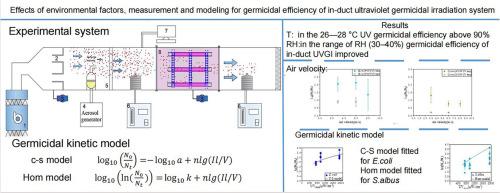
In-duct ultraviolet germicidal irradiation (UVGI) systems effectively decontaminate airborne microorganisms that are present in duct air. In this study, the main objectives were to determine the effects of temperature, relative humidity (RH), air velocity, and measurement on the germicidal efficiency of in-duct UVGI and to analyze three germicidal kinetic models. Staphylococcus albus and Escherichia coli were selected as the test bacteria. The maximum UV disinfection efficacy was observed in the temperature range of 26–28 °C and RH range of 30–40 %. The germicidal efficiency of the in-duct UVGI was negatively corelated with air velocity. When the UV lamps were arranged either parallel or vertical to the airflow, there were no obvious differences in-duct UVGI germicidal efficiency. In addition, three mathematical prediction models (C-W model, C-S model, Hom model) were chosen to predict the efficacy of in-duct UVGI in specific applications. The C-S model was fitted to predict the efficacy of E. coli, and the Hom model was fitted to predict that of Staphylococcus albus.





 京公网安备 11010802042870号
京ICP备2023020795号-1
京公网安备 11010802042870号
京ICP备2023020795号-1

 分享
分享
 求助内容:
求助内容: 应助结果提醒方式:
 扫码关注我们
