Keyang Wang, Shaobo Zhou, Yao Yao, Qi Sun, Yintao Wang
{"title":"考虑目标阻碍效应的目标防御-入侵博弈","authors":"Keyang Wang, Shaobo Zhou, Yao Yao, Qi Sun, Yintao Wang","doi":"10.1049/cth2.12630","DOIUrl":null,"url":null,"abstract":"<p>This paper considers the problem of a defender agent to guard the target area being attacked by a hostile agent. There are two different agents-intruder and defender here. The purpose of the defender is to prevent the intruder from approaching the target and if possible, catch the intruder. As the guardian object of the defender, the target area also obstructs its free movement. Therefore, a new geometric method is proposed to solve the problem. Firstly, the winning zones are constructed for the agents using two different methods. When the defender's initial position is in the defender's winning zone, the defender can capture the intruder. When the initial position of the defender is in the winning zone of the intruder, the intruder can successfully attack the target. Subsequently, a method is proposed for determining the dominance region boundary under the influence of target obstruction. Also, the winner can be ascertained by observing whether the dominance region boundary intersects the target area. The optimal strategy is then given according to the different payoff functions. Finally, some examples show the effectiveness of the method. In addition, the conditions and limitations for applying this method to other convex targets are provided.</p>","PeriodicalId":50382,"journal":{"name":"IET Control Theory and Applications","volume":"18 18","pages":"2660-2674"},"PeriodicalIF":2.3000,"publicationDate":"2024-02-26","publicationTypes":"Journal Article","fieldsOfStudy":null,"isOpenAccess":false,"openAccessPdf":"https://onlinelibrary.wiley.com/doi/epdf/10.1049/cth2.12630","citationCount":"0","resultStr":"{\"title\":\"A target defence-intrusion game with considering the obstructive effect of target\",\"authors\":\"Keyang Wang, Shaobo Zhou, Yao Yao, Qi Sun, Yintao Wang\",\"doi\":\"10.1049/cth2.12630\",\"DOIUrl\":null,\"url\":null,\"abstract\":\"<p>This paper considers the problem of a defender agent to guard the target area being attacked by a hostile agent. There are two different agents-intruder and defender here. The purpose of the defender is to prevent the intruder from approaching the target and if possible, catch the intruder. As the guardian object of the defender, the target area also obstructs its free movement. Therefore, a new geometric method is proposed to solve the problem. Firstly, the winning zones are constructed for the agents using two different methods. When the defender's initial position is in the defender's winning zone, the defender can capture the intruder. When the initial position of the defender is in the winning zone of the intruder, the intruder can successfully attack the target. Subsequently, a method is proposed for determining the dominance region boundary under the influence of target obstruction. Also, the winner can be ascertained by observing whether the dominance region boundary intersects the target area. The optimal strategy is then given according to the different payoff functions. Finally, some examples show the effectiveness of the method. In addition, the conditions and limitations for applying this method to other convex targets are provided.</p>\",\"PeriodicalId\":50382,\"journal\":{\"name\":\"IET Control Theory and Applications\",\"volume\":\"18 18\",\"pages\":\"2660-2674\"},\"PeriodicalIF\":2.3000,\"publicationDate\":\"2024-02-26\",\"publicationTypes\":\"Journal Article\",\"fieldsOfStudy\":null,\"isOpenAccess\":false,\"openAccessPdf\":\"https://onlinelibrary.wiley.com/doi/epdf/10.1049/cth2.12630\",\"citationCount\":\"0\",\"resultStr\":null,\"platform\":\"Semanticscholar\",\"paperid\":null,\"PeriodicalName\":\"IET Control Theory and Applications\",\"FirstCategoryId\":\"94\",\"ListUrlMain\":\"https://ietresearch.onlinelibrary.wiley.com/doi/10.1049/cth2.12630\",\"RegionNum\":4,\"RegionCategory\":\"计算机科学\",\"ArticlePicture\":[],\"TitleCN\":null,\"AbstractTextCN\":null,\"PMCID\":null,\"EPubDate\":\"\",\"PubModel\":\"\",\"JCR\":\"Q2\",\"JCRName\":\"AUTOMATION & CONTROL SYSTEMS\",\"Score\":null,\"Total\":0}","platform":"Semanticscholar","paperid":null,"PeriodicalName":"IET Control Theory and Applications","FirstCategoryId":"94","ListUrlMain":"https://ietresearch.onlinelibrary.wiley.com/doi/10.1049/cth2.12630","RegionNum":4,"RegionCategory":"计算机科学","ArticlePicture":[],"TitleCN":null,"AbstractTextCN":null,"PMCID":null,"EPubDate":"","PubModel":"","JCR":"Q2","JCRName":"AUTOMATION & CONTROL SYSTEMS","Score":null,"Total":0}
A target defence-intrusion game with considering the obstructive effect of target
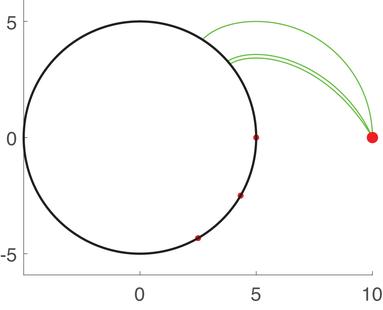
This paper considers the problem of a defender agent to guard the target area being attacked by a hostile agent. There are two different agents-intruder and defender here. The purpose of the defender is to prevent the intruder from approaching the target and if possible, catch the intruder. As the guardian object of the defender, the target area also obstructs its free movement. Therefore, a new geometric method is proposed to solve the problem. Firstly, the winning zones are constructed for the agents using two different methods. When the defender's initial position is in the defender's winning zone, the defender can capture the intruder. When the initial position of the defender is in the winning zone of the intruder, the intruder can successfully attack the target. Subsequently, a method is proposed for determining the dominance region boundary under the influence of target obstruction. Also, the winner can be ascertained by observing whether the dominance region boundary intersects the target area. The optimal strategy is then given according to the different payoff functions. Finally, some examples show the effectiveness of the method. In addition, the conditions and limitations for applying this method to other convex targets are provided.
期刊介绍:
IET Control Theory & Applications is devoted to control systems in the broadest sense, covering new theoretical results and the applications of new and established control methods. Among the topics of interest are system modelling, identification and simulation, the analysis and design of control systems (including computer-aided design), and practical implementation. The scope encompasses technological, economic, physiological (biomedical) and other systems, including man-machine interfaces.
Most of the papers published deal with original work from industrial and government laboratories and universities, but subject reviews and tutorial expositions of current methods are welcomed. Correspondence discussing published papers is also welcomed.
Applications papers need not necessarily involve new theory. Papers which describe new realisations of established methods, or control techniques applied in a novel situation, or practical studies which compare various designs, would be of interest. Of particular value are theoretical papers which discuss the applicability of new work or applications which engender new theoretical applications.





 京公网安备 11010802042870号
京ICP备2023020795号-1
京公网安备 11010802042870号
京ICP备2023020795号-1

 分享
分享
 求助内容:
求助内容: 应助结果提醒方式:
 扫码关注我们
