Huiqiang Li, Xiaochen Li, Lingyi Sun, Yanjie He, Li Wang, Yongju Gao, Dexing Zeng*, Xinchang Pang* and Junling Xu*,
{"title":"18F-放射标记和 AMD3465 衍生物用于小鼠乳腺肿瘤模型中 CXCR4 的 PET 成像评估","authors":"Huiqiang Li, Xiaochen Li, Lingyi Sun, Yanjie He, Li Wang, Yongju Gao, Dexing Zeng*, Xinchang Pang* and Junling Xu*, ","doi":"10.1021/acs.bioconjchem.4c00167","DOIUrl":null,"url":null,"abstract":"<p >The exploration of pharmaceutically active agents and positron emission tomography (PET) tracers targeting CXCR4 has been a focal point in cancer research given its pivotal role in the development and progression of various cancers. While significant strides have been made in PET imaging with radiometal-labeled tracers, the landscape of <sup>18</sup>F-labeled small molecule tracers remains relatively limited. Herein, we introduce a novel and promising derivative, [<sup>18</sup>F]SFB-AMD3465, as a targeted PET tracer for CXCR4. The compound was synthesized by modifying the pyridine ring of AMD3465, which was subsequently labeled with <sup>18</sup>F using [<sup>18</sup>F]SFB. The study provides comprehensive insights into the design, synthesis, and biological evaluation of [<sup>18</sup>F]SFB-AMD3465. <i>In vitro</i> and <i>in vivo</i> assessments demonstrated the CXCR4-dependent, specific, and sensitive uptake of [<sup>18</sup>F]SFB-AMD3465 in the CXCR4-overexpressing 4T1 cell line and the corresponding xenograft-bearing mouse model. These findings contribute to bridging the gap in <sup>18</sup>F-labeled PET tracers for CXCR4 and underscore the potential of [<sup>18</sup>F]SFB-AMD3465 as a PET radiotracer for <i>in vivo</i> CXCR4 imaging.</p>","PeriodicalId":29,"journal":{"name":"Bioconjugate Chemistry","volume":"35 5","pages":"567–574"},"PeriodicalIF":3.9000,"publicationDate":"2024-04-18","publicationTypes":"Journal Article","fieldsOfStudy":null,"isOpenAccess":false,"openAccessPdf":"","citationCount":"0","resultStr":"{\"title\":\"18F-Radiolabeling and Evaluation of an AMD3465 Derivative for PET Imaging of CXCR4 in a Mouse Breast Tumor Model\",\"authors\":\"Huiqiang Li, Xiaochen Li, Lingyi Sun, Yanjie He, Li Wang, Yongju Gao, Dexing Zeng*, Xinchang Pang* and Junling Xu*, \",\"doi\":\"10.1021/acs.bioconjchem.4c00167\",\"DOIUrl\":null,\"url\":null,\"abstract\":\"<p >The exploration of pharmaceutically active agents and positron emission tomography (PET) tracers targeting CXCR4 has been a focal point in cancer research given its pivotal role in the development and progression of various cancers. While significant strides have been made in PET imaging with radiometal-labeled tracers, the landscape of <sup>18</sup>F-labeled small molecule tracers remains relatively limited. Herein, we introduce a novel and promising derivative, [<sup>18</sup>F]SFB-AMD3465, as a targeted PET tracer for CXCR4. The compound was synthesized by modifying the pyridine ring of AMD3465, which was subsequently labeled with <sup>18</sup>F using [<sup>18</sup>F]SFB. The study provides comprehensive insights into the design, synthesis, and biological evaluation of [<sup>18</sup>F]SFB-AMD3465. <i>In vitro</i> and <i>in vivo</i> assessments demonstrated the CXCR4-dependent, specific, and sensitive uptake of [<sup>18</sup>F]SFB-AMD3465 in the CXCR4-overexpressing 4T1 cell line and the corresponding xenograft-bearing mouse model. These findings contribute to bridging the gap in <sup>18</sup>F-labeled PET tracers for CXCR4 and underscore the potential of [<sup>18</sup>F]SFB-AMD3465 as a PET radiotracer for <i>in vivo</i> CXCR4 imaging.</p>\",\"PeriodicalId\":29,\"journal\":{\"name\":\"Bioconjugate Chemistry\",\"volume\":\"35 5\",\"pages\":\"567–574\"},\"PeriodicalIF\":3.9000,\"publicationDate\":\"2024-04-18\",\"publicationTypes\":\"Journal Article\",\"fieldsOfStudy\":null,\"isOpenAccess\":false,\"openAccessPdf\":\"\",\"citationCount\":\"0\",\"resultStr\":null,\"platform\":\"Semanticscholar\",\"paperid\":null,\"PeriodicalName\":\"Bioconjugate Chemistry\",\"FirstCategoryId\":\"1\",\"ListUrlMain\":\"https://pubs.acs.org/doi/10.1021/acs.bioconjchem.4c00167\",\"RegionNum\":2,\"RegionCategory\":\"化学\",\"ArticlePicture\":[],\"TitleCN\":null,\"AbstractTextCN\":null,\"PMCID\":null,\"EPubDate\":\"\",\"PubModel\":\"\",\"JCR\":\"Q1\",\"JCRName\":\"BIOCHEMICAL RESEARCH METHODS\",\"Score\":null,\"Total\":0}","platform":"Semanticscholar","paperid":null,"PeriodicalName":"Bioconjugate Chemistry","FirstCategoryId":"1","ListUrlMain":"https://pubs.acs.org/doi/10.1021/acs.bioconjchem.4c00167","RegionNum":2,"RegionCategory":"化学","ArticlePicture":[],"TitleCN":null,"AbstractTextCN":null,"PMCID":null,"EPubDate":"","PubModel":"","JCR":"Q1","JCRName":"BIOCHEMICAL RESEARCH METHODS","Score":null,"Total":0}
18F-Radiolabeling and Evaluation of an AMD3465 Derivative for PET Imaging of CXCR4 in a Mouse Breast Tumor Model
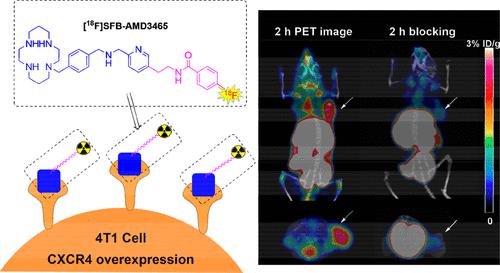
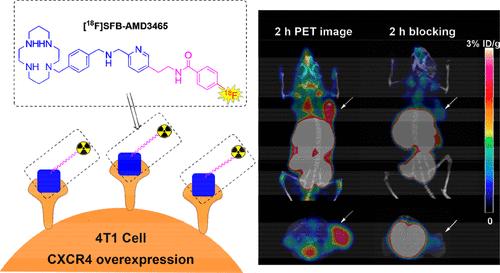
The exploration of pharmaceutically active agents and positron emission tomography (PET) tracers targeting CXCR4 has been a focal point in cancer research given its pivotal role in the development and progression of various cancers. While significant strides have been made in PET imaging with radiometal-labeled tracers, the landscape of 18F-labeled small molecule tracers remains relatively limited. Herein, we introduce a novel and promising derivative, [18F]SFB-AMD3465, as a targeted PET tracer for CXCR4. The compound was synthesized by modifying the pyridine ring of AMD3465, which was subsequently labeled with 18F using [18F]SFB. The study provides comprehensive insights into the design, synthesis, and biological evaluation of [18F]SFB-AMD3465. In vitro and in vivo assessments demonstrated the CXCR4-dependent, specific, and sensitive uptake of [18F]SFB-AMD3465 in the CXCR4-overexpressing 4T1 cell line and the corresponding xenograft-bearing mouse model. These findings contribute to bridging the gap in 18F-labeled PET tracers for CXCR4 and underscore the potential of [18F]SFB-AMD3465 as a PET radiotracer for in vivo CXCR4 imaging.
期刊介绍:
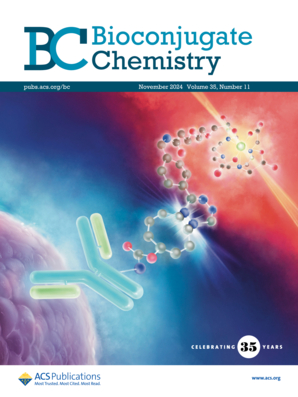
Bioconjugate Chemistry invites original contributions on all research at the interface between man-made and biological materials. The mission of the journal is to communicate to advances in fields including therapeutic delivery, imaging, bionanotechnology, and synthetic biology. Bioconjugate Chemistry is intended to provide a forum for presentation of research relevant to all aspects of bioconjugates, including the preparation, properties and applications of biomolecular conjugates.




 京公网安备 11010802042870号
京ICP备2023020795号-1
京公网安备 11010802042870号
京ICP备2023020795号-1

 分享
分享
 求助内容:
求助内容: 应助结果提醒方式:
 扫码关注我们
