K. Kaviyarasan, R. Soundararajan, S. Sivasankaran, A. Sathishkumar
{"title":"中熵和高熵合金填料对采用 GTAW 工艺连接的 AA5083 板材微观结构和腐蚀行为的影响","authors":"K. Kaviyarasan, R. Soundararajan, S. Sivasankaran, A. Sathishkumar","doi":"10.1007/s10853-024-09654-w","DOIUrl":null,"url":null,"abstract":"<div><p>The impact of medium- and high-entropy alloy fillers (4E MEA- Al<sub>0.25</sub>Fe<sub>0.25</sub>Ni<sub>0.25</sub>Cu<sub>0.25</sub>, and 5E HEA-Al<sub>0.20</sub>Fe<sub>0.20</sub>Ni<sub>0.20</sub>Cu<sub>0.20</sub>Ti<sub>0.20</sub>) on the microstructures and corrosion behaviour of AA5083 plates, joined through the GTAW process, is investigated. MEA and HEA fillers were fabricated using the CCW method, and ER5356 filler was used for comparison. This study delves into the alloy fillers’ influence on the resultant microstructural characteristics and corrosion resistance of the welded joints. XRD results on weld samples showcased the presence of FCC and BCC phases. The weldment EBSD data revealed unique grain morphologies: long columnar grains, coarse grains, and fine equiaxed grains in WZ, HAZ, and BM, respectively. Microstructural investigations of the weldment revealed heterogeneous structures with finely distributed grains and strong bonding between the AA5083 base metal and filler wires, influenced by constitutional elements. MEA and HEA weldments showed no intermetallic compounds or precipitates. In the ambient temperature potentiodynamic polarisation test, HEA’s polarisation resistance was 3.76 times greater, while MEA’s was 3.15 times higher than ER5356. The higher corrosion resistance is due to grain refinement, increased grain boundaries, and the formation of a strong passive film. Conversely, in the higher-temperature corrosion experiment, the mass loss for the 5E-HEA and MEA weldments was 4.87 and 3.09 times lower than that of the ER5356 weldments. The corroded surface morphology revealed that the ER5356 weldment had deeper pits, while the MEA and 5E-HEA weldments had pits of smaller sizes. The formation of oxidation film layers on the corroded surface improves the corrosion resistance. X-ray photoelectron spectroscopy (XPS) findings showed metal oxide layer depositions for all the weldments. Researchers observed that equimolar MEA and HEA filler wires can increase durability and be employed in shipbuilding sectors.</p><h3>Graphical Abstract</h3>\n<div><figure><div><div><picture><source><img></source></picture></div></div></figure></div></div>","PeriodicalId":645,"journal":{"name":"Journal of Materials Science","volume":"59 18","pages":""},"PeriodicalIF":4.4000,"publicationDate":"2024-04-25","publicationTypes":"Journal Article","fieldsOfStudy":null,"isOpenAccess":false,"openAccessPdf":"","citationCount":"0","resultStr":"{\"title\":\"Influence of medium- and high-entropy alloy fillers on microstructures and corrosion behaviour of AA5083 plates joined by GTAW process\",\"authors\":\"K. Kaviyarasan, R. Soundararajan, S. Sivasankaran, A. Sathishkumar\",\"doi\":\"10.1007/s10853-024-09654-w\",\"DOIUrl\":null,\"url\":null,\"abstract\":\"<div><p>The impact of medium- and high-entropy alloy fillers (4E MEA- Al<sub>0.25</sub>Fe<sub>0.25</sub>Ni<sub>0.25</sub>Cu<sub>0.25</sub>, and 5E HEA-Al<sub>0.20</sub>Fe<sub>0.20</sub>Ni<sub>0.20</sub>Cu<sub>0.20</sub>Ti<sub>0.20</sub>) on the microstructures and corrosion behaviour of AA5083 plates, joined through the GTAW process, is investigated. MEA and HEA fillers were fabricated using the CCW method, and ER5356 filler was used for comparison. This study delves into the alloy fillers’ influence on the resultant microstructural characteristics and corrosion resistance of the welded joints. XRD results on weld samples showcased the presence of FCC and BCC phases. The weldment EBSD data revealed unique grain morphologies: long columnar grains, coarse grains, and fine equiaxed grains in WZ, HAZ, and BM, respectively. Microstructural investigations of the weldment revealed heterogeneous structures with finely distributed grains and strong bonding between the AA5083 base metal and filler wires, influenced by constitutional elements. MEA and HEA weldments showed no intermetallic compounds or precipitates. In the ambient temperature potentiodynamic polarisation test, HEA’s polarisation resistance was 3.76 times greater, while MEA’s was 3.15 times higher than ER5356. The higher corrosion resistance is due to grain refinement, increased grain boundaries, and the formation of a strong passive film. Conversely, in the higher-temperature corrosion experiment, the mass loss for the 5E-HEA and MEA weldments was 4.87 and 3.09 times lower than that of the ER5356 weldments. The corroded surface morphology revealed that the ER5356 weldment had deeper pits, while the MEA and 5E-HEA weldments had pits of smaller sizes. The formation of oxidation film layers on the corroded surface improves the corrosion resistance. X-ray photoelectron spectroscopy (XPS) findings showed metal oxide layer depositions for all the weldments. Researchers observed that equimolar MEA and HEA filler wires can increase durability and be employed in shipbuilding sectors.</p><h3>Graphical Abstract</h3>\\n<div><figure><div><div><picture><source><img></source></picture></div></div></figure></div></div>\",\"PeriodicalId\":645,\"journal\":{\"name\":\"Journal of Materials Science\",\"volume\":\"59 18\",\"pages\":\"\"},\"PeriodicalIF\":4.4000,\"publicationDate\":\"2024-04-25\",\"publicationTypes\":\"Journal Article\",\"fieldsOfStudy\":null,\"isOpenAccess\":false,\"openAccessPdf\":\"\",\"citationCount\":\"0\",\"resultStr\":null,\"platform\":\"Semanticscholar\",\"paperid\":null,\"PeriodicalName\":\"Journal of Materials Science\",\"FirstCategoryId\":\"88\",\"ListUrlMain\":\"https://link.springer.com/article/10.1007/s10853-024-09654-w\",\"RegionNum\":3,\"RegionCategory\":\"材料科学\",\"ArticlePicture\":[],\"TitleCN\":null,\"AbstractTextCN\":null,\"PMCID\":null,\"EPubDate\":\"\",\"PubModel\":\"\",\"JCR\":\"Q2\",\"JCRName\":\"MATERIALS SCIENCE, MULTIDISCIPLINARY\",\"Score\":null,\"Total\":0}","platform":"Semanticscholar","paperid":null,"PeriodicalName":"Journal of Materials Science","FirstCategoryId":"88","ListUrlMain":"https://link.springer.com/article/10.1007/s10853-024-09654-w","RegionNum":3,"RegionCategory":"材料科学","ArticlePicture":[],"TitleCN":null,"AbstractTextCN":null,"PMCID":null,"EPubDate":"","PubModel":"","JCR":"Q2","JCRName":"MATERIALS SCIENCE, MULTIDISCIPLINARY","Score":null,"Total":0}
引用次数: 0
摘要
研究了中熵和高熵合金填料(4E MEA- Al0.25Fe0.25Ni0.25Cu0.25和 5E HEA-Al0.20Fe0.20Ni0.20Cu0.20Ti0.20)对通过 GTAW 工艺连接的 AA5083 板材的微观结构和腐蚀行为的影响。使用 CCW 方法制造了 MEA 和 HEA 填料,并使用 ER5356 填料进行对比。本研究深入探讨了合金填料对焊接接头的微观结构特征和耐腐蚀性能的影响。焊接样品的 XRD 结果显示了 FCC 和 BCC 相的存在。焊接件的 EBSD 数据显示了独特的晶粒形态:在 WZ、HAZ 和 BM 中分别存在长柱状晶粒、粗晶粒和细等轴晶粒。焊接件的微观结构研究表明,AA5083 母材和填充焊丝之间的异质结构具有细小分布的晶粒和强结合力,并受到成分元素的影响。MEA 和 HEA 焊件没有金属间化合物或析出物。在常温电位极化测试中,HEA 的极化电阻是 ER5356 的 3.76 倍,而 MEA 则是 ER5356 的 3.15 倍。较高的耐腐蚀性是由于晶粒细化、晶界增加以及形成了较强的被动膜。相反,在高温腐蚀实验中,5E-HEA 和 MEA 焊件的质量损失分别是 ER5356 焊件的 4.87 倍和 3.09 倍。腐蚀表面形态显示,ER5356 焊件的凹坑较深,而 MEA 和 5E-HEA 焊件的凹坑较小。腐蚀表面氧化膜层的形成提高了耐腐蚀性。X 射线光电子能谱 (XPS) 发现,所有焊接件都有金属氧化物层沉积。研究人员发现,等摩尔 MEA 和 HEA 填充丝可以提高耐久性,并可用于造船业。
Influence of medium- and high-entropy alloy fillers on microstructures and corrosion behaviour of AA5083 plates joined by GTAW process
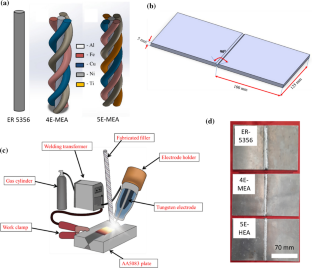
The impact of medium- and high-entropy alloy fillers (4E MEA- Al0.25Fe0.25Ni0.25Cu0.25, and 5E HEA-Al0.20Fe0.20Ni0.20Cu0.20Ti0.20) on the microstructures and corrosion behaviour of AA5083 plates, joined through the GTAW process, is investigated. MEA and HEA fillers were fabricated using the CCW method, and ER5356 filler was used for comparison. This study delves into the alloy fillers’ influence on the resultant microstructural characteristics and corrosion resistance of the welded joints. XRD results on weld samples showcased the presence of FCC and BCC phases. The weldment EBSD data revealed unique grain morphologies: long columnar grains, coarse grains, and fine equiaxed grains in WZ, HAZ, and BM, respectively. Microstructural investigations of the weldment revealed heterogeneous structures with finely distributed grains and strong bonding between the AA5083 base metal and filler wires, influenced by constitutional elements. MEA and HEA weldments showed no intermetallic compounds or precipitates. In the ambient temperature potentiodynamic polarisation test, HEA’s polarisation resistance was 3.76 times greater, while MEA’s was 3.15 times higher than ER5356. The higher corrosion resistance is due to grain refinement, increased grain boundaries, and the formation of a strong passive film. Conversely, in the higher-temperature corrosion experiment, the mass loss for the 5E-HEA and MEA weldments was 4.87 and 3.09 times lower than that of the ER5356 weldments. The corroded surface morphology revealed that the ER5356 weldment had deeper pits, while the MEA and 5E-HEA weldments had pits of smaller sizes. The formation of oxidation film layers on the corroded surface improves the corrosion resistance. X-ray photoelectron spectroscopy (XPS) findings showed metal oxide layer depositions for all the weldments. Researchers observed that equimolar MEA and HEA filler wires can increase durability and be employed in shipbuilding sectors.
期刊介绍:
The Journal of Materials Science publishes reviews, full-length papers, and short Communications recording original research results on, or techniques for studying the relationship between structure, properties, and uses of materials. The subjects are seen from international and interdisciplinary perspectives covering areas including metals, ceramics, glasses, polymers, electrical materials, composite materials, fibers, nanostructured materials, nanocomposites, and biological and biomedical materials. The Journal of Materials Science is now firmly established as the leading source of primary communication for scientists investigating the structure and properties of all engineering materials.




 京公网安备 11010802042870号
京ICP备2023020795号-1
京公网安备 11010802042870号
京ICP备2023020795号-1

 分享
分享
 求助内容:
求助内容: 应助结果提醒方式:
 扫码关注我们
