{"title":"生物可降解 WE43 合金在不同生理流速下的体外腐蚀行为","authors":"Jianwei Dai, Xiangang Zhang, Lu Zhang, Linjuan Zhan, Juyi Yang, Linyuan Han, Xuan Li, Zhijun Guo, Jing Bai, Feng Xue, Chenglin Chu","doi":"10.1007/s10853-024-09617-1","DOIUrl":null,"url":null,"abstract":"<div><p>In the present work, the influence of the simulated physiological flow field on the in vitro corrosion behavior of biodegradable WE43 (Mg-4.05 wt% Y-3.64 wt% RE-0.52 wt% Zr) magnesium alloy has been studied, using Hanks' balanced salt solution (HBSS) as the corrosion medium. The results indicate that the corrosion rate of WE43 alloy is time-dependent under each condition. After immersion for 168 h, the corrosion rate of WE43 alloy with a flow rate of 5.33 cm/s is about 3.49 mm/year, which is 1.7 times higher than that under static condition. The contradictory between the dynamic dissolution and re-deposition of the corrosion products is strongly related to the flow velocity. Initially, an accelerated mass transfer at a low flow rate would promote the corrosion layer generation of WE43 alloy, dominating the integrity of the corrosion layer, while continually high shear stress induced by a high flow rate field would destroy the integrity of the corrosion layer, primarily mitigate the thickness of the Ca-P layer. Owing to the corrosion product evolution and the influences of Cl<sup>−</sup>, the corrosion mode of the WE43 alloy herein transforms from localized corrosion to relatively uniform corrosion with the increase in flow rate.</p></div>","PeriodicalId":645,"journal":{"name":"Journal of Materials Science","volume":"59 18","pages":""},"PeriodicalIF":3.9000,"publicationDate":"2024-04-25","publicationTypes":"Journal Article","fieldsOfStudy":null,"isOpenAccess":false,"openAccessPdf":"","citationCount":"0","resultStr":"{\"title\":\"In vitro corrosion behavior of biodegradable WE43 alloy under various physiological flow velocities\",\"authors\":\"Jianwei Dai, Xiangang Zhang, Lu Zhang, Linjuan Zhan, Juyi Yang, Linyuan Han, Xuan Li, Zhijun Guo, Jing Bai, Feng Xue, Chenglin Chu\",\"doi\":\"10.1007/s10853-024-09617-1\",\"DOIUrl\":null,\"url\":null,\"abstract\":\"<div><p>In the present work, the influence of the simulated physiological flow field on the in vitro corrosion behavior of biodegradable WE43 (Mg-4.05 wt% Y-3.64 wt% RE-0.52 wt% Zr) magnesium alloy has been studied, using Hanks' balanced salt solution (HBSS) as the corrosion medium. The results indicate that the corrosion rate of WE43 alloy is time-dependent under each condition. After immersion for 168 h, the corrosion rate of WE43 alloy with a flow rate of 5.33 cm/s is about 3.49 mm/year, which is 1.7 times higher than that under static condition. The contradictory between the dynamic dissolution and re-deposition of the corrosion products is strongly related to the flow velocity. Initially, an accelerated mass transfer at a low flow rate would promote the corrosion layer generation of WE43 alloy, dominating the integrity of the corrosion layer, while continually high shear stress induced by a high flow rate field would destroy the integrity of the corrosion layer, primarily mitigate the thickness of the Ca-P layer. Owing to the corrosion product evolution and the influences of Cl<sup>−</sup>, the corrosion mode of the WE43 alloy herein transforms from localized corrosion to relatively uniform corrosion with the increase in flow rate.</p></div>\",\"PeriodicalId\":645,\"journal\":{\"name\":\"Journal of Materials Science\",\"volume\":\"59 18\",\"pages\":\"\"},\"PeriodicalIF\":3.9000,\"publicationDate\":\"2024-04-25\",\"publicationTypes\":\"Journal Article\",\"fieldsOfStudy\":null,\"isOpenAccess\":false,\"openAccessPdf\":\"\",\"citationCount\":\"0\",\"resultStr\":null,\"platform\":\"Semanticscholar\",\"paperid\":null,\"PeriodicalName\":\"Journal of Materials Science\",\"FirstCategoryId\":\"88\",\"ListUrlMain\":\"https://link.springer.com/article/10.1007/s10853-024-09617-1\",\"RegionNum\":3,\"RegionCategory\":\"材料科学\",\"ArticlePicture\":[],\"TitleCN\":null,\"AbstractTextCN\":null,\"PMCID\":null,\"EPubDate\":\"\",\"PubModel\":\"\",\"JCR\":\"Q2\",\"JCRName\":\"MATERIALS SCIENCE, MULTIDISCIPLINARY\",\"Score\":null,\"Total\":0}","platform":"Semanticscholar","paperid":null,"PeriodicalName":"Journal of Materials Science","FirstCategoryId":"88","ListUrlMain":"https://link.springer.com/article/10.1007/s10853-024-09617-1","RegionNum":3,"RegionCategory":"材料科学","ArticlePicture":[],"TitleCN":null,"AbstractTextCN":null,"PMCID":null,"EPubDate":"","PubModel":"","JCR":"Q2","JCRName":"MATERIALS SCIENCE, MULTIDISCIPLINARY","Score":null,"Total":0}
In vitro corrosion behavior of biodegradable WE43 alloy under various physiological flow velocities
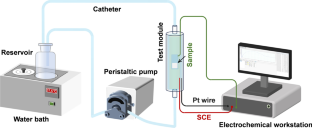
In the present work, the influence of the simulated physiological flow field on the in vitro corrosion behavior of biodegradable WE43 (Mg-4.05 wt% Y-3.64 wt% RE-0.52 wt% Zr) magnesium alloy has been studied, using Hanks' balanced salt solution (HBSS) as the corrosion medium. The results indicate that the corrosion rate of WE43 alloy is time-dependent under each condition. After immersion for 168 h, the corrosion rate of WE43 alloy with a flow rate of 5.33 cm/s is about 3.49 mm/year, which is 1.7 times higher than that under static condition. The contradictory between the dynamic dissolution and re-deposition of the corrosion products is strongly related to the flow velocity. Initially, an accelerated mass transfer at a low flow rate would promote the corrosion layer generation of WE43 alloy, dominating the integrity of the corrosion layer, while continually high shear stress induced by a high flow rate field would destroy the integrity of the corrosion layer, primarily mitigate the thickness of the Ca-P layer. Owing to the corrosion product evolution and the influences of Cl−, the corrosion mode of the WE43 alloy herein transforms from localized corrosion to relatively uniform corrosion with the increase in flow rate.
期刊介绍:
The Journal of Materials Science publishes reviews, full-length papers, and short Communications recording original research results on, or techniques for studying the relationship between structure, properties, and uses of materials. The subjects are seen from international and interdisciplinary perspectives covering areas including metals, ceramics, glasses, polymers, electrical materials, composite materials, fibers, nanostructured materials, nanocomposites, and biological and biomedical materials. The Journal of Materials Science is now firmly established as the leading source of primary communication for scientists investigating the structure and properties of all engineering materials.



 京公网安备 11010802042870号
京ICP备2023020795号-1
京公网安备 11010802042870号
京ICP备2023020795号-1

 分享
分享
 求助内容:
求助内容: 应助结果提醒方式:
 扫码关注我们
