ASGE AI Task Force, Sravanthi Parasa MD , Tyler Berzin MD , Cadman Leggett MD , Seth Gross MD , Alessandro Repici MD , Omer F. Ahmad MD , Austin Chiang MD , Nayantara Coelho-Prabhu MD , Jonathan Cohen MD , Evelien Dekker MD , Rajesh N. Keswani MD , Charles E. Kahn MD , Cesare Hassan PhD , Nicholas Petrick PhD , Peter Mountney MBBS , Jonathan Ng PhD , Michael Riegler PhD , Yuichi Mori MD, PhD , Yutaka Saito MD , Prateek Sharma MD
{"title":"就人工智能在内窥镜检查中的应用现状、解决障碍以及推进人工智能在消化内科中的应用发表共识声明。","authors":"ASGE AI Task Force, Sravanthi Parasa MD , Tyler Berzin MD , Cadman Leggett MD , Seth Gross MD , Alessandro Repici MD , Omer F. Ahmad MD , Austin Chiang MD , Nayantara Coelho-Prabhu MD , Jonathan Cohen MD , Evelien Dekker MD , Rajesh N. Keswani MD , Charles E. Kahn MD , Cesare Hassan PhD , Nicholas Petrick PhD , Peter Mountney MBBS , Jonathan Ng PhD , Michael Riegler PhD , Yuichi Mori MD, PhD , Yutaka Saito MD , Prateek Sharma MD","doi":"10.1016/j.gie.2023.12.003","DOIUrl":null,"url":null,"abstract":"<div><h3>Background and Aims</h3><div>The American Society for Gastrointestinal Endoscopy (ASGE) AI Task Force along with experts in endoscopy, technology space, regulatory authorities, and other medical subspecialties initiated a consensus process that analyzed the current literature, highlighted potential areas, and outlined the necessary research in artificial intelligence (AI) to allow a clearer understanding of AI as it pertains to endoscopy currently.</div></div><div><h3>Methods</h3><div>A modified Delphi process was used to develop these consensus statements.</div></div><div><h3>Results</h3><div><em>Statement 1</em>: Current advances in AI allow for the development of AI-based algorithms that can be applied to endoscopy to augment endoscopist performance in detection and characterization of endoscopic lesions. <em>Statement 2:</em> Computer vision–based algorithms provide opportunities to redefine quality metrics in endoscopy using AI, which can be standardized and can reduce subjectivity in reporting quality metrics. Natural language processing–based algorithms can help with the data abstraction needed for reporting current quality metrics in GI endoscopy effortlessly. <em>Statement 3:</em> AI technologies can support smart endoscopy suites, which may help optimize workflows in the endoscopy suite, including automated documentation. <em>Statement 4:</em> Using AI and machine learning helps in predictive modeling, diagnosis, and prognostication. High-quality data with multidimensionality are needed for risk prediction, prognostication of specific clinical conditions, and their outcomes when using machine learning methods. <em>Statement 5:</em> Big data and cloud-based tools can help advance clinical research in gastroenterology. Multimodal data are key to understanding the maximal extent of the disease state and unlocking treatment options. <em>Statement 6:</em> Understanding how to evaluate AI algorithms in the gastroenterology literature and clinical trials is important for gastroenterologists, trainees, and researchers, and hence education efforts by GI societies are needed. <em>Statement 7:</em> Several challenges regarding integrating AI solutions into the clinical practice of endoscopy exist, including understanding the role of human–AI interaction. Transparency, interpretability, and explainability of AI algorithms play a key role in their clinical adoption in GI endoscopy. Developing appropriate AI governance, data procurement, and tools needed for the AI lifecycle are critical for the successful implementation of AI into clinical practice. <em>Statement 8:</em> For payment of AI in endoscopy, a thorough evaluation of the potential value proposition for AI systems may help guide purchasing decisions in endoscopy. Reliable cost-effectiveness studies to guide reimbursement are needed. <em>Statement 9:</em> Relevant clinical outcomes and performance metrics for AI in gastroenterology are currently not well defined. To improve the quality and interpretability of research in the field, steps need to be taken to define these evidence standards. <em>Statement 10:</em> A balanced view of AI technologies and active collaboration between the medical technology industry, computer scientists, gastroenterologists, and researchers are critical for the meaningful advancement of AI in gastroenterology.</div></div><div><h3>Conclusions</h3><div>The consensus process led by the ASGE AI Task Force and experts from various disciplines has shed light on the potential of AI in endoscopy and gastroenterology. AI-based algorithms have shown promise in augmenting endoscopist performance, redefining quality metrics, optimizing workflows, and aiding in predictive modeling and diagnosis. However, challenges remain in evaluating AI algorithms, ensuring transparency and interpretability, addressing governance and data procurement, determining payment models, defining relevant clinical outcomes, and fostering collaboration between stakeholders. Addressing these challenges while maintaining a balanced perspective is crucial for the meaningful advancement of AI in gastroenterology.</div></div>","PeriodicalId":12542,"journal":{"name":"Gastrointestinal endoscopy","volume":"101 1","pages":"Pages 2-9.e1"},"PeriodicalIF":7.5000,"publicationDate":"2025-01-01","publicationTypes":"Journal Article","fieldsOfStudy":null,"isOpenAccess":false,"openAccessPdf":"","citationCount":"0","resultStr":"{\"title\":\"Consensus statements on the current landscape of artificial intelligence applications in endoscopy, addressing roadblocks, and advancing artificial intelligence in gastroenterology\",\"authors\":\"ASGE AI Task Force, Sravanthi Parasa MD , Tyler Berzin MD , Cadman Leggett MD , Seth Gross MD , Alessandro Repici MD , Omer F. Ahmad MD , Austin Chiang MD , Nayantara Coelho-Prabhu MD , Jonathan Cohen MD , Evelien Dekker MD , Rajesh N. Keswani MD , Charles E. Kahn MD , Cesare Hassan PhD , Nicholas Petrick PhD , Peter Mountney MBBS , Jonathan Ng PhD , Michael Riegler PhD , Yuichi Mori MD, PhD , Yutaka Saito MD , Prateek Sharma MD\",\"doi\":\"10.1016/j.gie.2023.12.003\",\"DOIUrl\":null,\"url\":null,\"abstract\":\"<div><h3>Background and Aims</h3><div>The American Society for Gastrointestinal Endoscopy (ASGE) AI Task Force along with experts in endoscopy, technology space, regulatory authorities, and other medical subspecialties initiated a consensus process that analyzed the current literature, highlighted potential areas, and outlined the necessary research in artificial intelligence (AI) to allow a clearer understanding of AI as it pertains to endoscopy currently.</div></div><div><h3>Methods</h3><div>A modified Delphi process was used to develop these consensus statements.</div></div><div><h3>Results</h3><div><em>Statement 1</em>: Current advances in AI allow for the development of AI-based algorithms that can be applied to endoscopy to augment endoscopist performance in detection and characterization of endoscopic lesions. <em>Statement 2:</em> Computer vision–based algorithms provide opportunities to redefine quality metrics in endoscopy using AI, which can be standardized and can reduce subjectivity in reporting quality metrics. Natural language processing–based algorithms can help with the data abstraction needed for reporting current quality metrics in GI endoscopy effortlessly. <em>Statement 3:</em> AI technologies can support smart endoscopy suites, which may help optimize workflows in the endoscopy suite, including automated documentation. <em>Statement 4:</em> Using AI and machine learning helps in predictive modeling, diagnosis, and prognostication. High-quality data with multidimensionality are needed for risk prediction, prognostication of specific clinical conditions, and their outcomes when using machine learning methods. <em>Statement 5:</em> Big data and cloud-based tools can help advance clinical research in gastroenterology. Multimodal data are key to understanding the maximal extent of the disease state and unlocking treatment options. <em>Statement 6:</em> Understanding how to evaluate AI algorithms in the gastroenterology literature and clinical trials is important for gastroenterologists, trainees, and researchers, and hence education efforts by GI societies are needed. <em>Statement 7:</em> Several challenges regarding integrating AI solutions into the clinical practice of endoscopy exist, including understanding the role of human–AI interaction. Transparency, interpretability, and explainability of AI algorithms play a key role in their clinical adoption in GI endoscopy. Developing appropriate AI governance, data procurement, and tools needed for the AI lifecycle are critical for the successful implementation of AI into clinical practice. <em>Statement 8:</em> For payment of AI in endoscopy, a thorough evaluation of the potential value proposition for AI systems may help guide purchasing decisions in endoscopy. Reliable cost-effectiveness studies to guide reimbursement are needed. <em>Statement 9:</em> Relevant clinical outcomes and performance metrics for AI in gastroenterology are currently not well defined. To improve the quality and interpretability of research in the field, steps need to be taken to define these evidence standards. <em>Statement 10:</em> A balanced view of AI technologies and active collaboration between the medical technology industry, computer scientists, gastroenterologists, and researchers are critical for the meaningful advancement of AI in gastroenterology.</div></div><div><h3>Conclusions</h3><div>The consensus process led by the ASGE AI Task Force and experts from various disciplines has shed light on the potential of AI in endoscopy and gastroenterology. AI-based algorithms have shown promise in augmenting endoscopist performance, redefining quality metrics, optimizing workflows, and aiding in predictive modeling and diagnosis. However, challenges remain in evaluating AI algorithms, ensuring transparency and interpretability, addressing governance and data procurement, determining payment models, defining relevant clinical outcomes, and fostering collaboration between stakeholders. Addressing these challenges while maintaining a balanced perspective is crucial for the meaningful advancement of AI in gastroenterology.</div></div>\",\"PeriodicalId\":12542,\"journal\":{\"name\":\"Gastrointestinal endoscopy\",\"volume\":\"101 1\",\"pages\":\"Pages 2-9.e1\"},\"PeriodicalIF\":7.5000,\"publicationDate\":\"2025-01-01\",\"publicationTypes\":\"Journal Article\",\"fieldsOfStudy\":null,\"isOpenAccess\":false,\"openAccessPdf\":\"\",\"citationCount\":\"0\",\"resultStr\":null,\"platform\":\"Semanticscholar\",\"paperid\":null,\"PeriodicalName\":\"Gastrointestinal endoscopy\",\"FirstCategoryId\":\"3\",\"ListUrlMain\":\"https://www.sciencedirect.com/science/article/pii/S0016510723031395\",\"RegionNum\":1,\"RegionCategory\":\"医学\",\"ArticlePicture\":[],\"TitleCN\":null,\"AbstractTextCN\":null,\"PMCID\":null,\"EPubDate\":\"2024/4/17 0:00:00\",\"PubModel\":\"Epub\",\"JCR\":\"Q1\",\"JCRName\":\"GASTROENTEROLOGY & HEPATOLOGY\",\"Score\":null,\"Total\":0}","platform":"Semanticscholar","paperid":null,"PeriodicalName":"Gastrointestinal endoscopy","FirstCategoryId":"3","ListUrlMain":"https://www.sciencedirect.com/science/article/pii/S0016510723031395","RegionNum":1,"RegionCategory":"医学","ArticlePicture":[],"TitleCN":null,"AbstractTextCN":null,"PMCID":null,"EPubDate":"2024/4/17 0:00:00","PubModel":"Epub","JCR":"Q1","JCRName":"GASTROENTEROLOGY & HEPATOLOGY","Score":null,"Total":0}
Consensus statements on the current landscape of artificial intelligence applications in endoscopy, addressing roadblocks, and advancing artificial intelligence in gastroenterology
Background and Aims
The American Society for Gastrointestinal Endoscopy (ASGE) AI Task Force along with experts in endoscopy, technology space, regulatory authorities, and other medical subspecialties initiated a consensus process that analyzed the current literature, highlighted potential areas, and outlined the necessary research in artificial intelligence (AI) to allow a clearer understanding of AI as it pertains to endoscopy currently.
Methods
A modified Delphi process was used to develop these consensus statements.
Results
Statement 1: Current advances in AI allow for the development of AI-based algorithms that can be applied to endoscopy to augment endoscopist performance in detection and characterization of endoscopic lesions. Statement 2: Computer vision–based algorithms provide opportunities to redefine quality metrics in endoscopy using AI, which can be standardized and can reduce subjectivity in reporting quality metrics. Natural language processing–based algorithms can help with the data abstraction needed for reporting current quality metrics in GI endoscopy effortlessly. Statement 3: AI technologies can support smart endoscopy suites, which may help optimize workflows in the endoscopy suite, including automated documentation. Statement 4: Using AI and machine learning helps in predictive modeling, diagnosis, and prognostication. High-quality data with multidimensionality are needed for risk prediction, prognostication of specific clinical conditions, and their outcomes when using machine learning methods. Statement 5: Big data and cloud-based tools can help advance clinical research in gastroenterology. Multimodal data are key to understanding the maximal extent of the disease state and unlocking treatment options. Statement 6: Understanding how to evaluate AI algorithms in the gastroenterology literature and clinical trials is important for gastroenterologists, trainees, and researchers, and hence education efforts by GI societies are needed. Statement 7: Several challenges regarding integrating AI solutions into the clinical practice of endoscopy exist, including understanding the role of human–AI interaction. Transparency, interpretability, and explainability of AI algorithms play a key role in their clinical adoption in GI endoscopy. Developing appropriate AI governance, data procurement, and tools needed for the AI lifecycle are critical for the successful implementation of AI into clinical practice. Statement 8: For payment of AI in endoscopy, a thorough evaluation of the potential value proposition for AI systems may help guide purchasing decisions in endoscopy. Reliable cost-effectiveness studies to guide reimbursement are needed. Statement 9: Relevant clinical outcomes and performance metrics for AI in gastroenterology are currently not well defined. To improve the quality and interpretability of research in the field, steps need to be taken to define these evidence standards. Statement 10: A balanced view of AI technologies and active collaboration between the medical technology industry, computer scientists, gastroenterologists, and researchers are critical for the meaningful advancement of AI in gastroenterology.
Conclusions
The consensus process led by the ASGE AI Task Force and experts from various disciplines has shed light on the potential of AI in endoscopy and gastroenterology. AI-based algorithms have shown promise in augmenting endoscopist performance, redefining quality metrics, optimizing workflows, and aiding in predictive modeling and diagnosis. However, challenges remain in evaluating AI algorithms, ensuring transparency and interpretability, addressing governance and data procurement, determining payment models, defining relevant clinical outcomes, and fostering collaboration between stakeholders. Addressing these challenges while maintaining a balanced perspective is crucial for the meaningful advancement of AI in gastroenterology.
期刊介绍:
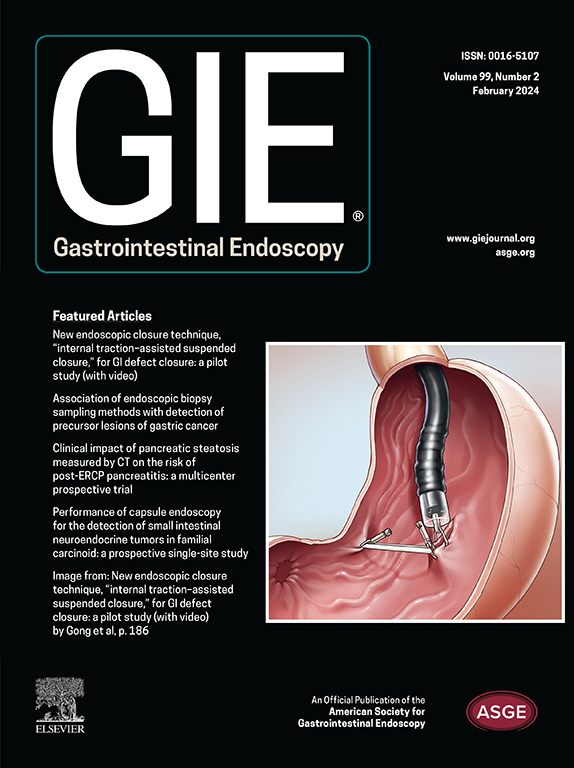
Gastrointestinal Endoscopy is a journal publishing original, peer-reviewed articles on endoscopic procedures for studying, diagnosing, and treating digestive diseases. It covers outcomes research, prospective studies, and controlled trials of new endoscopic instruments and treatment methods. The online features include full-text articles, video and audio clips, and MEDLINE links. The journal serves as an international forum for the latest developments in the specialty, offering challenging reports from authorities worldwide. It also publishes abstracts of significant articles from other clinical publications, accompanied by expert commentaries.




 京公网安备 11010802042870号
京ICP备2023020795号-1
京公网安备 11010802042870号
京ICP备2023020795号-1

 分享
分享
 求助内容:
求助内容: 应助结果提醒方式:
 扫码关注我们
