Taiba Bashir, Joydeep Dutta, Shaista Masarat, George Z. Kyzas
{"title":"木质素改性壳聚糖珠的制备与表征","authors":"Taiba Bashir, Joydeep Dutta, Shaista Masarat, George Z. Kyzas","doi":"10.1007/s10450-024-00478-3","DOIUrl":null,"url":null,"abstract":"<div><p>A simple manual flow injection method was used to formulate chitosan-lignin composite beads in a ratio of 1:1. The beads were then characterized using FT-IR (Fourier Transform Infrared Spectroscopy), SEM (Scanning Electron Microscopy), TGA (Thermogravimetric Analysis), and XRD (X-ray Diffraction). The FT-IR results indicate the chemical composition, revealing the presence of C-O, NH, C-H, and OH on chitosan, as well as OH, C-O-C, C = C, -O-CH3, and C-H, showing the presence and dispersion of lignin within chitosan molecules. SEM was useful for looking at the surface shape and showed structural differences between pure chitosan (which had a smooth surface with few holes) and composite beads (which had sharp edges and a rough, wrinkled shape). The TGA sheds light on the thermal stability and degradation properties of the beads. The thermograms show a similar pattern; however, the degradation temperature improved with the addition of lignin. An XRD investigation revealed the crystalline nature of the beads. Chitosan beads showed a sharp peak at 2<i>θ</i> = 21.8°, whereas in composites, the first peak was observed at 2<i>θ</i> = 9.9° second at 2<i>θ</i> = 20.130° and the third at 2<i>θ</i> = 28°. These findings allowed for the possibility that chitosan/lignin composite beads may be a good adsorbent for use in wastewater treatment systems.</p></div>","PeriodicalId":458,"journal":{"name":"Adsorption","volume":"30 6","pages":"947 - 955"},"PeriodicalIF":3.1000,"publicationDate":"2024-04-29","publicationTypes":"Journal Article","fieldsOfStudy":null,"isOpenAccess":false,"openAccessPdf":"","citationCount":"0","resultStr":"{\"title\":\"Formulation and characterization of lignin modified chitosan beads\",\"authors\":\"Taiba Bashir, Joydeep Dutta, Shaista Masarat, George Z. Kyzas\",\"doi\":\"10.1007/s10450-024-00478-3\",\"DOIUrl\":null,\"url\":null,\"abstract\":\"<div><p>A simple manual flow injection method was used to formulate chitosan-lignin composite beads in a ratio of 1:1. The beads were then characterized using FT-IR (Fourier Transform Infrared Spectroscopy), SEM (Scanning Electron Microscopy), TGA (Thermogravimetric Analysis), and XRD (X-ray Diffraction). The FT-IR results indicate the chemical composition, revealing the presence of C-O, NH, C-H, and OH on chitosan, as well as OH, C-O-C, C = C, -O-CH3, and C-H, showing the presence and dispersion of lignin within chitosan molecules. SEM was useful for looking at the surface shape and showed structural differences between pure chitosan (which had a smooth surface with few holes) and composite beads (which had sharp edges and a rough, wrinkled shape). The TGA sheds light on the thermal stability and degradation properties of the beads. The thermograms show a similar pattern; however, the degradation temperature improved with the addition of lignin. An XRD investigation revealed the crystalline nature of the beads. Chitosan beads showed a sharp peak at 2<i>θ</i> = 21.8°, whereas in composites, the first peak was observed at 2<i>θ</i> = 9.9° second at 2<i>θ</i> = 20.130° and the third at 2<i>θ</i> = 28°. These findings allowed for the possibility that chitosan/lignin composite beads may be a good adsorbent for use in wastewater treatment systems.</p></div>\",\"PeriodicalId\":458,\"journal\":{\"name\":\"Adsorption\",\"volume\":\"30 6\",\"pages\":\"947 - 955\"},\"PeriodicalIF\":3.1000,\"publicationDate\":\"2024-04-29\",\"publicationTypes\":\"Journal Article\",\"fieldsOfStudy\":null,\"isOpenAccess\":false,\"openAccessPdf\":\"\",\"citationCount\":\"0\",\"resultStr\":null,\"platform\":\"Semanticscholar\",\"paperid\":null,\"PeriodicalName\":\"Adsorption\",\"FirstCategoryId\":\"5\",\"ListUrlMain\":\"https://link.springer.com/article/10.1007/s10450-024-00478-3\",\"RegionNum\":4,\"RegionCategory\":\"工程技术\",\"ArticlePicture\":[],\"TitleCN\":null,\"AbstractTextCN\":null,\"PMCID\":null,\"EPubDate\":\"\",\"PubModel\":\"\",\"JCR\":\"Q3\",\"JCRName\":\"CHEMISTRY, PHYSICAL\",\"Score\":null,\"Total\":0}","platform":"Semanticscholar","paperid":null,"PeriodicalName":"Adsorption","FirstCategoryId":"5","ListUrlMain":"https://link.springer.com/article/10.1007/s10450-024-00478-3","RegionNum":4,"RegionCategory":"工程技术","ArticlePicture":[],"TitleCN":null,"AbstractTextCN":null,"PMCID":null,"EPubDate":"","PubModel":"","JCR":"Q3","JCRName":"CHEMISTRY, PHYSICAL","Score":null,"Total":0}
Formulation and characterization of lignin modified chitosan beads
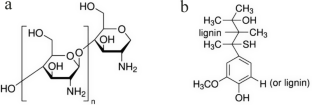
A simple manual flow injection method was used to formulate chitosan-lignin composite beads in a ratio of 1:1. The beads were then characterized using FT-IR (Fourier Transform Infrared Spectroscopy), SEM (Scanning Electron Microscopy), TGA (Thermogravimetric Analysis), and XRD (X-ray Diffraction). The FT-IR results indicate the chemical composition, revealing the presence of C-O, NH, C-H, and OH on chitosan, as well as OH, C-O-C, C = C, -O-CH3, and C-H, showing the presence and dispersion of lignin within chitosan molecules. SEM was useful for looking at the surface shape and showed structural differences between pure chitosan (which had a smooth surface with few holes) and composite beads (which had sharp edges and a rough, wrinkled shape). The TGA sheds light on the thermal stability and degradation properties of the beads. The thermograms show a similar pattern; however, the degradation temperature improved with the addition of lignin. An XRD investigation revealed the crystalline nature of the beads. Chitosan beads showed a sharp peak at 2θ = 21.8°, whereas in composites, the first peak was observed at 2θ = 9.9° second at 2θ = 20.130° and the third at 2θ = 28°. These findings allowed for the possibility that chitosan/lignin composite beads may be a good adsorbent for use in wastewater treatment systems.
期刊介绍:
The journal Adsorption provides authoritative information on adsorption and allied fields to scientists, engineers, and technologists throughout the world. The information takes the form of peer-reviewed articles, R&D notes, topical review papers, tutorial papers, book reviews, meeting announcements, and news.
Coverage includes fundamental and practical aspects of adsorption: mathematics, thermodynamics, chemistry, and physics, as well as processes, applications, models engineering, and equipment design.
Among the topics are Adsorbents: new materials, new synthesis techniques, characterization of structure and properties, and applications; Equilibria: novel theories or semi-empirical models, experimental data, and new measurement methods; Kinetics: new models, experimental data, and measurement methods. Processes: chemical, biochemical, environmental, and other applications, purification or bulk separation, fixed bed or moving bed systems, simulations, experiments, and design procedures.





 京公网安备 11010802042870号
京ICP备2023020795号-1
京公网安备 11010802042870号
京ICP备2023020795号-1

 分享
分享
 求助内容:
求助内容: 应助结果提醒方式:
 扫码关注我们
