Ziao Zeng , Chella Krishna Vadivel , Maria Gluud , Martin R.J. Namini , Lang Yan , Sana Ahmad , Morten Bagge Hansen , Jonathan Coquet , Tomas Mustelin , Sergei B. Koralov , Charlotte Menne Bonefeld , Anders Woetmann , Carsten Geisler , Emmanuella Guenova , Maria R. Kamstrup , Thomas Litman , Lise-Mette R. Gjerdrum , Terkild B. Buus , Niels Ødum
{"title":"角质细胞呈现金黄色葡萄球菌肠毒素,促进皮肤 T 细胞淋巴瘤中恶性和非恶性 T 细胞的增殖。","authors":"Ziao Zeng , Chella Krishna Vadivel , Maria Gluud , Martin R.J. Namini , Lang Yan , Sana Ahmad , Morten Bagge Hansen , Jonathan Coquet , Tomas Mustelin , Sergei B. Koralov , Charlotte Menne Bonefeld , Anders Woetmann , Carsten Geisler , Emmanuella Guenova , Maria R. Kamstrup , Thomas Litman , Lise-Mette R. Gjerdrum , Terkild B. Buus , Niels Ødum","doi":"10.1016/j.jid.2024.04.018","DOIUrl":null,"url":null,"abstract":"<div><div>Cutaneous T-cell lymphoma is characterized by malignant T cells proliferating in a unique tumor microenvironment dominated by keratinocytes (KCs). Skin colonization and infection by <em>Staphylococcus aureus</em> are a common cause of morbidity and are suspected of fueling disease activity. In this study, we show that expression of HLA-DRs, high-affinity receptors for staphylococcal enterotoxins (SEs), by KCs correlates with IFN-γ expression in the tumor microenvironment. Importantly, IFN-γ induces HLA-DR, SE binding, and SE presentation by KCs to malignant T cells from patients with Sézary syndrome and malignant and nonmalignant T-cell lines derived from patients with Sézary syndrome and mycosis fungoides. Likewise, preincubation of KCs with supernatant from patient-derived SE-producing <em>S aureus</em> triggers proliferation in malignant T cells and cytokine release (including IL-2), when cultured with nonmalignant T cells. This is inhibited by pretreatment with engineered bacteriophage <em>S aureus–</em>specific endolysins. Furthermore, alteration in the HLA-DR–binding sites of SE type A and small interfering RNA–mediated knockdown of Jak3 and IL-2Rγ block induction of malignant T-cell proliferation. In conclusion, we show that upon exposure to patient-derived <em>S aureus</em> and SE, KCs stimulate IL-2Rγ/Jak3–dependent proliferation of malignant and nonmalignant T cells in an environment with nonmalignant T cells. These findings suggest that KCs in the tumor microenvironment play a key role in <em>S aureus</em>–mediated disease activity in cutaneous T-cell lymphoma.</div></div>","PeriodicalId":16311,"journal":{"name":"Journal of Investigative Dermatology","volume":"144 12","pages":"Pages 2789-2804.e10"},"PeriodicalIF":7.0000,"publicationDate":"2024-12-01","publicationTypes":"Journal Article","fieldsOfStudy":null,"isOpenAccess":false,"openAccessPdf":"","citationCount":"0","resultStr":"{\"title\":\"Keratinocytes Present Staphylococcus aureus Enterotoxins and Promote Malignant and Nonmalignant T Cell Proliferation in Cutaneous T-Cell Lymphoma\",\"authors\":\"Ziao Zeng , Chella Krishna Vadivel , Maria Gluud , Martin R.J. Namini , Lang Yan , Sana Ahmad , Morten Bagge Hansen , Jonathan Coquet , Tomas Mustelin , Sergei B. Koralov , Charlotte Menne Bonefeld , Anders Woetmann , Carsten Geisler , Emmanuella Guenova , Maria R. Kamstrup , Thomas Litman , Lise-Mette R. Gjerdrum , Terkild B. Buus , Niels Ødum\",\"doi\":\"10.1016/j.jid.2024.04.018\",\"DOIUrl\":null,\"url\":null,\"abstract\":\"<div><div>Cutaneous T-cell lymphoma is characterized by malignant T cells proliferating in a unique tumor microenvironment dominated by keratinocytes (KCs). Skin colonization and infection by <em>Staphylococcus aureus</em> are a common cause of morbidity and are suspected of fueling disease activity. In this study, we show that expression of HLA-DRs, high-affinity receptors for staphylococcal enterotoxins (SEs), by KCs correlates with IFN-γ expression in the tumor microenvironment. Importantly, IFN-γ induces HLA-DR, SE binding, and SE presentation by KCs to malignant T cells from patients with Sézary syndrome and malignant and nonmalignant T-cell lines derived from patients with Sézary syndrome and mycosis fungoides. Likewise, preincubation of KCs with supernatant from patient-derived SE-producing <em>S aureus</em> triggers proliferation in malignant T cells and cytokine release (including IL-2), when cultured with nonmalignant T cells. This is inhibited by pretreatment with engineered bacteriophage <em>S aureus–</em>specific endolysins. Furthermore, alteration in the HLA-DR–binding sites of SE type A and small interfering RNA–mediated knockdown of Jak3 and IL-2Rγ block induction of malignant T-cell proliferation. In conclusion, we show that upon exposure to patient-derived <em>S aureus</em> and SE, KCs stimulate IL-2Rγ/Jak3–dependent proliferation of malignant and nonmalignant T cells in an environment with nonmalignant T cells. These findings suggest that KCs in the tumor microenvironment play a key role in <em>S aureus</em>–mediated disease activity in cutaneous T-cell lymphoma.</div></div>\",\"PeriodicalId\":16311,\"journal\":{\"name\":\"Journal of Investigative Dermatology\",\"volume\":\"144 12\",\"pages\":\"Pages 2789-2804.e10\"},\"PeriodicalIF\":7.0000,\"publicationDate\":\"2024-12-01\",\"publicationTypes\":\"Journal Article\",\"fieldsOfStudy\":null,\"isOpenAccess\":false,\"openAccessPdf\":\"\",\"citationCount\":\"0\",\"resultStr\":null,\"platform\":\"Semanticscholar\",\"paperid\":null,\"PeriodicalName\":\"Journal of Investigative Dermatology\",\"FirstCategoryId\":\"3\",\"ListUrlMain\":\"https://www.sciencedirect.com/science/article/pii/S0022202X24003774\",\"RegionNum\":2,\"RegionCategory\":\"医学\",\"ArticlePicture\":[],\"TitleCN\":null,\"AbstractTextCN\":null,\"PMCID\":null,\"EPubDate\":\"2024/5/16 0:00:00\",\"PubModel\":\"Epub\",\"JCR\":\"Q1\",\"JCRName\":\"DERMATOLOGY\",\"Score\":null,\"Total\":0}","platform":"Semanticscholar","paperid":null,"PeriodicalName":"Journal of Investigative Dermatology","FirstCategoryId":"3","ListUrlMain":"https://www.sciencedirect.com/science/article/pii/S0022202X24003774","RegionNum":2,"RegionCategory":"医学","ArticlePicture":[],"TitleCN":null,"AbstractTextCN":null,"PMCID":null,"EPubDate":"2024/5/16 0:00:00","PubModel":"Epub","JCR":"Q1","JCRName":"DERMATOLOGY","Score":null,"Total":0}
引用次数: 0
摘要
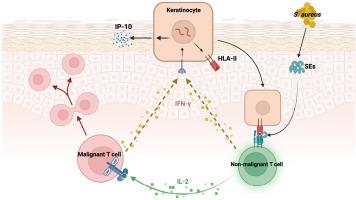
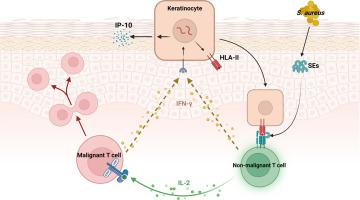
皮肤 T 细胞淋巴瘤(CTCL)的特点是恶性 T 细胞在以角质形成细胞为主的独特肿瘤微环境(TME)中增殖。金黄色葡萄球菌(S. aureus)的皮肤定植和感染是发病的常见原因,并被怀疑助长了疾病的活动。在这里,我们发现角朊细胞表达的葡萄球菌肠毒素(SE)高亲和力受体 HLA-DR 与 IFN-γ 在 TME 中的表达相关。重要的是,IFN-γ 能诱导 HLA-DR、SE 结合以及角朊细胞向来自塞扎里综合征(SS)患者的恶性 T 细胞、来自塞扎里综合征和放线菌病患者的恶性和非恶性 T 细胞系呈递 SE。同样,用源自患者的产SE金黄色葡萄球菌的上清液预孵育角朊细胞,当与非恶性T细胞一起培养时,会引发恶性T细胞的增殖和细胞因子的释放(包括IL-2)。用工程噬菌体金黄色葡萄球菌特异性内溶素进行预处理可抑制这种情况。此外,SE-A 型 HLA-DR 结合位点的突变以及 siRNA 介导的 Janus 激酶-3(JAK3)和 IL-2Rγ 的敲除会阻止恶性 T 细胞增殖的诱导。总之,我们的研究表明,当暴露于患者源性金黄色葡萄球菌和 SE 时,角质形成细胞会在非恶性 T 细胞的环境中刺激 IL-2Rγ/JAK3 依赖性的恶性和非恶性 T 细胞增殖。这些发现表明,TME 中的角质形成细胞在金黄色葡萄球菌介导的 CTCL 疾病活动中起着关键作用。
Keratinocytes Present Staphylococcus aureus Enterotoxins and Promote Malignant and Nonmalignant T Cell Proliferation in Cutaneous T-Cell Lymphoma
Cutaneous T-cell lymphoma is characterized by malignant T cells proliferating in a unique tumor microenvironment dominated by keratinocytes (KCs). Skin colonization and infection by Staphylococcus aureus are a common cause of morbidity and are suspected of fueling disease activity. In this study, we show that expression of HLA-DRs, high-affinity receptors for staphylococcal enterotoxins (SEs), by KCs correlates with IFN-γ expression in the tumor microenvironment. Importantly, IFN-γ induces HLA-DR, SE binding, and SE presentation by KCs to malignant T cells from patients with Sézary syndrome and malignant and nonmalignant T-cell lines derived from patients with Sézary syndrome and mycosis fungoides. Likewise, preincubation of KCs with supernatant from patient-derived SE-producing S aureus triggers proliferation in malignant T cells and cytokine release (including IL-2), when cultured with nonmalignant T cells. This is inhibited by pretreatment with engineered bacteriophage S aureus–specific endolysins. Furthermore, alteration in the HLA-DR–binding sites of SE type A and small interfering RNA–mediated knockdown of Jak3 and IL-2Rγ block induction of malignant T-cell proliferation. In conclusion, we show that upon exposure to patient-derived S aureus and SE, KCs stimulate IL-2Rγ/Jak3–dependent proliferation of malignant and nonmalignant T cells in an environment with nonmalignant T cells. These findings suggest that KCs in the tumor microenvironment play a key role in S aureus–mediated disease activity in cutaneous T-cell lymphoma.
期刊介绍:
Journal of Investigative Dermatology (JID) publishes reports describing original research on all aspects of cutaneous biology and skin disease. Topics include biochemistry, biophysics, carcinogenesis, cell regulation, clinical research, development, embryology, epidemiology and other population-based research, extracellular matrix, genetics, immunology, melanocyte biology, microbiology, molecular and cell biology, pathology, percutaneous absorption, pharmacology, photobiology, physiology, skin structure, and wound healing




 京公网安备 11010802042870号
京ICP备2023020795号-1
京公网安备 11010802042870号
京ICP备2023020795号-1

 分享
分享
 求助内容:
求助内容: 应助结果提醒方式:
 扫码关注我们
