Dimitar N. Petrov, N. T. Dang, N. D. Co, B. D. Tu, N. D. Lam, T. V. Quang, V. Q. Nguyen, J. H. Lee, B. T. Huy, D. S. Yang, D. T. Khan, T. L. Phan
{"title":"氢化 Zn1-xCoxO 中增强的光催化活性和铁磁有序性","authors":"Dimitar N. Petrov, N. T. Dang, N. D. Co, B. D. Tu, N. D. Lam, T. V. Quang, V. Q. Nguyen, J. H. Lee, B. T. Huy, D. S. Yang, D. T. Khan, T. L. Phan","doi":"10.1007/s10853-024-09724-z","DOIUrl":null,"url":null,"abstract":"<div><p>Impacts of hydrogen annealing on crystallographic characterization, electronic structure, and optical, photocatalytic, and magnetic properties of polycrystalline Zn<sub>1−<i>x</i></sub>Co<sub><i>x</i></sub>O (<i>x</i> = 0.01–0.06) samples have been considered. Structural analyses based on powder X-ray diffraction, Rietveld refinement, and Raman spectroscopy prove all materials having the <i>P</i>6<sub>3</sub><i>mc</i> wurtzite-type structure. The Co-doping and hydrogenation changed the concentration of Zn– and O–related defects whose energy levels occupy the band gap. This also enhanced photocatalytic performance of hydrogenated samples with <i>x</i> > 0.02. X-ray and UV–Vis absorption analyses indicate the substitution of Co<sup>2+</sup> for Zn<sup>2+</sup> in the wurtzite-type ZnO lattice, leading to irregularly changed the unit-cell parameters. While all the as-prepared samples are paramagnetic, the hydrogenated ones exhibit weak ferromagnetism. Ferromagnetic (FM) ordering increases when <i>x</i> increases, particularly for <i>x</i> ≥ 0.02. According to the results achieved from studying crystalline and electronic structures, we believe that oxygen-vacancies-mediated interactions between Co<sup>2+</sup> ions and H–Co–H exchange dimers enhanced FM ordering in hydrogenated Zn<sub>1−<i>x</i></sub>Co<sub><i>x</i></sub>O. Computational investigations have also indicated that the magnetization value of H–Zn<sub>1−<i>x</i></sub>Co<sub><i>x</i></sub>O is influenced by the positioning of the H dopant, meaning that the couplings between Co and H play an essential role in establishing FM order in H–Zn<sub>1−<i>x</i></sub>Co<sub><i>x</i></sub>O.</p><h3>Graphical Abstract</h3>\n<div><figure><div><div><picture><source><img></source></picture></div></div></figure></div></div>","PeriodicalId":645,"journal":{"name":"Journal of Materials Science","volume":"59 21","pages":""},"PeriodicalIF":3.9000,"publicationDate":"2024-05-17","publicationTypes":"Journal Article","fieldsOfStudy":null,"isOpenAccess":false,"openAccessPdf":"","citationCount":"0","resultStr":"{\"title\":\"Enhanced photocatalytic activity and ferromagnetic ordering in hydrogenated Zn1−xCoxO\",\"authors\":\"Dimitar N. Petrov, N. T. Dang, N. D. Co, B. D. Tu, N. D. Lam, T. V. Quang, V. Q. Nguyen, J. H. Lee, B. T. Huy, D. S. Yang, D. T. Khan, T. L. Phan\",\"doi\":\"10.1007/s10853-024-09724-z\",\"DOIUrl\":null,\"url\":null,\"abstract\":\"<div><p>Impacts of hydrogen annealing on crystallographic characterization, electronic structure, and optical, photocatalytic, and magnetic properties of polycrystalline Zn<sub>1−<i>x</i></sub>Co<sub><i>x</i></sub>O (<i>x</i> = 0.01–0.06) samples have been considered. Structural analyses based on powder X-ray diffraction, Rietveld refinement, and Raman spectroscopy prove all materials having the <i>P</i>6<sub>3</sub><i>mc</i> wurtzite-type structure. The Co-doping and hydrogenation changed the concentration of Zn– and O–related defects whose energy levels occupy the band gap. This also enhanced photocatalytic performance of hydrogenated samples with <i>x</i> > 0.02. X-ray and UV–Vis absorption analyses indicate the substitution of Co<sup>2+</sup> for Zn<sup>2+</sup> in the wurtzite-type ZnO lattice, leading to irregularly changed the unit-cell parameters. While all the as-prepared samples are paramagnetic, the hydrogenated ones exhibit weak ferromagnetism. Ferromagnetic (FM) ordering increases when <i>x</i> increases, particularly for <i>x</i> ≥ 0.02. According to the results achieved from studying crystalline and electronic structures, we believe that oxygen-vacancies-mediated interactions between Co<sup>2+</sup> ions and H–Co–H exchange dimers enhanced FM ordering in hydrogenated Zn<sub>1−<i>x</i></sub>Co<sub><i>x</i></sub>O. Computational investigations have also indicated that the magnetization value of H–Zn<sub>1−<i>x</i></sub>Co<sub><i>x</i></sub>O is influenced by the positioning of the H dopant, meaning that the couplings between Co and H play an essential role in establishing FM order in H–Zn<sub>1−<i>x</i></sub>Co<sub><i>x</i></sub>O.</p><h3>Graphical Abstract</h3>\\n<div><figure><div><div><picture><source><img></source></picture></div></div></figure></div></div>\",\"PeriodicalId\":645,\"journal\":{\"name\":\"Journal of Materials Science\",\"volume\":\"59 21\",\"pages\":\"\"},\"PeriodicalIF\":3.9000,\"publicationDate\":\"2024-05-17\",\"publicationTypes\":\"Journal Article\",\"fieldsOfStudy\":null,\"isOpenAccess\":false,\"openAccessPdf\":\"\",\"citationCount\":\"0\",\"resultStr\":null,\"platform\":\"Semanticscholar\",\"paperid\":null,\"PeriodicalName\":\"Journal of Materials Science\",\"FirstCategoryId\":\"88\",\"ListUrlMain\":\"https://link.springer.com/article/10.1007/s10853-024-09724-z\",\"RegionNum\":3,\"RegionCategory\":\"材料科学\",\"ArticlePicture\":[],\"TitleCN\":null,\"AbstractTextCN\":null,\"PMCID\":null,\"EPubDate\":\"\",\"PubModel\":\"\",\"JCR\":\"Q2\",\"JCRName\":\"MATERIALS SCIENCE, MULTIDISCIPLINARY\",\"Score\":null,\"Total\":0}","platform":"Semanticscholar","paperid":null,"PeriodicalName":"Journal of Materials Science","FirstCategoryId":"88","ListUrlMain":"https://link.springer.com/article/10.1007/s10853-024-09724-z","RegionNum":3,"RegionCategory":"材料科学","ArticlePicture":[],"TitleCN":null,"AbstractTextCN":null,"PMCID":null,"EPubDate":"","PubModel":"","JCR":"Q2","JCRName":"MATERIALS SCIENCE, MULTIDISCIPLINARY","Score":null,"Total":0}
引用次数: 0
摘要
研究考虑了氢退火对多晶 Zn1-xCoxO(x = 0.01-0.06)样品的晶体学特征、电子结构以及光学、光催化和磁性能的影响。基于粉末 X 射线衍射、里特维尔德细化和拉曼光谱的结构分析表明,所有材料都具有 P63mc钨锆石型结构。钴掺杂和氢化改变了能级占据带隙的 Zn 和 O 相关缺陷的浓度。这也增强了 x > 0.02 的氢化样品的光催化性能。X 射线和紫外可见吸收分析表明,在钨锆型 ZnO 晶格中,Co2+ 取代了 Zn2+,导致晶胞参数发生了不规则变化。所有制备的样品都具有顺磁性,而氢化样品则表现出弱铁磁性。当 x 增加时,铁磁(FM)有序性增加,尤其是 x ≥ 0.02 时。根据晶体结构和电子结构的研究结果,我们认为氧空位介导的 Co2+ 离子与 H-Co-H 交换二聚体之间的相互作用增强了氢化 Zn1-xCoxO 中的铁磁有序性。计算研究还表明,H-Zn1-xCoxO 的磁化值受 H 掺杂剂位置的影响,这意味着 Co 和 H 之间的耦合在 H-Zn1-xCoxO 中建立调频有序中起着至关重要的作用。
Enhanced photocatalytic activity and ferromagnetic ordering in hydrogenated Zn1−xCoxO
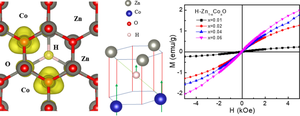
Impacts of hydrogen annealing on crystallographic characterization, electronic structure, and optical, photocatalytic, and magnetic properties of polycrystalline Zn1−xCoxO (x = 0.01–0.06) samples have been considered. Structural analyses based on powder X-ray diffraction, Rietveld refinement, and Raman spectroscopy prove all materials having the P63mc wurtzite-type structure. The Co-doping and hydrogenation changed the concentration of Zn– and O–related defects whose energy levels occupy the band gap. This also enhanced photocatalytic performance of hydrogenated samples with x > 0.02. X-ray and UV–Vis absorption analyses indicate the substitution of Co2+ for Zn2+ in the wurtzite-type ZnO lattice, leading to irregularly changed the unit-cell parameters. While all the as-prepared samples are paramagnetic, the hydrogenated ones exhibit weak ferromagnetism. Ferromagnetic (FM) ordering increases when x increases, particularly for x ≥ 0.02. According to the results achieved from studying crystalline and electronic structures, we believe that oxygen-vacancies-mediated interactions between Co2+ ions and H–Co–H exchange dimers enhanced FM ordering in hydrogenated Zn1−xCoxO. Computational investigations have also indicated that the magnetization value of H–Zn1−xCoxO is influenced by the positioning of the H dopant, meaning that the couplings between Co and H play an essential role in establishing FM order in H–Zn1−xCoxO.
期刊介绍:
The Journal of Materials Science publishes reviews, full-length papers, and short Communications recording original research results on, or techniques for studying the relationship between structure, properties, and uses of materials. The subjects are seen from international and interdisciplinary perspectives covering areas including metals, ceramics, glasses, polymers, electrical materials, composite materials, fibers, nanostructured materials, nanocomposites, and biological and biomedical materials. The Journal of Materials Science is now firmly established as the leading source of primary communication for scientists investigating the structure and properties of all engineering materials.




 京公网安备 11010802042870号
京ICP备2023020795号-1
京公网安备 11010802042870号
京ICP备2023020795号-1

 分享
分享
 求助内容:
求助内容: 应助结果提醒方式:
 扫码关注我们
