Jian Xia
(, ), Yunxiao Dong
(, ), Junjie Gong
(, ), Zixuan Wang
(, ), Tianci Wang
(, ), Rui Yang
(, ), Xiangshui Miao
(, )
{"title":"用于损耗型集成光子器件的相变材料评价标准和设计策略","authors":"Jian Xia \n (, ), Yunxiao Dong \n (, ), Junjie Gong \n (, ), Zixuan Wang \n (, ), Tianci Wang \n (, ), Rui Yang \n (, ), Xiangshui Miao \n (, )","doi":"10.1007/s40843-024-2874-2","DOIUrl":null,"url":null,"abstract":"<div><p>Phase change materials (PCMs) exhibit unique optical properties and have been widely used in various fields, such as optical memory, optical switches, and optical neuromorphic computing devices. However, owing to the lack of an evaluation criterion for assessing the optical performance of PCMs, the design of new PCMs mainly depends on empirical knowledge. Herein, a new evaluation criterion known as the material figure of merit (FOM<sub>2</sub> = Δ<i>k/k</i><sub>amor</sub>) was introduced to assess the optical performance of PCMs in absorption-modulated integrated photonics. The FOM value represents the potential of PCMs in constructing high-performance PCM-based photonic devices. A higher FOM value indicates broader applicability of PCMs in photonic devices. To explore the relationships between the optical parameters of PCMs and the FOM value, three new optical PCMs based on Ge<sub>2</sub>Sb<sub>2</sub>Te<sub>5</sub> (GST) were developed according to the theory of optical bandgap. The results indicate that doping with non-metallic elements, such as nitrogen, increases the FOM<sub>2</sub> values of GST, which is beneficial for developing low-loss and high-modulation space absorption-modulated PCM-based photonic devices and large-scale absorption-modulated PCM-based photonic arrays. Additionally, the crystallization temperature of PCMs affects the programming power, endurance, and stability of the devices. Therefore, selecting suitable PCMs tailored to the specific requirements of the device in real-world applications is crucial. Our study provides an evaluation criterion for assessing the optical performance of PCMs, thereby facilitating the design of customized materials for photonic applications.\n</p><div><figure><div><div><picture><source><img></source></picture></div></div></figure></div></div>","PeriodicalId":773,"journal":{"name":"Science China Materials","volume":"67 6","pages":"2008 - 2015"},"PeriodicalIF":7.4000,"publicationDate":"2024-05-15","publicationTypes":"Journal Article","fieldsOfStudy":null,"isOpenAccess":false,"openAccessPdf":"","citationCount":"0","resultStr":"{\"title\":\"An evaluation criterion and a design strategy for high-performance optical phase change materials in absorption-modulated integrated photonics\",\"authors\":\"Jian Xia \\n (, ), Yunxiao Dong \\n (, ), Junjie Gong \\n (, ), Zixuan Wang \\n (, ), Tianci Wang \\n (, ), Rui Yang \\n (, ), Xiangshui Miao \\n (, )\",\"doi\":\"10.1007/s40843-024-2874-2\",\"DOIUrl\":null,\"url\":null,\"abstract\":\"<div><p>Phase change materials (PCMs) exhibit unique optical properties and have been widely used in various fields, such as optical memory, optical switches, and optical neuromorphic computing devices. However, owing to the lack of an evaluation criterion for assessing the optical performance of PCMs, the design of new PCMs mainly depends on empirical knowledge. Herein, a new evaluation criterion known as the material figure of merit (FOM<sub>2</sub> = Δ<i>k/k</i><sub>amor</sub>) was introduced to assess the optical performance of PCMs in absorption-modulated integrated photonics. The FOM value represents the potential of PCMs in constructing high-performance PCM-based photonic devices. A higher FOM value indicates broader applicability of PCMs in photonic devices. To explore the relationships between the optical parameters of PCMs and the FOM value, three new optical PCMs based on Ge<sub>2</sub>Sb<sub>2</sub>Te<sub>5</sub> (GST) were developed according to the theory of optical bandgap. The results indicate that doping with non-metallic elements, such as nitrogen, increases the FOM<sub>2</sub> values of GST, which is beneficial for developing low-loss and high-modulation space absorption-modulated PCM-based photonic devices and large-scale absorption-modulated PCM-based photonic arrays. Additionally, the crystallization temperature of PCMs affects the programming power, endurance, and stability of the devices. Therefore, selecting suitable PCMs tailored to the specific requirements of the device in real-world applications is crucial. Our study provides an evaluation criterion for assessing the optical performance of PCMs, thereby facilitating the design of customized materials for photonic applications.\\n</p><div><figure><div><div><picture><source><img></source></picture></div></div></figure></div></div>\",\"PeriodicalId\":773,\"journal\":{\"name\":\"Science China Materials\",\"volume\":\"67 6\",\"pages\":\"2008 - 2015\"},\"PeriodicalIF\":7.4000,\"publicationDate\":\"2024-05-15\",\"publicationTypes\":\"Journal Article\",\"fieldsOfStudy\":null,\"isOpenAccess\":false,\"openAccessPdf\":\"\",\"citationCount\":\"0\",\"resultStr\":null,\"platform\":\"Semanticscholar\",\"paperid\":null,\"PeriodicalName\":\"Science China Materials\",\"FirstCategoryId\":\"88\",\"ListUrlMain\":\"https://link.springer.com/article/10.1007/s40843-024-2874-2\",\"RegionNum\":2,\"RegionCategory\":\"材料科学\",\"ArticlePicture\":[],\"TitleCN\":null,\"AbstractTextCN\":null,\"PMCID\":null,\"EPubDate\":\"\",\"PubModel\":\"\",\"JCR\":\"Q1\",\"JCRName\":\"MATERIALS SCIENCE, MULTIDISCIPLINARY\",\"Score\":null,\"Total\":0}","platform":"Semanticscholar","paperid":null,"PeriodicalName":"Science China Materials","FirstCategoryId":"88","ListUrlMain":"https://link.springer.com/article/10.1007/s40843-024-2874-2","RegionNum":2,"RegionCategory":"材料科学","ArticlePicture":[],"TitleCN":null,"AbstractTextCN":null,"PMCID":null,"EPubDate":"","PubModel":"","JCR":"Q1","JCRName":"MATERIALS SCIENCE, MULTIDISCIPLINARY","Score":null,"Total":0}
An evaluation criterion and a design strategy for high-performance optical phase change materials in absorption-modulated integrated photonics
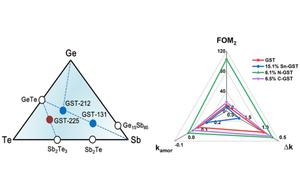
Phase change materials (PCMs) exhibit unique optical properties and have been widely used in various fields, such as optical memory, optical switches, and optical neuromorphic computing devices. However, owing to the lack of an evaluation criterion for assessing the optical performance of PCMs, the design of new PCMs mainly depends on empirical knowledge. Herein, a new evaluation criterion known as the material figure of merit (FOM2 = Δk/kamor) was introduced to assess the optical performance of PCMs in absorption-modulated integrated photonics. The FOM value represents the potential of PCMs in constructing high-performance PCM-based photonic devices. A higher FOM value indicates broader applicability of PCMs in photonic devices. To explore the relationships between the optical parameters of PCMs and the FOM value, three new optical PCMs based on Ge2Sb2Te5 (GST) were developed according to the theory of optical bandgap. The results indicate that doping with non-metallic elements, such as nitrogen, increases the FOM2 values of GST, which is beneficial for developing low-loss and high-modulation space absorption-modulated PCM-based photonic devices and large-scale absorption-modulated PCM-based photonic arrays. Additionally, the crystallization temperature of PCMs affects the programming power, endurance, and stability of the devices. Therefore, selecting suitable PCMs tailored to the specific requirements of the device in real-world applications is crucial. Our study provides an evaluation criterion for assessing the optical performance of PCMs, thereby facilitating the design of customized materials for photonic applications.
期刊介绍:
Science China Materials (SCM) is a globally peer-reviewed journal that covers all facets of materials science. It is supervised by the Chinese Academy of Sciences and co-sponsored by the Chinese Academy of Sciences and the National Natural Science Foundation of China. The journal is jointly published monthly in both printed and electronic forms by Science China Press and Springer. The aim of SCM is to encourage communication of high-quality, innovative research results at the cutting-edge interface of materials science with chemistry, physics, biology, and engineering. It focuses on breakthroughs from around the world and aims to become a world-leading academic journal for materials science.




 京公网安备 11010802042870号
京ICP备2023020795号-1
京公网安备 11010802042870号
京ICP备2023020795号-1

 分享
分享
 求助内容:
求助内容: 应助结果提醒方式:
 扫码关注我们
