Wen Zhao
(, ), Juan Liu
(, ), Guangtao Wang
(, ), Xintian Wang
(, ), Chuanju Yang
(, ), Jian Li
(, ), Yuting Wang
(, ), Xiaolian Sun
(, ), Richen Lin
(, ), Gancheng Zuo
(, ), Wenlei Zhu
(, )
{"title":"用于将一氧化碳电还原为多碳产品的铜基催化剂","authors":"Wen Zhao \n (, ), Juan Liu \n (, ), Guangtao Wang \n (, ), Xintian Wang \n (, ), Chuanju Yang \n (, ), Jian Li \n (, ), Yuting Wang \n (, ), Xiaolian Sun \n (, ), Richen Lin \n (, ), Gancheng Zuo \n (, ), Wenlei Zhu \n (, )","doi":"10.1007/s40843-023-2884-8","DOIUrl":null,"url":null,"abstract":"<div><p>Electrochemical carbon dioxide reduction (ECO<sub>2</sub>R) is an attractive pathway to store carbon and renewable energy as chemical bonds in multi-carbon products. However, the complex multi-step reaction processes set huge obstacles for the direct conversion of CO<sub>2</sub> to C<sub>2+</sub> products. A strategy that uses carbon monoxide (CO) as a “transfer station” to produce C<sub>2+</sub> at improved selectivity and reaction rates <i>via</i> the tandem ECO<sub>2</sub>R to CO and electrochemical CO reduction (ECOR) has attracted a lot attention. In this review, we focus on the design strategy of Cu-based electrocatalysts toward the formation of specific C<sub>2+</sub> products in ECOR. Representative design strategies for catalysts engineering are summarized in various aspects, and the most recent research in the improvement of electrolysis reactor is included. Finally, the main challenges and the future prospects in this research field are expounded. These insights and perspectives offer meaningful guidance for designing Cu-based electrocatalytic system with enhanced C<sub>2+</sub> product selectivity.\n</p><div><figure><div><div><picture><source><img></source></picture></div></div></figure></div></div>","PeriodicalId":773,"journal":{"name":"Science China Materials","volume":"67 6","pages":"1684 - 1705"},"PeriodicalIF":7.4000,"publicationDate":"2024-05-13","publicationTypes":"Journal Article","fieldsOfStudy":null,"isOpenAccess":false,"openAccessPdf":"","citationCount":"0","resultStr":"{\"title\":\"Copper-based catalysts for carbon monoxide electroreduction to multicarbon products\",\"authors\":\"Wen Zhao \\n (, ), Juan Liu \\n (, ), Guangtao Wang \\n (, ), Xintian Wang \\n (, ), Chuanju Yang \\n (, ), Jian Li \\n (, ), Yuting Wang \\n (, ), Xiaolian Sun \\n (, ), Richen Lin \\n (, ), Gancheng Zuo \\n (, ), Wenlei Zhu \\n (, )\",\"doi\":\"10.1007/s40843-023-2884-8\",\"DOIUrl\":null,\"url\":null,\"abstract\":\"<div><p>Electrochemical carbon dioxide reduction (ECO<sub>2</sub>R) is an attractive pathway to store carbon and renewable energy as chemical bonds in multi-carbon products. However, the complex multi-step reaction processes set huge obstacles for the direct conversion of CO<sub>2</sub> to C<sub>2+</sub> products. A strategy that uses carbon monoxide (CO) as a “transfer station” to produce C<sub>2+</sub> at improved selectivity and reaction rates <i>via</i> the tandem ECO<sub>2</sub>R to CO and electrochemical CO reduction (ECOR) has attracted a lot attention. In this review, we focus on the design strategy of Cu-based electrocatalysts toward the formation of specific C<sub>2+</sub> products in ECOR. Representative design strategies for catalysts engineering are summarized in various aspects, and the most recent research in the improvement of electrolysis reactor is included. Finally, the main challenges and the future prospects in this research field are expounded. These insights and perspectives offer meaningful guidance for designing Cu-based electrocatalytic system with enhanced C<sub>2+</sub> product selectivity.\\n</p><div><figure><div><div><picture><source><img></source></picture></div></div></figure></div></div>\",\"PeriodicalId\":773,\"journal\":{\"name\":\"Science China Materials\",\"volume\":\"67 6\",\"pages\":\"1684 - 1705\"},\"PeriodicalIF\":7.4000,\"publicationDate\":\"2024-05-13\",\"publicationTypes\":\"Journal Article\",\"fieldsOfStudy\":null,\"isOpenAccess\":false,\"openAccessPdf\":\"\",\"citationCount\":\"0\",\"resultStr\":null,\"platform\":\"Semanticscholar\",\"paperid\":null,\"PeriodicalName\":\"Science China Materials\",\"FirstCategoryId\":\"88\",\"ListUrlMain\":\"https://link.springer.com/article/10.1007/s40843-023-2884-8\",\"RegionNum\":2,\"RegionCategory\":\"材料科学\",\"ArticlePicture\":[],\"TitleCN\":null,\"AbstractTextCN\":null,\"PMCID\":null,\"EPubDate\":\"\",\"PubModel\":\"\",\"JCR\":\"Q1\",\"JCRName\":\"MATERIALS SCIENCE, MULTIDISCIPLINARY\",\"Score\":null,\"Total\":0}","platform":"Semanticscholar","paperid":null,"PeriodicalName":"Science China Materials","FirstCategoryId":"88","ListUrlMain":"https://link.springer.com/article/10.1007/s40843-023-2884-8","RegionNum":2,"RegionCategory":"材料科学","ArticlePicture":[],"TitleCN":null,"AbstractTextCN":null,"PMCID":null,"EPubDate":"","PubModel":"","JCR":"Q1","JCRName":"MATERIALS SCIENCE, MULTIDISCIPLINARY","Score":null,"Total":0}
引用次数: 0
摘要
电化学二氧化碳还原(ECO2R)是将碳和可再生能源作为化学键储存在多碳产品中的一种极具吸引力的途径。然而,复杂的多步反应过程为将 CO2 直接转化为 C2+ 产品设置了巨大障碍。一种利用一氧化碳(CO)作为 "中转站",通过串联 ECO2R 到 CO 和电化学 CO 还原(ECOR)以更高的选择性和反应速率生产 C2+ 的策略引起了广泛关注。在本综述中,我们将重点讨论铜基电催化剂在 ECOR 中形成特定 C2+ 产物的设计策略。文章从多个方面总结了催化剂工程的代表性设计策略,并介绍了在改进电解反应器方面的最新研究。最后,阐述了该研究领域的主要挑战和未来前景。这些见解和观点为设计具有更高的 C2+ 产物选择性的铜基电催化系统提供了有意义的指导。
Copper-based catalysts for carbon monoxide electroreduction to multicarbon products
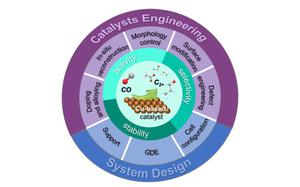
Electrochemical carbon dioxide reduction (ECO2R) is an attractive pathway to store carbon and renewable energy as chemical bonds in multi-carbon products. However, the complex multi-step reaction processes set huge obstacles for the direct conversion of CO2 to C2+ products. A strategy that uses carbon monoxide (CO) as a “transfer station” to produce C2+ at improved selectivity and reaction rates via the tandem ECO2R to CO and electrochemical CO reduction (ECOR) has attracted a lot attention. In this review, we focus on the design strategy of Cu-based electrocatalysts toward the formation of specific C2+ products in ECOR. Representative design strategies for catalysts engineering are summarized in various aspects, and the most recent research in the improvement of electrolysis reactor is included. Finally, the main challenges and the future prospects in this research field are expounded. These insights and perspectives offer meaningful guidance for designing Cu-based electrocatalytic system with enhanced C2+ product selectivity.
期刊介绍:
Science China Materials (SCM) is a globally peer-reviewed journal that covers all facets of materials science. It is supervised by the Chinese Academy of Sciences and co-sponsored by the Chinese Academy of Sciences and the National Natural Science Foundation of China. The journal is jointly published monthly in both printed and electronic forms by Science China Press and Springer. The aim of SCM is to encourage communication of high-quality, innovative research results at the cutting-edge interface of materials science with chemistry, physics, biology, and engineering. It focuses on breakthroughs from around the world and aims to become a world-leading academic journal for materials science.




 京公网安备 11010802042870号
京ICP备2023020795号-1
京公网安备 11010802042870号
京ICP备2023020795号-1

 分享
分享
 求助内容:
求助内容: 应助结果提醒方式:
 扫码关注我们
