{"title":"用于筛分手性药物的手性功能化膜","authors":"Sijia He \n (, ), Yaqian Zhang \n (, ), Sravan Baddi, Changli Zhao \n (, ), Xiaoqiu Dou \n (, ), Chuanliang Feng \n (, )","doi":"10.1007/s40843-023-2806-8","DOIUrl":null,"url":null,"abstract":"<div><p>Current trend that integrates chiral designs into robust membrane systems is providing distinct horizons for the development of chiral separation technology. However, creating chiral sites in-between membrane laminates is still an open issue. Herein, we demonstrate a decorated layered chitosan/graphene oxide (CG) membrane <i>via</i> non-covalent interactions with <i>L</i>-tryptophan derivatives (LPWM), yielding materials with chiral functionality and superior mechanical strength. LPWM introduces chiral environment into the membrane, giving rise to visual recognition sensitivity and decent enantioseparation performance toward chiral drug molecules, with optical isomeric excess value exceeding 80% for pseudoephedrine (PEP). The chiral discrimination is associated with preferential binding of one of the isomers due to stronger or additional H-bonds with chiral assemblies. This work not only paves a new way for the fabrication of chiral membranes <i>via</i> a simple non-covalent interaction, but also guides a potential direction to realize enantioseparation employing decorated laminated membranes.</p><div><figure><div><div><picture><source><img></source></picture></div></div></figure></div></div>","PeriodicalId":773,"journal":{"name":"Science China Materials","volume":"67 8","pages":"2532 - 2539"},"PeriodicalIF":7.7000,"publicationDate":"2024-05-11","publicationTypes":"Journal Article","fieldsOfStudy":null,"isOpenAccess":false,"openAccessPdf":"https://link.springer.com/content/pdf/10.1007/s40843-023-2806-8.pdf","citationCount":"0","resultStr":"{\"title\":\"Chiral-functionalized membranes for chiral drugs sieving\",\"authors\":\"Sijia He \\n (, ), Yaqian Zhang \\n (, ), Sravan Baddi, Changli Zhao \\n (, ), Xiaoqiu Dou \\n (, ), Chuanliang Feng \\n (, )\",\"doi\":\"10.1007/s40843-023-2806-8\",\"DOIUrl\":null,\"url\":null,\"abstract\":\"<div><p>Current trend that integrates chiral designs into robust membrane systems is providing distinct horizons for the development of chiral separation technology. However, creating chiral sites in-between membrane laminates is still an open issue. Herein, we demonstrate a decorated layered chitosan/graphene oxide (CG) membrane <i>via</i> non-covalent interactions with <i>L</i>-tryptophan derivatives (LPWM), yielding materials with chiral functionality and superior mechanical strength. LPWM introduces chiral environment into the membrane, giving rise to visual recognition sensitivity and decent enantioseparation performance toward chiral drug molecules, with optical isomeric excess value exceeding 80% for pseudoephedrine (PEP). The chiral discrimination is associated with preferential binding of one of the isomers due to stronger or additional H-bonds with chiral assemblies. This work not only paves a new way for the fabrication of chiral membranes <i>via</i> a simple non-covalent interaction, but also guides a potential direction to realize enantioseparation employing decorated laminated membranes.</p><div><figure><div><div><picture><source><img></source></picture></div></div></figure></div></div>\",\"PeriodicalId\":773,\"journal\":{\"name\":\"Science China Materials\",\"volume\":\"67 8\",\"pages\":\"2532 - 2539\"},\"PeriodicalIF\":7.7000,\"publicationDate\":\"2024-05-11\",\"publicationTypes\":\"Journal Article\",\"fieldsOfStudy\":null,\"isOpenAccess\":false,\"openAccessPdf\":\"https://link.springer.com/content/pdf/10.1007/s40843-023-2806-8.pdf\",\"citationCount\":\"0\",\"resultStr\":null,\"platform\":\"Semanticscholar\",\"paperid\":null,\"PeriodicalName\":\"Science China Materials\",\"FirstCategoryId\":\"88\",\"ListUrlMain\":\"https://link.springer.com/article/10.1007/s40843-023-2806-8\",\"RegionNum\":2,\"RegionCategory\":\"材料科学\",\"ArticlePicture\":[],\"TitleCN\":null,\"AbstractTextCN\":null,\"PMCID\":null,\"EPubDate\":\"\",\"PubModel\":\"\",\"JCR\":\"Q1\",\"JCRName\":\"MATERIALS SCIENCE, MULTIDISCIPLINARY\",\"Score\":null,\"Total\":0}","platform":"Semanticscholar","paperid":null,"PeriodicalName":"Science China Materials","FirstCategoryId":"88","ListUrlMain":"https://link.springer.com/article/10.1007/s40843-023-2806-8","RegionNum":2,"RegionCategory":"材料科学","ArticlePicture":[],"TitleCN":null,"AbstractTextCN":null,"PMCID":null,"EPubDate":"","PubModel":"","JCR":"Q1","JCRName":"MATERIALS SCIENCE, MULTIDISCIPLINARY","Score":null,"Total":0}
引用次数: 0
摘要
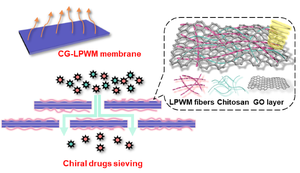
当前的趋势是将手性设计整合到坚固的膜系统中,这为手性分离技术的发展提供了独特的前景。然而,在膜层之间创建手性位点仍是一个有待解决的问题。在此,我们展示了一种通过与 L-色氨酸衍生物(LPWM)的非共价相互作用装饰的层状壳聚糖/氧化石墨烯(CG)膜,从而获得了具有手性功能和优异机械强度的材料。LPWM 将手性环境引入膜中,使其对手性药物分子具有视觉识别灵敏度和良好的对映体分离性能,其中伪麻黄碱(PEP)的光学异构体过量值超过 80%。手性识别与其中一种异构体的优先结合有关,这是因为手性组装体具有更强或更多的 H 键。这项工作不仅为通过简单的非共价相互作用制造手性膜铺平了新的道路,而且为利用装饰层膜实现对映体分离指引了潜在的方向。
Chiral-functionalized membranes for chiral drugs sieving
Current trend that integrates chiral designs into robust membrane systems is providing distinct horizons for the development of chiral separation technology. However, creating chiral sites in-between membrane laminates is still an open issue. Herein, we demonstrate a decorated layered chitosan/graphene oxide (CG) membrane via non-covalent interactions with L-tryptophan derivatives (LPWM), yielding materials with chiral functionality and superior mechanical strength. LPWM introduces chiral environment into the membrane, giving rise to visual recognition sensitivity and decent enantioseparation performance toward chiral drug molecules, with optical isomeric excess value exceeding 80% for pseudoephedrine (PEP). The chiral discrimination is associated with preferential binding of one of the isomers due to stronger or additional H-bonds with chiral assemblies. This work not only paves a new way for the fabrication of chiral membranes via a simple non-covalent interaction, but also guides a potential direction to realize enantioseparation employing decorated laminated membranes.
期刊介绍:
Science China Materials (SCM) is a globally peer-reviewed journal that covers all facets of materials science. It is supervised by the Chinese Academy of Sciences and co-sponsored by the Chinese Academy of Sciences and the National Natural Science Foundation of China. The journal is jointly published monthly in both printed and electronic forms by Science China Press and Springer. The aim of SCM is to encourage communication of high-quality, innovative research results at the cutting-edge interface of materials science with chemistry, physics, biology, and engineering. It focuses on breakthroughs from around the world and aims to become a world-leading academic journal for materials science.




 京公网安备 11010802042870号
京ICP备2023020795号-1
京公网安备 11010802042870号
京ICP备2023020795号-1

 分享
分享
 求助内容:
求助内容: 应助结果提醒方式:
 扫码关注我们
