J. Sánchez-Vargas , F.J. Valdés-Parada , L. Peraza-Reyes , D. Lasseux , M.A. Trujillo-Roldán
{"title":"真菌颗粒的流动模型和结构特征。","authors":"J. Sánchez-Vargas , F.J. Valdés-Parada , L. Peraza-Reyes , D. Lasseux , M.A. Trujillo-Roldán","doi":"10.1016/j.jtbi.2024.111853","DOIUrl":null,"url":null,"abstract":"<div><p>Fungal pellets are hierarchical systems that can be found in an ample variety of applications. Modeling transport phenomena in this type of systems is a challenging but necessary task to provide knowledge-based processes that improve the outcome of their biotechnological applications. In this work, an upscaled model for total mass and momentum transport in fungal pellets is implemented and analyzed, using elements of the volume averaging and adjoint homogenization methods departing from the governing equations at the microscale in the intracellular and extracellular phases. The biomass is assumed to be composed of a non-Newtonian fluid and the organelles impervious to momentum transport are modeled as a rigid solid phase. The upscaled equations contain effective-medium coefficients, which are predicted from the solution of adjoint closure problems in a three-dimensional periodic domains representative of the microstructure. The construction of these domains was performed for <em>Laccaria trichodermophora</em> based on observations of actual biological structures. The upscaled model was validated with direct numerical simulations in homogeneous portions of the pellets core. It is shown that no significant differences are observed when the dolipores are open or closed to fluid flow. By comparing the predictions of the average velocity in the extracellular phase resulting from the upscaled model with those from the classical Darcy equation (<em>i.e.</em>, assuming that the biomass is a solid phase) the contribution of the intracellular fluid phase was evidenced. This work sets the foundations for further studies dedicated to transport phenomena in this type of systems.</p></div>","PeriodicalId":54763,"journal":{"name":"Journal of Theoretical Biology","volume":"590 ","pages":"Article 111853"},"PeriodicalIF":2.0000,"publicationDate":"2024-08-07","publicationTypes":"Journal Article","fieldsOfStudy":null,"isOpenAccess":false,"openAccessPdf":"https://www.sciencedirect.com/science/article/pii/S0022519324001346/pdfft?md5=5ddbb5be4ce6b442d72971519d621c36&pid=1-s2.0-S0022519324001346-main.pdf","citationCount":"0","resultStr":"{\"title\":\"Flow modeling and structural characterization in fungal pellets\",\"authors\":\"J. Sánchez-Vargas , F.J. Valdés-Parada , L. Peraza-Reyes , D. Lasseux , M.A. Trujillo-Roldán\",\"doi\":\"10.1016/j.jtbi.2024.111853\",\"DOIUrl\":null,\"url\":null,\"abstract\":\"<div><p>Fungal pellets are hierarchical systems that can be found in an ample variety of applications. Modeling transport phenomena in this type of systems is a challenging but necessary task to provide knowledge-based processes that improve the outcome of their biotechnological applications. In this work, an upscaled model for total mass and momentum transport in fungal pellets is implemented and analyzed, using elements of the volume averaging and adjoint homogenization methods departing from the governing equations at the microscale in the intracellular and extracellular phases. The biomass is assumed to be composed of a non-Newtonian fluid and the organelles impervious to momentum transport are modeled as a rigid solid phase. The upscaled equations contain effective-medium coefficients, which are predicted from the solution of adjoint closure problems in a three-dimensional periodic domains representative of the microstructure. The construction of these domains was performed for <em>Laccaria trichodermophora</em> based on observations of actual biological structures. The upscaled model was validated with direct numerical simulations in homogeneous portions of the pellets core. It is shown that no significant differences are observed when the dolipores are open or closed to fluid flow. By comparing the predictions of the average velocity in the extracellular phase resulting from the upscaled model with those from the classical Darcy equation (<em>i.e.</em>, assuming that the biomass is a solid phase) the contribution of the intracellular fluid phase was evidenced. This work sets the foundations for further studies dedicated to transport phenomena in this type of systems.</p></div>\",\"PeriodicalId\":54763,\"journal\":{\"name\":\"Journal of Theoretical Biology\",\"volume\":\"590 \",\"pages\":\"Article 111853\"},\"PeriodicalIF\":2.0000,\"publicationDate\":\"2024-08-07\",\"publicationTypes\":\"Journal Article\",\"fieldsOfStudy\":null,\"isOpenAccess\":false,\"openAccessPdf\":\"https://www.sciencedirect.com/science/article/pii/S0022519324001346/pdfft?md5=5ddbb5be4ce6b442d72971519d621c36&pid=1-s2.0-S0022519324001346-main.pdf\",\"citationCount\":\"0\",\"resultStr\":null,\"platform\":\"Semanticscholar\",\"paperid\":null,\"PeriodicalName\":\"Journal of Theoretical Biology\",\"FirstCategoryId\":\"99\",\"ListUrlMain\":\"https://www.sciencedirect.com/science/article/pii/S0022519324001346\",\"RegionNum\":4,\"RegionCategory\":\"数学\",\"ArticlePicture\":[],\"TitleCN\":null,\"AbstractTextCN\":null,\"PMCID\":null,\"EPubDate\":\"2024/5/18 0:00:00\",\"PubModel\":\"Epub\",\"JCR\":\"Q2\",\"JCRName\":\"BIOLOGY\",\"Score\":null,\"Total\":0}","platform":"Semanticscholar","paperid":null,"PeriodicalName":"Journal of Theoretical Biology","FirstCategoryId":"99","ListUrlMain":"https://www.sciencedirect.com/science/article/pii/S0022519324001346","RegionNum":4,"RegionCategory":"数学","ArticlePicture":[],"TitleCN":null,"AbstractTextCN":null,"PMCID":null,"EPubDate":"2024/5/18 0:00:00","PubModel":"Epub","JCR":"Q2","JCRName":"BIOLOGY","Score":null,"Total":0}
Flow modeling and structural characterization in fungal pellets
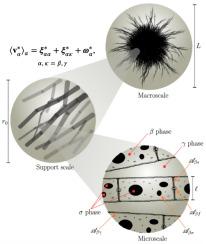
Fungal pellets are hierarchical systems that can be found in an ample variety of applications. Modeling transport phenomena in this type of systems is a challenging but necessary task to provide knowledge-based processes that improve the outcome of their biotechnological applications. In this work, an upscaled model for total mass and momentum transport in fungal pellets is implemented and analyzed, using elements of the volume averaging and adjoint homogenization methods departing from the governing equations at the microscale in the intracellular and extracellular phases. The biomass is assumed to be composed of a non-Newtonian fluid and the organelles impervious to momentum transport are modeled as a rigid solid phase. The upscaled equations contain effective-medium coefficients, which are predicted from the solution of adjoint closure problems in a three-dimensional periodic domains representative of the microstructure. The construction of these domains was performed for Laccaria trichodermophora based on observations of actual biological structures. The upscaled model was validated with direct numerical simulations in homogeneous portions of the pellets core. It is shown that no significant differences are observed when the dolipores are open or closed to fluid flow. By comparing the predictions of the average velocity in the extracellular phase resulting from the upscaled model with those from the classical Darcy equation (i.e., assuming that the biomass is a solid phase) the contribution of the intracellular fluid phase was evidenced. This work sets the foundations for further studies dedicated to transport phenomena in this type of systems.
期刊介绍:
The Journal of Theoretical Biology is the leading forum for theoretical perspectives that give insight into biological processes. It covers a very wide range of topics and is of interest to biologists in many areas of research, including:
• Brain and Neuroscience
• Cancer Growth and Treatment
• Cell Biology
• Developmental Biology
• Ecology
• Evolution
• Immunology,
• Infectious and non-infectious Diseases,
• Mathematical, Computational, Biophysical and Statistical Modeling
• Microbiology, Molecular Biology, and Biochemistry
• Networks and Complex Systems
• Physiology
• Pharmacodynamics
• Animal Behavior and Game Theory
Acceptable papers are those that bear significant importance on the biology per se being presented, and not on the mathematical analysis. Papers that include some data or experimental material bearing on theory will be considered, including those that contain comparative study, statistical data analysis, mathematical proof, computer simulations, experiments, field observations, or even philosophical arguments, which are all methods to support or reject theoretical ideas. However, there should be a concerted effort to make papers intelligible to biologists in the chosen field.




 京公网安备 11010802042870号
京ICP备2023020795号-1
京公网安备 11010802042870号
京ICP备2023020795号-1

 分享
分享
 求助内容:
求助内容: 应助结果提醒方式:
 扫码关注我们
