Giulia Santonoceto, Aneta Jurkiewicz, Roman J Szczesny
{"title":"人类线粒体中的 RNA 降解:旅程尚未结束。","authors":"Giulia Santonoceto, Aneta Jurkiewicz, Roman J Szczesny","doi":"10.1093/hmg/ddae043","DOIUrl":null,"url":null,"abstract":"<p><p>Mitochondria are vital organelles present in almost all eukaryotic cells. Although most of the mitochondrial proteins are nuclear-encoded, mitochondria contain their own genome, whose proper expression is necessary for mitochondrial function. Transcription of the human mitochondrial genome results in the synthesis of long polycistronic transcripts that are subsequently processed by endonucleases to release individual RNA molecules, including precursors of sense protein-encoding mRNA (mt-mRNA) and a vast amount of antisense noncoding RNAs. Because of mitochondrial DNA (mtDNA) organization, the regulation of individual gene expression at the transcriptional level is limited. Although transcription of most protein-coding mitochondrial genes occurs with the same frequency, steady-state levels of mature transcripts are different. Therefore, post-transcriptional processes are important for regulating mt-mRNA levels. The mitochondrial degradosome is a complex composed of the RNA helicase SUV3 (also known as SUPV3L1) and polynucleotide phosphorylase (PNPase, PNPT1). It is the best-characterized RNA-degrading machinery in human mitochondria, which is primarily responsible for the decay of mitochondrial antisense RNA. The mechanism of mitochondrial sense RNA decay is less understood. This review aims to provide a general picture of mitochondrial genome expression, with a particular focus on mitochondrial RNA (mtRNA) degradation.</p>","PeriodicalId":13070,"journal":{"name":"Human molecular genetics","volume":"33 R1","pages":"R26-R33"},"PeriodicalIF":3.1000,"publicationDate":"2024-05-22","publicationTypes":"Journal Article","fieldsOfStudy":null,"isOpenAccess":false,"openAccessPdf":"https://www.ncbi.nlm.nih.gov/pmc/articles/PMC11497605/pdf/","citationCount":"0","resultStr":"{\"title\":\"RNA degradation in human mitochondria: the journey is not finished.\",\"authors\":\"Giulia Santonoceto, Aneta Jurkiewicz, Roman J Szczesny\",\"doi\":\"10.1093/hmg/ddae043\",\"DOIUrl\":null,\"url\":null,\"abstract\":\"<p><p>Mitochondria are vital organelles present in almost all eukaryotic cells. Although most of the mitochondrial proteins are nuclear-encoded, mitochondria contain their own genome, whose proper expression is necessary for mitochondrial function. Transcription of the human mitochondrial genome results in the synthesis of long polycistronic transcripts that are subsequently processed by endonucleases to release individual RNA molecules, including precursors of sense protein-encoding mRNA (mt-mRNA) and a vast amount of antisense noncoding RNAs. Because of mitochondrial DNA (mtDNA) organization, the regulation of individual gene expression at the transcriptional level is limited. Although transcription of most protein-coding mitochondrial genes occurs with the same frequency, steady-state levels of mature transcripts are different. Therefore, post-transcriptional processes are important for regulating mt-mRNA levels. The mitochondrial degradosome is a complex composed of the RNA helicase SUV3 (also known as SUPV3L1) and polynucleotide phosphorylase (PNPase, PNPT1). It is the best-characterized RNA-degrading machinery in human mitochondria, which is primarily responsible for the decay of mitochondrial antisense RNA. The mechanism of mitochondrial sense RNA decay is less understood. This review aims to provide a general picture of mitochondrial genome expression, with a particular focus on mitochondrial RNA (mtRNA) degradation.</p>\",\"PeriodicalId\":13070,\"journal\":{\"name\":\"Human molecular genetics\",\"volume\":\"33 R1\",\"pages\":\"R26-R33\"},\"PeriodicalIF\":3.1000,\"publicationDate\":\"2024-05-22\",\"publicationTypes\":\"Journal Article\",\"fieldsOfStudy\":null,\"isOpenAccess\":false,\"openAccessPdf\":\"https://www.ncbi.nlm.nih.gov/pmc/articles/PMC11497605/pdf/\",\"citationCount\":\"0\",\"resultStr\":null,\"platform\":\"Semanticscholar\",\"paperid\":null,\"PeriodicalName\":\"Human molecular genetics\",\"FirstCategoryId\":\"99\",\"ListUrlMain\":\"https://doi.org/10.1093/hmg/ddae043\",\"RegionNum\":2,\"RegionCategory\":\"生物学\",\"ArticlePicture\":[],\"TitleCN\":null,\"AbstractTextCN\":null,\"PMCID\":null,\"EPubDate\":\"\",\"PubModel\":\"\",\"JCR\":\"Q3\",\"JCRName\":\"BIOCHEMISTRY & MOLECULAR BIOLOGY\",\"Score\":null,\"Total\":0}","platform":"Semanticscholar","paperid":null,"PeriodicalName":"Human molecular genetics","FirstCategoryId":"99","ListUrlMain":"https://doi.org/10.1093/hmg/ddae043","RegionNum":2,"RegionCategory":"生物学","ArticlePicture":[],"TitleCN":null,"AbstractTextCN":null,"PMCID":null,"EPubDate":"","PubModel":"","JCR":"Q3","JCRName":"BIOCHEMISTRY & MOLECULAR BIOLOGY","Score":null,"Total":0}
RNA degradation in human mitochondria: the journey is not finished.
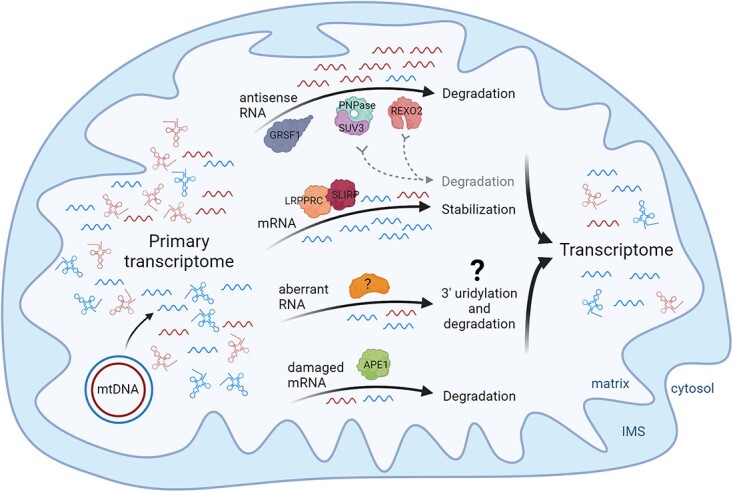
Mitochondria are vital organelles present in almost all eukaryotic cells. Although most of the mitochondrial proteins are nuclear-encoded, mitochondria contain their own genome, whose proper expression is necessary for mitochondrial function. Transcription of the human mitochondrial genome results in the synthesis of long polycistronic transcripts that are subsequently processed by endonucleases to release individual RNA molecules, including precursors of sense protein-encoding mRNA (mt-mRNA) and a vast amount of antisense noncoding RNAs. Because of mitochondrial DNA (mtDNA) organization, the regulation of individual gene expression at the transcriptional level is limited. Although transcription of most protein-coding mitochondrial genes occurs with the same frequency, steady-state levels of mature transcripts are different. Therefore, post-transcriptional processes are important for regulating mt-mRNA levels. The mitochondrial degradosome is a complex composed of the RNA helicase SUV3 (also known as SUPV3L1) and polynucleotide phosphorylase (PNPase, PNPT1). It is the best-characterized RNA-degrading machinery in human mitochondria, which is primarily responsible for the decay of mitochondrial antisense RNA. The mechanism of mitochondrial sense RNA decay is less understood. This review aims to provide a general picture of mitochondrial genome expression, with a particular focus on mitochondrial RNA (mtRNA) degradation.
期刊介绍:
Human Molecular Genetics concentrates on full-length research papers covering a wide range of topics in all aspects of human molecular genetics. These include:
the molecular basis of human genetic disease
developmental genetics
cancer genetics
neurogenetics
chromosome and genome structure and function
therapy of genetic disease
stem cells in human genetic disease and therapy, including the application of iPS cells
genome-wide association studies
mouse and other models of human diseases
functional genomics
computational genomics
In addition, the journal also publishes research on other model systems for the analysis of genes, especially when there is an obvious relevance to human genetics.






 京公网安备 11010802042870号
京ICP备2023020795号-1
京公网安备 11010802042870号
京ICP备2023020795号-1

 分享
分享
 求助内容:
求助内容: 应助结果提醒方式:
 扫码关注我们
