Ruicong Xue , Jiancheng Zhang , Zhe Zhen , Weihao Liang , Yi Li , Lili Zhang , Yugang Dong , Bin Dong , Chen Liu
{"title":"估计脉搏波速度可预测射血分数保留型心力衰竭患者的死亡率","authors":"Ruicong Xue , Jiancheng Zhang , Zhe Zhen , Weihao Liang , Yi Li , Lili Zhang , Yugang Dong , Bin Dong , Chen Liu","doi":"10.1016/j.hjc.2024.05.013","DOIUrl":null,"url":null,"abstract":"<div><h3>Objective</h3><div>Estimated pulse wave velocity (ePWV), a newly established arterial stiffness (AS) parameter, predicts the development of cardiovascular disease (CVD) and death in the general population or in patients with CVD risk factors. However, whether ePWV is associated with adverse outcomes in heart failure with preserved ejection fraction (HFpEF) patients remains unknown. Our study aimed to evaluate the prognostic value of ePWV on clinical outcomes in HFpEF.</div></div><div><h3>Methods and Results</h3><div>We analyzed HFpEF participants from the Americas in the Treatment of Preserved Cardiac Function Heart Failure with an Aldosterone Antagonist (TOPCAT) trial with available baseline data (n = 1764). Cox proportional hazard model was used to explore the prognostic value of ePWV on long-term clinical outcomes (all-cause mortality, cardiovascular mortality, all-cause hospitalization, and heart failure hospitalization). Each ePWV increase by 1 m/s increased the risk for all-cause death by 16% (HR:1.16; 95% CI:1.10–1.23; P < 0.001) and CVD mortality by 13% (HR:1.13; 95% CI:1.04–1.21; P = 0.002) after adjusting for confounders. Patients were then grouped into 4 quartiles of ePWV. Our study indicated that the highest ePWV quartile (ePWV ≥ 12.806 m/s) was associated with increased risk of all-cause mortality (HR: 1.96; 95% CI: 1.43–2.69; P < 0.001) and CVD mortality (HR: 1.72; 95% CI: 1.16–2.56; P = 0.008) after adjusting for potential confounders.</div></div><div><h3>Conclusion</h3><div>These results suggested ePWV is independently associated with increased all-cause mortality and CVD mortality in HFpEF patients, indicating ePWV is an appropriate predictor of prognosis in patients with HFpEF.</div></div>","PeriodicalId":55062,"journal":{"name":"Hellenic Journal of Cardiology","volume":"86 ","pages":"Pages 51-62"},"PeriodicalIF":3.2000,"publicationDate":"2025-11-01","publicationTypes":"Journal Article","fieldsOfStudy":null,"isOpenAccess":false,"openAccessPdf":"","citationCount":"0","resultStr":"{\"title\":\"Estimated pulse wave velocity predicts mortality in patients with heart failure with preserved ejection fraction\",\"authors\":\"Ruicong Xue , Jiancheng Zhang , Zhe Zhen , Weihao Liang , Yi Li , Lili Zhang , Yugang Dong , Bin Dong , Chen Liu\",\"doi\":\"10.1016/j.hjc.2024.05.013\",\"DOIUrl\":null,\"url\":null,\"abstract\":\"<div><h3>Objective</h3><div>Estimated pulse wave velocity (ePWV), a newly established arterial stiffness (AS) parameter, predicts the development of cardiovascular disease (CVD) and death in the general population or in patients with CVD risk factors. However, whether ePWV is associated with adverse outcomes in heart failure with preserved ejection fraction (HFpEF) patients remains unknown. Our study aimed to evaluate the prognostic value of ePWV on clinical outcomes in HFpEF.</div></div><div><h3>Methods and Results</h3><div>We analyzed HFpEF participants from the Americas in the Treatment of Preserved Cardiac Function Heart Failure with an Aldosterone Antagonist (TOPCAT) trial with available baseline data (n = 1764). Cox proportional hazard model was used to explore the prognostic value of ePWV on long-term clinical outcomes (all-cause mortality, cardiovascular mortality, all-cause hospitalization, and heart failure hospitalization). Each ePWV increase by 1 m/s increased the risk for all-cause death by 16% (HR:1.16; 95% CI:1.10–1.23; P < 0.001) and CVD mortality by 13% (HR:1.13; 95% CI:1.04–1.21; P = 0.002) after adjusting for confounders. Patients were then grouped into 4 quartiles of ePWV. Our study indicated that the highest ePWV quartile (ePWV ≥ 12.806 m/s) was associated with increased risk of all-cause mortality (HR: 1.96; 95% CI: 1.43–2.69; P < 0.001) and CVD mortality (HR: 1.72; 95% CI: 1.16–2.56; P = 0.008) after adjusting for potential confounders.</div></div><div><h3>Conclusion</h3><div>These results suggested ePWV is independently associated with increased all-cause mortality and CVD mortality in HFpEF patients, indicating ePWV is an appropriate predictor of prognosis in patients with HFpEF.</div></div>\",\"PeriodicalId\":55062,\"journal\":{\"name\":\"Hellenic Journal of Cardiology\",\"volume\":\"86 \",\"pages\":\"Pages 51-62\"},\"PeriodicalIF\":3.2000,\"publicationDate\":\"2025-11-01\",\"publicationTypes\":\"Journal Article\",\"fieldsOfStudy\":null,\"isOpenAccess\":false,\"openAccessPdf\":\"\",\"citationCount\":\"0\",\"resultStr\":null,\"platform\":\"Semanticscholar\",\"paperid\":null,\"PeriodicalName\":\"Hellenic Journal of Cardiology\",\"FirstCategoryId\":\"3\",\"ListUrlMain\":\"https://www.sciencedirect.com/science/article/pii/S1109966624001179\",\"RegionNum\":3,\"RegionCategory\":\"医学\",\"ArticlePicture\":[],\"TitleCN\":null,\"AbstractTextCN\":null,\"PMCID\":null,\"EPubDate\":\"2024/5/23 0:00:00\",\"PubModel\":\"Epub\",\"JCR\":\"Q2\",\"JCRName\":\"CARDIAC & CARDIOVASCULAR SYSTEMS\",\"Score\":null,\"Total\":0}","platform":"Semanticscholar","paperid":null,"PeriodicalName":"Hellenic Journal of Cardiology","FirstCategoryId":"3","ListUrlMain":"https://www.sciencedirect.com/science/article/pii/S1109966624001179","RegionNum":3,"RegionCategory":"医学","ArticlePicture":[],"TitleCN":null,"AbstractTextCN":null,"PMCID":null,"EPubDate":"2024/5/23 0:00:00","PubModel":"Epub","JCR":"Q2","JCRName":"CARDIAC & CARDIOVASCULAR SYSTEMS","Score":null,"Total":0}
引用次数: 0
摘要
目的估计脉搏波速度(ePWV)是一个新建立的动脉硬度(AS)参数,可预测普通人群或有心血管疾病危险因素的患者心血管疾病(CVD)的发展和死亡。然而,ePWV是否与保留射血分数(HFpEF)心力衰竭患者的不良结局相关仍不清楚。本研究旨在评估ePWV对HFpEF临床预后的预测价值。方法和结果我们分析了来自美洲的HFpEF参与者,在醛固酮拮抗剂(TOPCAT)治疗保留心功能心力衰竭的试验中,有可用的基线数据(n = 1764)。采用Cox比例风险模型探讨ePWV对长期临床结局(全因死亡率、心血管死亡率、全因住院率和心力衰竭住院率)的预后价值。调整混杂因素后,ePWV每增加1 m/s,全因死亡风险增加16% (HR:1.16; 95% CI: 1.10-1.23; P < 0.001),心血管疾病死亡率增加13% (HR:1.13; 95% CI: 1.04-1.21; P = 0.002)。然后将患者分为4个ePWV四分位数。我们的研究表明,在调整潜在混杂因素后,最高ePWV四分位数(ePWV≥12.806 m/s)与全因死亡率(HR: 1.96; 95% CI: 1.43-2.69; P < 0.001)和心血管疾病死亡率(HR: 1.72; 95% CI: 1.16-2.56; P = 0.008)的风险增加相关。结论ePWV与HFpEF患者全因死亡率和CVD死亡率升高独立相关,提示ePWV可作为HFpEF患者预后的预测指标。
Estimated pulse wave velocity predicts mortality in patients with heart failure with preserved ejection fraction
Objective
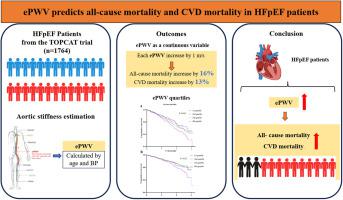
Estimated pulse wave velocity (ePWV), a newly established arterial stiffness (AS) parameter, predicts the development of cardiovascular disease (CVD) and death in the general population or in patients with CVD risk factors. However, whether ePWV is associated with adverse outcomes in heart failure with preserved ejection fraction (HFpEF) patients remains unknown. Our study aimed to evaluate the prognostic value of ePWV on clinical outcomes in HFpEF.
Methods and Results
We analyzed HFpEF participants from the Americas in the Treatment of Preserved Cardiac Function Heart Failure with an Aldosterone Antagonist (TOPCAT) trial with available baseline data (n = 1764). Cox proportional hazard model was used to explore the prognostic value of ePWV on long-term clinical outcomes (all-cause mortality, cardiovascular mortality, all-cause hospitalization, and heart failure hospitalization). Each ePWV increase by 1 m/s increased the risk for all-cause death by 16% (HR:1.16; 95% CI:1.10–1.23; P < 0.001) and CVD mortality by 13% (HR:1.13; 95% CI:1.04–1.21; P = 0.002) after adjusting for confounders. Patients were then grouped into 4 quartiles of ePWV. Our study indicated that the highest ePWV quartile (ePWV ≥ 12.806 m/s) was associated with increased risk of all-cause mortality (HR: 1.96; 95% CI: 1.43–2.69; P < 0.001) and CVD mortality (HR: 1.72; 95% CI: 1.16–2.56; P = 0.008) after adjusting for potential confounders.
Conclusion
These results suggested ePWV is independently associated with increased all-cause mortality and CVD mortality in HFpEF patients, indicating ePWV is an appropriate predictor of prognosis in patients with HFpEF.
期刊介绍:
The Hellenic Journal of Cardiology (International Edition, ISSN 1109-9666) is the official journal of the Hellenic Society of Cardiology and aims to publish high-quality articles on all aspects of cardiovascular medicine. A primary goal is to publish in each issue a number of original articles related to clinical and basic research. Many of these will be accompanied by invited editorial comments.
Hot topics, such as molecular cardiology, and innovative cardiac imaging and electrophysiological mapping techniques, will appear frequently in the journal in the form of invited expert articles or special reports. The Editorial Committee also attaches great importance to subjects related to continuing medical education, the implementation of guidelines and cost effectiveness in cardiology.





 京公网安备 11010802042870号
京ICP备2023020795号-1
京公网安备 11010802042870号
京ICP备2023020795号-1

 分享
分享
 求助内容:
求助内容: 应助结果提醒方式:
 扫码关注我们
