Ya Xie, Zifeng Xu, Yumin Zhang, Yisheng Li, Pengyu Du, Chun Wang
{"title":"中国精神病住院患者感染 SARS-CoV-2 导致首发精神障碍的风险临床分析。","authors":"Ya Xie, Zifeng Xu, Yumin Zhang, Yisheng Li, Pengyu Du, Chun Wang","doi":"10.7555/JBR.38.20240005","DOIUrl":null,"url":null,"abstract":"<p><p>The extensive spread of severe acute respiratory syndrome coronavirus 2 (SARS-CoV-2) throughout China in late 2022 has underscored the correlation between this virus and severe psychiatric disorders. However, there remains a lack of reported clinical and pathological features. Accordingly, we retrospectively reviewed the electronic medical records of psychiatric inpatients for seven days from early January 2023. Twenty-one inpatients who developed first-episode psychiatric disorders within two weeks after SARS-CoV-2 infection were recruited, while 24 uninfected first-episode psychiatric inpatients were selected as controls. Comparative analyses of clinical manifestations, routine laboratory tests, and imaging examinations were performed. Our investigation demonstrated a 330% increase in the incidence of first-episode psychiatric inpatients after SARS-CoV-2 infection in 2023, compared with the preceding year without SARS-CoV-2 infections. Most cases exhibited psychiatric symptoms within one week of SARS-CoV-2 infection, which resolved after approximately two weeks, with no residual symptoms after three months. One-way ANOVA demonstrated a significant difference in the highest fever temperature between inpatients with and without psychotic symptoms. Infected inpatients displayed elevated levels of interleukin-4, interleukin-8, and interferon-α, but decreased levels of eosinophils and basophils. These findings suggest that SARS-CoV-2 may contribute to the development of psychiatric disorders, likely mediated by the virus-induced inflammatory response and neuronal dysfunction in the context of psychological distress.</p>","PeriodicalId":15061,"journal":{"name":"Journal of Biomedical Research","volume":" ","pages":"50-60"},"PeriodicalIF":3.7000,"publicationDate":"2024-05-29","publicationTypes":"Journal Article","fieldsOfStudy":null,"isOpenAccess":false,"openAccessPdf":"https://www.ncbi.nlm.nih.gov/pmc/articles/PMC11873594/pdf/","citationCount":"0","resultStr":"{\"title\":\"First-episode psychiatric disorder risk from SARS-CoV-2 infection: A clinical analysis with Chinese psychiatric inpatients.\",\"authors\":\"Ya Xie, Zifeng Xu, Yumin Zhang, Yisheng Li, Pengyu Du, Chun Wang\",\"doi\":\"10.7555/JBR.38.20240005\",\"DOIUrl\":null,\"url\":null,\"abstract\":\"<p><p>The extensive spread of severe acute respiratory syndrome coronavirus 2 (SARS-CoV-2) throughout China in late 2022 has underscored the correlation between this virus and severe psychiatric disorders. However, there remains a lack of reported clinical and pathological features. Accordingly, we retrospectively reviewed the electronic medical records of psychiatric inpatients for seven days from early January 2023. Twenty-one inpatients who developed first-episode psychiatric disorders within two weeks after SARS-CoV-2 infection were recruited, while 24 uninfected first-episode psychiatric inpatients were selected as controls. Comparative analyses of clinical manifestations, routine laboratory tests, and imaging examinations were performed. Our investigation demonstrated a 330% increase in the incidence of first-episode psychiatric inpatients after SARS-CoV-2 infection in 2023, compared with the preceding year without SARS-CoV-2 infections. Most cases exhibited psychiatric symptoms within one week of SARS-CoV-2 infection, which resolved after approximately two weeks, with no residual symptoms after three months. One-way ANOVA demonstrated a significant difference in the highest fever temperature between inpatients with and without psychotic symptoms. Infected inpatients displayed elevated levels of interleukin-4, interleukin-8, and interferon-α, but decreased levels of eosinophils and basophils. These findings suggest that SARS-CoV-2 may contribute to the development of psychiatric disorders, likely mediated by the virus-induced inflammatory response and neuronal dysfunction in the context of psychological distress.</p>\",\"PeriodicalId\":15061,\"journal\":{\"name\":\"Journal of Biomedical Research\",\"volume\":\" \",\"pages\":\"50-60\"},\"PeriodicalIF\":3.7000,\"publicationDate\":\"2024-05-29\",\"publicationTypes\":\"Journal Article\",\"fieldsOfStudy\":null,\"isOpenAccess\":false,\"openAccessPdf\":\"https://www.ncbi.nlm.nih.gov/pmc/articles/PMC11873594/pdf/\",\"citationCount\":\"0\",\"resultStr\":null,\"platform\":\"Semanticscholar\",\"paperid\":null,\"PeriodicalName\":\"Journal of Biomedical Research\",\"FirstCategoryId\":\"3\",\"ListUrlMain\":\"https://doi.org/10.7555/JBR.38.20240005\",\"RegionNum\":4,\"RegionCategory\":\"医学\",\"ArticlePicture\":[],\"TitleCN\":null,\"AbstractTextCN\":null,\"PMCID\":null,\"EPubDate\":\"\",\"PubModel\":\"\",\"JCR\":\"Q3\",\"JCRName\":\"MEDICINE, RESEARCH & EXPERIMENTAL\",\"Score\":null,\"Total\":0}","platform":"Semanticscholar","paperid":null,"PeriodicalName":"Journal of Biomedical Research","FirstCategoryId":"3","ListUrlMain":"https://doi.org/10.7555/JBR.38.20240005","RegionNum":4,"RegionCategory":"医学","ArticlePicture":[],"TitleCN":null,"AbstractTextCN":null,"PMCID":null,"EPubDate":"","PubModel":"","JCR":"Q3","JCRName":"MEDICINE, RESEARCH & EXPERIMENTAL","Score":null,"Total":0}
First-episode psychiatric disorder risk from SARS-CoV-2 infection: A clinical analysis with Chinese psychiatric inpatients.
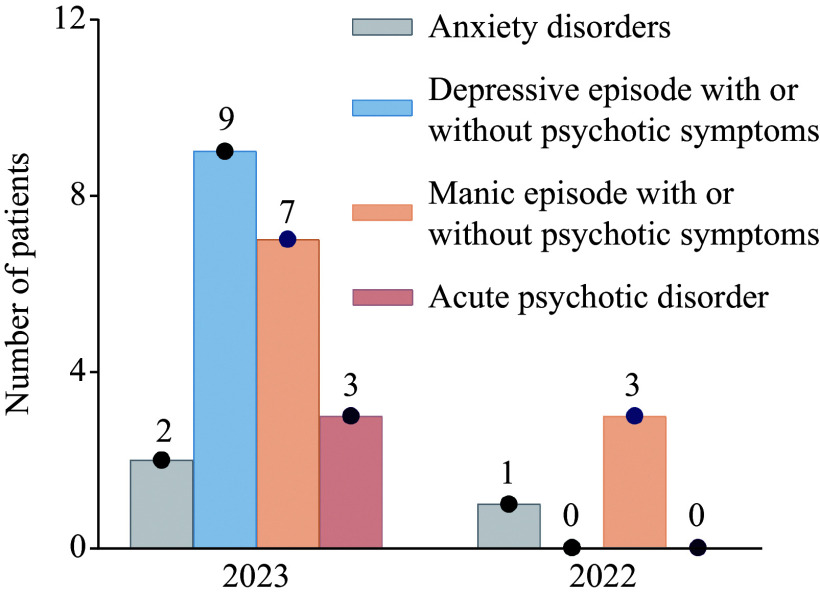
The extensive spread of severe acute respiratory syndrome coronavirus 2 (SARS-CoV-2) throughout China in late 2022 has underscored the correlation between this virus and severe psychiatric disorders. However, there remains a lack of reported clinical and pathological features. Accordingly, we retrospectively reviewed the electronic medical records of psychiatric inpatients for seven days from early January 2023. Twenty-one inpatients who developed first-episode psychiatric disorders within two weeks after SARS-CoV-2 infection were recruited, while 24 uninfected first-episode psychiatric inpatients were selected as controls. Comparative analyses of clinical manifestations, routine laboratory tests, and imaging examinations were performed. Our investigation demonstrated a 330% increase in the incidence of first-episode psychiatric inpatients after SARS-CoV-2 infection in 2023, compared with the preceding year without SARS-CoV-2 infections. Most cases exhibited psychiatric symptoms within one week of SARS-CoV-2 infection, which resolved after approximately two weeks, with no residual symptoms after three months. One-way ANOVA demonstrated a significant difference in the highest fever temperature between inpatients with and without psychotic symptoms. Infected inpatients displayed elevated levels of interleukin-4, interleukin-8, and interferon-α, but decreased levels of eosinophils and basophils. These findings suggest that SARS-CoV-2 may contribute to the development of psychiatric disorders, likely mediated by the virus-induced inflammatory response and neuronal dysfunction in the context of psychological distress.





 京公网安备 11010802042870号
京ICP备2023020795号-1
京公网安备 11010802042870号
京ICP备2023020795号-1

 分享
分享
 求助内容:
求助内容: 应助结果提醒方式:
 扫码关注我们
