{"title":"花寄生虫:授粉中的互利还是剥削?","authors":"Kenji Suetsugu","doi":"10.1002/fee.2774","DOIUrl":null,"url":null,"abstract":"<p>Floral rewards are essential in attracting pollinators for recurrent visits to flowers, promoting the likelihood of reproductive success in angiosperms. Pollen and nectar serve as the primary incentives in these interactions, but in rare instances, flowering plants provide brood sites for the offspring of their pollinators, thereby fostering interdependent relationships in which both partners rely on one another for reproduction. Historically, the fig (<i>Ficus</i> spp)–fig wasp (family Agaonidae) and yucca (<i>Yucca</i> spp)–yucca moth (<i>Tegeticula</i> and <i>Parategeticula</i> spp) interactions were identified as examples of such mutualisms. In these scenarios, female insect pollinators both pollinate the flowers and deposit eggs within them, resulting in a subset of the plant's seeds being sacrificed to nourish the pollinator larvae. This trade-off, however, can impose substantial costs to the plants, especially when the larvae act as seed parasites and thus undermine the mutualistic effect of pollination.</p><p>The relationship between the achlorophyllous plant <i>Balanophora tobiracola</i> and the snout moth <i>Assara balanophorae</i> observed on Yakushima Island, Kagoshima Prefecture, Japan, might represent another type of nursery pollination mutualism. Here, female moths lay eggs within the <i>Balanophora</i> inflorescences, and pollination is likely achieved passively through nectar-feeding and oviposition. As revealed by dissected mature inflorescences, moth larvae hatched after approximately two weeks and were documented feeding on the swollen, fleshy axes of inflorescences without consuming the many small seeds (indicated by white arrowheads) that constitute a thin surface layer on the inflorescence. Therefore, relative to their respective plant partners, snout moths may be less costly pollinators than fig wasps or yucca moths. Nevertheless, intense herbivory by snout moth larvae could restrict the nutrient transfer required for seed maturation, potentially resulting in an antagonistic relationship. Thus, while this case seemingly exhibits a cooperative relationship, further research is necessary to thoroughly comprehend its costs and benefits.</p>","PeriodicalId":171,"journal":{"name":"Frontiers in Ecology and the Environment","volume":"22 5","pages":""},"PeriodicalIF":7.6000,"publicationDate":"2024-06-03","publicationTypes":"Journal Article","fieldsOfStudy":null,"isOpenAccess":false,"openAccessPdf":"https://onlinelibrary.wiley.com/doi/epdf/10.1002/fee.2774","citationCount":"0","resultStr":"{\"title\":\"Floral parasites: mutualism or exploitation in pollination?\",\"authors\":\"Kenji Suetsugu\",\"doi\":\"10.1002/fee.2774\",\"DOIUrl\":null,\"url\":null,\"abstract\":\"<p>Floral rewards are essential in attracting pollinators for recurrent visits to flowers, promoting the likelihood of reproductive success in angiosperms. Pollen and nectar serve as the primary incentives in these interactions, but in rare instances, flowering plants provide brood sites for the offspring of their pollinators, thereby fostering interdependent relationships in which both partners rely on one another for reproduction. Historically, the fig (<i>Ficus</i> spp)–fig wasp (family Agaonidae) and yucca (<i>Yucca</i> spp)–yucca moth (<i>Tegeticula</i> and <i>Parategeticula</i> spp) interactions were identified as examples of such mutualisms. In these scenarios, female insect pollinators both pollinate the flowers and deposit eggs within them, resulting in a subset of the plant's seeds being sacrificed to nourish the pollinator larvae. This trade-off, however, can impose substantial costs to the plants, especially when the larvae act as seed parasites and thus undermine the mutualistic effect of pollination.</p><p>The relationship between the achlorophyllous plant <i>Balanophora tobiracola</i> and the snout moth <i>Assara balanophorae</i> observed on Yakushima Island, Kagoshima Prefecture, Japan, might represent another type of nursery pollination mutualism. Here, female moths lay eggs within the <i>Balanophora</i> inflorescences, and pollination is likely achieved passively through nectar-feeding and oviposition. As revealed by dissected mature inflorescences, moth larvae hatched after approximately two weeks and were documented feeding on the swollen, fleshy axes of inflorescences without consuming the many small seeds (indicated by white arrowheads) that constitute a thin surface layer on the inflorescence. Therefore, relative to their respective plant partners, snout moths may be less costly pollinators than fig wasps or yucca moths. Nevertheless, intense herbivory by snout moth larvae could restrict the nutrient transfer required for seed maturation, potentially resulting in an antagonistic relationship. Thus, while this case seemingly exhibits a cooperative relationship, further research is necessary to thoroughly comprehend its costs and benefits.</p>\",\"PeriodicalId\":171,\"journal\":{\"name\":\"Frontiers in Ecology and the Environment\",\"volume\":\"22 5\",\"pages\":\"\"},\"PeriodicalIF\":7.6000,\"publicationDate\":\"2024-06-03\",\"publicationTypes\":\"Journal Article\",\"fieldsOfStudy\":null,\"isOpenAccess\":false,\"openAccessPdf\":\"https://onlinelibrary.wiley.com/doi/epdf/10.1002/fee.2774\",\"citationCount\":\"0\",\"resultStr\":null,\"platform\":\"Semanticscholar\",\"paperid\":null,\"PeriodicalName\":\"Frontiers in Ecology and the Environment\",\"FirstCategoryId\":\"93\",\"ListUrlMain\":\"https://esajournals.onlinelibrary.wiley.com/doi/10.1002/fee.2774\",\"RegionNum\":1,\"RegionCategory\":\"环境科学与生态学\",\"ArticlePicture\":[],\"TitleCN\":null,\"AbstractTextCN\":null,\"PMCID\":null,\"EPubDate\":\"\",\"PubModel\":\"\",\"JCR\":\"Q1\",\"JCRName\":\"ECOLOGY\",\"Score\":null,\"Total\":0}","platform":"Semanticscholar","paperid":null,"PeriodicalName":"Frontiers in Ecology and the Environment","FirstCategoryId":"93","ListUrlMain":"https://esajournals.onlinelibrary.wiley.com/doi/10.1002/fee.2774","RegionNum":1,"RegionCategory":"环境科学与生态学","ArticlePicture":[],"TitleCN":null,"AbstractTextCN":null,"PMCID":null,"EPubDate":"","PubModel":"","JCR":"Q1","JCRName":"ECOLOGY","Score":null,"Total":0}
引用次数: 0
摘要
花的奖励在吸引传粉者反复访问花中是必不可少的,提高了被子植物繁殖成功的可能性。花粉和花蜜是这些相互作用的主要诱因,但在极少数情况下,开花植物为其传粉者的后代提供育雏场所,从而培养了相互依赖的关系,在这种关系中,双方相互依赖以进行繁殖。历史上,无花果(Ficus spp) -无花果黄蜂(Agaonidae科)和丝兰(yucca spp) -丝兰蛾(Tegeticula and Parategeticula spp)的相互作用被确定为这种相互作用的例子。在这些情况下,雌性昆虫传粉者既为花授粉,又在花中产卵,导致植物的一部分种子被牺牲,以滋养传粉者的幼虫。然而,这种权衡可能会给植物带来巨大的代价,特别是当幼虫作为种子寄生虫时,从而破坏了授粉的互惠效应。在日本鹿儿岛县屋久岛发现的无叶绿素植物Balanophora tobiracola与吻蛾Assara balanophorae之间的关系可能代表了另一种苗圃授粉互惠关系。在这里,雌蛾在Balanophora花序内产卵,并可能通过采蜜和产卵被动地实现授粉。经解剖的成熟花序显示,蛾子幼虫大约在两周后孵化,并在肿胀的、肉质的花序轴上进食,而不消耗构成花序薄表面层的许多小种子(白色箭头表示)。因此,相对于它们各自的植物伴侣,吻蛾可能比无花果黄蜂或丝兰蛾更便宜。然而,口蛾幼虫的强烈食草性可能会限制种子成熟所需的营养转移,可能导致拮抗关系。因此,虽然这个案例表面上表现出一种合作关系,但要彻底了解其成本和收益,还需要进一步的研究。
Floral parasites: mutualism or exploitation in pollination?
Floral rewards are essential in attracting pollinators for recurrent visits to flowers, promoting the likelihood of reproductive success in angiosperms. Pollen and nectar serve as the primary incentives in these interactions, but in rare instances, flowering plants provide brood sites for the offspring of their pollinators, thereby fostering interdependent relationships in which both partners rely on one another for reproduction. Historically, the fig (Ficus spp)–fig wasp (family Agaonidae) and yucca (Yucca spp)–yucca moth (Tegeticula and Parategeticula spp) interactions were identified as examples of such mutualisms. In these scenarios, female insect pollinators both pollinate the flowers and deposit eggs within them, resulting in a subset of the plant's seeds being sacrificed to nourish the pollinator larvae. This trade-off, however, can impose substantial costs to the plants, especially when the larvae act as seed parasites and thus undermine the mutualistic effect of pollination.
The relationship between the achlorophyllous plant Balanophora tobiracola and the snout moth Assara balanophorae observed on Yakushima Island, Kagoshima Prefecture, Japan, might represent another type of nursery pollination mutualism. Here, female moths lay eggs within the Balanophora inflorescences, and pollination is likely achieved passively through nectar-feeding and oviposition. As revealed by dissected mature inflorescences, moth larvae hatched after approximately two weeks and were documented feeding on the swollen, fleshy axes of inflorescences without consuming the many small seeds (indicated by white arrowheads) that constitute a thin surface layer on the inflorescence. Therefore, relative to their respective plant partners, snout moths may be less costly pollinators than fig wasps or yucca moths. Nevertheless, intense herbivory by snout moth larvae could restrict the nutrient transfer required for seed maturation, potentially resulting in an antagonistic relationship. Thus, while this case seemingly exhibits a cooperative relationship, further research is necessary to thoroughly comprehend its costs and benefits.
期刊介绍:
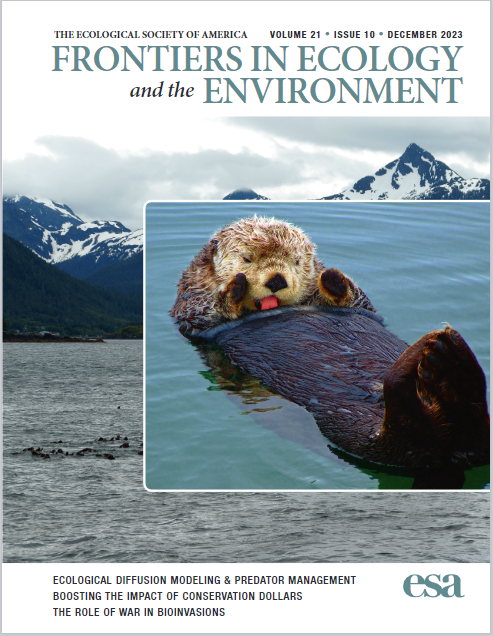
Frontiers in Ecology and the Environment is a publication by the Ecological Society of America that focuses on the significance of ecology and environmental science in various aspects of research and problem-solving. The journal covers topics such as biodiversity conservation, ecosystem preservation, natural resource management, public policy, and other related areas.
The publication features a range of content, including peer-reviewed articles, editorials, commentaries, letters, and occasional special issues and topical series. It releases ten issues per year, excluding January and July. ESA members receive both print and electronic copies of the journal, while institutional subscriptions are also available.
Frontiers in Ecology and the Environment is highly regarded in the field, as indicated by its ranking in the 2021 Journal Citation Reports by Clarivate Analytics. The journal is ranked 4th out of 174 in ecology journals and 11th out of 279 in environmental sciences journals. Its impact factor for 2021 is reported as 13.789, which further demonstrates its influence and importance in the scientific community.





 京公网安备 11010802042870号
京ICP备2023020795号-1
京公网安备 11010802042870号
京ICP备2023020795号-1

 分享
分享
 求助内容:
求助内容: 应助结果提醒方式:
 扫码关注我们
