Nadja H. Pedersen, Valdemar W. Nielsen, Nikolaj Holgersen, Nana A. L. Rosenø, Jacob P. Thyssen, Alexander Egeberg, Marcus Maurer, Ivan Cherrez-Ojeda, Hans C. Ring, Simon F. Thomsen
{"title":"化脓性扁桃体炎患者使用数字信息和通信技术的情况","authors":"Nadja H. Pedersen, Valdemar W. Nielsen, Nikolaj Holgersen, Nana A. L. Rosenø, Jacob P. Thyssen, Alexander Egeberg, Marcus Maurer, Ivan Cherrez-Ojeda, Hans C. Ring, Simon F. Thomsen","doi":"10.1002/jvc2.474","DOIUrl":null,"url":null,"abstract":"<p>Hidradenitis suppurativa (HS) is a chronic inflammatory skin disease characterized by nodules, draining sinus tracts, and abscesses in intertriginous regions. The reported prevalence of HS ranges from 0.4% to 4% with an average age of HS disease onset at 23 years.<span><sup>1</sup></span> Given the early onset of HS and the advocated use of dedicated social network channels,<span><sup>2</sup></span> we explored the current use of information and communications technologies (ICT) in adult HS patients.</p><p>Data on adult outpatients with HS from the Department of Dermatology at Bispebjerg Hospital from February to September 2020 was obtained through clinical examination and a survey about ICT usage. ICTs were categorized into three groups (Figure 1).</p><p>Of 48 HS patients included, 79.2% were female, the mean age was 38.4 (SD = 11.1) years, and all patients had internet access (Table 1). Daily, patients generally used one-to-one and one-to-many ICT platforms most often (both 93.8%), followed by many-to-many ICTs (47.9%). Web browsers (91.7%), Facebook/Messenger (81.3%), and SMS (81.3%) had the most daily users. There was a numerical, but statistically nonsignificant, difference between Hurley stages of users of many-to-many ICTs (42.4% of Hurley II + III versus. 60% of Hurley I, <i>p</i> = 0.26). We found no association between the daily use of ICTs and VAS bother score,<span><sup>3</sup></span> family history of HS, number of boils in the last month, and IHS4.<span><sup>4</sup></span> There was a statistically significant association between daily ICT use and median disease duration for many-to-many ICTs (<i>p</i> = 0.03), but not for one-to-one and one-to-many (Table 1). One-to-many was the preferred ICT category for obtaining general health information (89.6%) and for HS-related information (81.3%). Information obtained through one-to-one ICTs was more frequently rated as very interesting and of good quality for general health information (53.3%) and HS-related information (50%) compared to one-to-many (48.8%; 45.9%).</p><p>When asked about their interest in receiving HS-related information through various ICTs, 68.1% of patients with HS expressed high interest (either ‘very’ or ‘extremely’ interested) in one-to-one ICT, followed by one-to-many (58.7%), and many-to-many (17%). Patients favoured receiving HS disease-related information via email (62.5%) among all available ICT options.</p><p>Similar results have been reported in a global study that utilized the same ICT usage survey with patients with chronic urticaria.<span><sup>5</sup></span> The authors found a preference for web browsers (74.6%) as the primary ICT tool for urticaria information. This might indicate the patients' inclination toward acquiring health-related information from search engines and a vast source of information, including accredited medical organizations. The second most favoured ICT tool for patients with chronic urticaria was YouTube, while for patients with HS, Facebook/Messenger emerged as their second most favoured ICT platform. The preference for different ICTs might be attributed to patients seeking patient organizations on Facebook in Denmark which currently has more than 3000 members. These organizations serve as forums where individuals share experiences, treatments, and practical insights, including advice on bandages and various techniques to alleviate symptoms. When examining a broader perspective of social media use for health information it is reported that addressing and mitigating risks (e.g., misinformation) associated with technology use is crucial for maximizing its potential.<span><sup>6</sup></span></p><p>Our findings indicate that adults with HS predominantly utilize web browsers as their primary ICT platform to gather information about their condition. However, only half rated the information as interesting and of good quality. These results could aid in crafting future HS-related informational sites of high quality tailored to the preferred ICT choices of patients with HS.</p><p>With no relation to the present manuscript, Simon F. Thomsen has received research support from Janssen, LEO Pharma, Novartis, Sanofi and UCB, and has been a speaker/consultant for AbbVie, Almirall, Eli Lilly, Galderma, Janssen, LEO Pharma, Novartis, Pfizer, Sanofi, Symphogen, UCB, and Union Therapeutics. Marcus Maurer has no conflicts of interest in relation to this manuscript. Outside of it, Marcus Maurer is or recently was a speaker and/or advisor for and/or has received research funding from Allakos, Almirall, Alvotech, Amgen, Aquestive, Aralez, AstraZeneca, Bayer, Celldex, Celltrion, Evommune, GSK, Ipsen, Janssen, Kyowa Kirin, Leo Pharma, Lilly, Menarini, Mitsubishi Tanabe Pharma, Moxie, Noucor, Novartis, Orion, Pfizer, Resoncance Medicine, Sanofi/Regeneron, Septerna, Third Harmonic Bio, ValenzaBio, Yuhan Corporation, and Zurabio. Outside the submitted work, Alexander Egeberg has received research funding from Almirall, Pfizer, Eli Lilly, Novartis, Bristol-Myers Squibb, AbbVie, Janssen Pharmaceuticals, Boehringer Ingelheim, the Danish National Psoriasis Foundation, the Simon Spies Foundation, and the Kgl Hofbundtmager Aage Bang Foundation, and honoraria as consultant and/or speaker from Amgen, AbbVie, Almirall, Leo Pharma, Zuellig Pharma Ltd., Galápagos NV, Sun Pharmaceuticals, Samsung Bioepis Co., Ltd., Pfizer, Eli Lilly and Company, Novartis, Union Therapeutics, Galderma, Dermavant, UCB, Mylan, Bristol-Myers Squibb, McNeil Consumer Healthcare, Horizon Therapeutics, Boehringer Ingelheim, and Janssen Pharmaceuticals. Jacob P. Thyssen is an advisor for AbbVie, Almirall, Arena Pharmaceuticals, Coloplast, OM Pharma, Aslan Pharmaceuticals, Union Therapeutics, Eli Lilly & Co, LEO Pharma, Pfizer, Regeneron, and Sanofi-Genzyme, a speaker for AbbVie, Almirall, Eli Lilly & Co, LEO Pharma, Pfizer, Regeneron, and Sanofi-Genzyme, and received research grants from Pfizer, Regeneron, and Sanofi-Genzyme. Dr. Thyssen is a full-time employee at Leo Pharma. The remaining authors report no conflict of interest.</p><p>Nadja H. Pedersen and Valdemar W. Nielsen had full access to all data in the study and take responsibility for the integrity of the data and the accuracy of the data analysis. Simon F. Thomsen, Valdemar W. Nielsen and Nadja H. Pedersen: Study concept and design. All authors: Acquisition, analysis, and interpretation of data. Nadja H. Pedersen: Drafting of the manuscript. All authors: Critical revision of the manuscript for important intellectual content. Nadja H. Pedersen and Valdemar W. Nielsen: Statistical analysis. Obtained funding: None. All authors: Administrative, technical, or material support. Simon F. Thomsen: Study supervision.</p><p>Ethical approval is not required for non-interventional studies in Denmark. All patients in this manuscript have given written informed consent for participation in the study and the use of their deidentified, anonymized, aggregated data and their case details for publication.</p>","PeriodicalId":94325,"journal":{"name":"JEADV clinical practice","volume":"3 5","pages":"1673-1676"},"PeriodicalIF":0.5000,"publicationDate":"2024-06-02","publicationTypes":"Journal Article","fieldsOfStudy":null,"isOpenAccess":false,"openAccessPdf":"https://onlinelibrary.wiley.com/doi/epdf/10.1002/jvc2.474","citationCount":"0","resultStr":"{\"title\":\"Usage of digital information and communications technologies in patients with hidradenitis suppurativa\",\"authors\":\"Nadja H. Pedersen, Valdemar W. Nielsen, Nikolaj Holgersen, Nana A. L. Rosenø, Jacob P. Thyssen, Alexander Egeberg, Marcus Maurer, Ivan Cherrez-Ojeda, Hans C. Ring, Simon F. Thomsen\",\"doi\":\"10.1002/jvc2.474\",\"DOIUrl\":null,\"url\":null,\"abstract\":\"<p>Hidradenitis suppurativa (HS) is a chronic inflammatory skin disease characterized by nodules, draining sinus tracts, and abscesses in intertriginous regions. The reported prevalence of HS ranges from 0.4% to 4% with an average age of HS disease onset at 23 years.<span><sup>1</sup></span> Given the early onset of HS and the advocated use of dedicated social network channels,<span><sup>2</sup></span> we explored the current use of information and communications technologies (ICT) in adult HS patients.</p><p>Data on adult outpatients with HS from the Department of Dermatology at Bispebjerg Hospital from February to September 2020 was obtained through clinical examination and a survey about ICT usage. ICTs were categorized into three groups (Figure 1).</p><p>Of 48 HS patients included, 79.2% were female, the mean age was 38.4 (SD = 11.1) years, and all patients had internet access (Table 1). Daily, patients generally used one-to-one and one-to-many ICT platforms most often (both 93.8%), followed by many-to-many ICTs (47.9%). Web browsers (91.7%), Facebook/Messenger (81.3%), and SMS (81.3%) had the most daily users. There was a numerical, but statistically nonsignificant, difference between Hurley stages of users of many-to-many ICTs (42.4% of Hurley II + III versus. 60% of Hurley I, <i>p</i> = 0.26). We found no association between the daily use of ICTs and VAS bother score,<span><sup>3</sup></span> family history of HS, number of boils in the last month, and IHS4.<span><sup>4</sup></span> There was a statistically significant association between daily ICT use and median disease duration for many-to-many ICTs (<i>p</i> = 0.03), but not for one-to-one and one-to-many (Table 1). One-to-many was the preferred ICT category for obtaining general health information (89.6%) and for HS-related information (81.3%). Information obtained through one-to-one ICTs was more frequently rated as very interesting and of good quality for general health information (53.3%) and HS-related information (50%) compared to one-to-many (48.8%; 45.9%).</p><p>When asked about their interest in receiving HS-related information through various ICTs, 68.1% of patients with HS expressed high interest (either ‘very’ or ‘extremely’ interested) in one-to-one ICT, followed by one-to-many (58.7%), and many-to-many (17%). Patients favoured receiving HS disease-related information via email (62.5%) among all available ICT options.</p><p>Similar results have been reported in a global study that utilized the same ICT usage survey with patients with chronic urticaria.<span><sup>5</sup></span> The authors found a preference for web browsers (74.6%) as the primary ICT tool for urticaria information. This might indicate the patients' inclination toward acquiring health-related information from search engines and a vast source of information, including accredited medical organizations. The second most favoured ICT tool for patients with chronic urticaria was YouTube, while for patients with HS, Facebook/Messenger emerged as their second most favoured ICT platform. The preference for different ICTs might be attributed to patients seeking patient organizations on Facebook in Denmark which currently has more than 3000 members. These organizations serve as forums where individuals share experiences, treatments, and practical insights, including advice on bandages and various techniques to alleviate symptoms. When examining a broader perspective of social media use for health information it is reported that addressing and mitigating risks (e.g., misinformation) associated with technology use is crucial for maximizing its potential.<span><sup>6</sup></span></p><p>Our findings indicate that adults with HS predominantly utilize web browsers as their primary ICT platform to gather information about their condition. However, only half rated the information as interesting and of good quality. These results could aid in crafting future HS-related informational sites of high quality tailored to the preferred ICT choices of patients with HS.</p><p>With no relation to the present manuscript, Simon F. Thomsen has received research support from Janssen, LEO Pharma, Novartis, Sanofi and UCB, and has been a speaker/consultant for AbbVie, Almirall, Eli Lilly, Galderma, Janssen, LEO Pharma, Novartis, Pfizer, Sanofi, Symphogen, UCB, and Union Therapeutics. Marcus Maurer has no conflicts of interest in relation to this manuscript. Outside of it, Marcus Maurer is or recently was a speaker and/or advisor for and/or has received research funding from Allakos, Almirall, Alvotech, Amgen, Aquestive, Aralez, AstraZeneca, Bayer, Celldex, Celltrion, Evommune, GSK, Ipsen, Janssen, Kyowa Kirin, Leo Pharma, Lilly, Menarini, Mitsubishi Tanabe Pharma, Moxie, Noucor, Novartis, Orion, Pfizer, Resoncance Medicine, Sanofi/Regeneron, Septerna, Third Harmonic Bio, ValenzaBio, Yuhan Corporation, and Zurabio. Outside the submitted work, Alexander Egeberg has received research funding from Almirall, Pfizer, Eli Lilly, Novartis, Bristol-Myers Squibb, AbbVie, Janssen Pharmaceuticals, Boehringer Ingelheim, the Danish National Psoriasis Foundation, the Simon Spies Foundation, and the Kgl Hofbundtmager Aage Bang Foundation, and honoraria as consultant and/or speaker from Amgen, AbbVie, Almirall, Leo Pharma, Zuellig Pharma Ltd., Galápagos NV, Sun Pharmaceuticals, Samsung Bioepis Co., Ltd., Pfizer, Eli Lilly and Company, Novartis, Union Therapeutics, Galderma, Dermavant, UCB, Mylan, Bristol-Myers Squibb, McNeil Consumer Healthcare, Horizon Therapeutics, Boehringer Ingelheim, and Janssen Pharmaceuticals. Jacob P. Thyssen is an advisor for AbbVie, Almirall, Arena Pharmaceuticals, Coloplast, OM Pharma, Aslan Pharmaceuticals, Union Therapeutics, Eli Lilly & Co, LEO Pharma, Pfizer, Regeneron, and Sanofi-Genzyme, a speaker for AbbVie, Almirall, Eli Lilly & Co, LEO Pharma, Pfizer, Regeneron, and Sanofi-Genzyme, and received research grants from Pfizer, Regeneron, and Sanofi-Genzyme. Dr. Thyssen is a full-time employee at Leo Pharma. The remaining authors report no conflict of interest.</p><p>Nadja H. Pedersen and Valdemar W. Nielsen had full access to all data in the study and take responsibility for the integrity of the data and the accuracy of the data analysis. Simon F. Thomsen, Valdemar W. Nielsen and Nadja H. Pedersen: Study concept and design. All authors: Acquisition, analysis, and interpretation of data. Nadja H. Pedersen: Drafting of the manuscript. All authors: Critical revision of the manuscript for important intellectual content. Nadja H. Pedersen and Valdemar W. Nielsen: Statistical analysis. Obtained funding: None. All authors: Administrative, technical, or material support. Simon F. Thomsen: Study supervision.</p><p>Ethical approval is not required for non-interventional studies in Denmark. All patients in this manuscript have given written informed consent for participation in the study and the use of their deidentified, anonymized, aggregated data and their case details for publication.</p>\",\"PeriodicalId\":94325,\"journal\":{\"name\":\"JEADV clinical practice\",\"volume\":\"3 5\",\"pages\":\"1673-1676\"},\"PeriodicalIF\":0.5000,\"publicationDate\":\"2024-06-02\",\"publicationTypes\":\"Journal Article\",\"fieldsOfStudy\":null,\"isOpenAccess\":false,\"openAccessPdf\":\"https://onlinelibrary.wiley.com/doi/epdf/10.1002/jvc2.474\",\"citationCount\":\"0\",\"resultStr\":null,\"platform\":\"Semanticscholar\",\"paperid\":null,\"PeriodicalName\":\"JEADV clinical practice\",\"FirstCategoryId\":\"1085\",\"ListUrlMain\":\"https://onlinelibrary.wiley.com/doi/10.1002/jvc2.474\",\"RegionNum\":0,\"RegionCategory\":null,\"ArticlePicture\":[],\"TitleCN\":null,\"AbstractTextCN\":null,\"PMCID\":null,\"EPubDate\":\"\",\"PubModel\":\"\",\"JCR\":\"\",\"JCRName\":\"\",\"Score\":null,\"Total\":0}","platform":"Semanticscholar","paperid":null,"PeriodicalName":"JEADV clinical practice","FirstCategoryId":"1085","ListUrlMain":"https://onlinelibrary.wiley.com/doi/10.1002/jvc2.474","RegionNum":0,"RegionCategory":null,"ArticlePicture":[],"TitleCN":null,"AbstractTextCN":null,"PMCID":null,"EPubDate":"","PubModel":"","JCR":"","JCRName":"","Score":null,"Total":0}
引用次数: 0
摘要
化脓性汗腺炎(HS)是一种慢性炎症性皮肤病,其特征为结节、窦道引流和三叉区脓肿。据报道,HS的患病率从0.4%到4%不等,HS发病的平均年龄为23岁鉴于HS的早期发病和提倡使用专用的社交网络渠道,2我们探讨了成人HS患者目前使用信息和通信技术(ICT)的情况。通过临床检查和信息通信技术使用调查,获得2020年2月至9月Bispebjerg医院皮肤科成年HS门诊患者的数据。ICT被分为三组(图1)。在纳入的48例HS患者中,79.2%为女性,平均年龄为38.4岁(SD = 11.1),所有患者都可以上网(表1)。每天,患者通常最常使用一对一和一对多ICT平台(均为93.8%),其次是多对多ICT(47.9%)。网页浏览器(91.7%)、Facebook/Messenger(81.3%)和短信(81.3%)的日常用户最多。多对多ict用户的Hurley阶段之间存在数字差异,但统计上不显著(42.4%的Hurley II + III与。60%的Hurley I, p = 0.26)。我们发现ICT的每日使用与VAS评分、HS家族史、最近一个月的疖子数和IHS4.4之间没有关联。对于多对多ICT, ICT的每日使用与中位病程有统计学意义(p = 0.03),但对于一对一和一对多(表1)没有关联。一对多是获取一般健康信息(89.6%)和HS相关信息(81.3%)首选的ICT类别。与一对多(48.8%)相比,通过一对一信息通信技术获得的信息通常被评为非常有趣和质量良好的一般健康信息(53.3%)和hs相关信息(50%)。45.9%)。当被问及是否有兴趣通过各种信息通信技术接收HS相关信息时,68.1%的HS患者表示对一对一信息通信技术非常感兴趣(“非常”或“非常”感兴趣),其次是一对多(58.7%)和多对多(17%)。在所有可用的ICT选项中,患者倾向于通过电子邮件接收HS疾病相关信息(62.5%)。一项全球研究也报告了类似的结果,该研究对慢性荨麻疹患者进行了相同的ICT使用情况调查作者发现,74.6%的人倾向于将网络浏览器作为获取荨麻疹信息的主要ICT工具。这可能表明患者倾向于从搜索引擎和大量信息来源(包括经过认证的医疗机构)获取与健康相关的信息。对于慢性荨麻疹患者来说,第二大最受欢迎的ICT工具是YouTube,而对于HS患者来说,Facebook/Messenger成为他们第二大最受欢迎的ICT平台。对不同信息通信技术的偏好可能归因于丹麦患者在Facebook上寻找患者组织,该组织目前有3000多名成员。这些组织是个人分享经验、治疗方法和实际见解的论坛,包括关于绷带和各种缓解症状技术的建议。从更广泛的角度审视利用社交媒体获取卫生信息时,据报告,处理和减轻与技术使用相关的风险(例如,错误信息)对于最大限度地发挥其潜力至关重要。我们的研究结果表明,患有HS的成年人主要利用网络浏览器作为主要的信息通信技术平台来收集有关其病情的信息。然而,只有一半的人认为这些信息有趣,质量好。这些结果有助于为HS患者的首选ICT选择量身定制高质量的HS相关信息网站。Simon F. Thomsen曾获得杨森、利奥制药、诺华、赛诺菲和UCB的研究支持,并曾担任艾伯维、Almirall、礼来、高德美、杨森、利奥制药、诺华、辉瑞、赛诺菲、Symphogen、UCB和Union Therapeutics的演讲/顾问。Marcus Maurer在这份手稿中没有任何利益冲突。除此之外,Marcus Maurer是或最近是Allakos, Almirall, Alvotech, Amgen, Aquestive, Aralez, AstraZeneca, Bayer, Celldex, Celltrion, Evommune, GSK, Ipsen, Janssen, Kyowa麒麟,Leo Pharma, Lilly, Menarini, Mitsubishi Tanabe Pharma, Moxie, Noucor, Novartis, Orion, Pfizer, resonance Medicine, Sanofi/Regeneron, Septerna, Third Harmonic Bio, ValenzaBio, Yuhan Corporation和Zurabio的演讲者和/或顾问,并/或获得了研究资金。 在提交的工作之外,Alexander Egeberg还获得了Almirall、辉瑞、礼来、诺华、百时美施贵宝、艾伯维、杨森制药、勃林格殷格翰、丹麦国家银屑病基金会、Simon Spies基金会和Kgl Hofbundtmager Aage Bang基金会的研究资助,以及安进、艾伯维、Almirall、Leo Pharma、Zuellig Pharma Ltd、Galápagos NV、Sun Pharmaceuticals、Samsung Bioepis Co., Ltd、辉瑞、礼来公司、诺华、联合治疗、高德美、Dermavant、UCB、Mylan、百时美施贵宝、麦克尼尔消费者医疗保健、地平线治疗、勃林格殷格翰和杨森制药。Jacob P. Thyssen是AbbVie, Almirall, Arena Pharmaceuticals,康乐保,OM Pharma, Aslan Pharmaceuticals, Union Therapeutics, Eli Lilly &;公司,LEO Pharma, Pfizer, Regeneron和Sanofi-Genzyme, AbbVie, Almirall, Eli Lilly &;公司、LEO Pharma、辉瑞、Regeneron和赛诺菲-健赞获得了辉瑞、Regeneron和赛诺菲-健赞的研究资助。蒂森医生是利奥制药的全职员工。其余作者报告无利益冲突。Nadja H. Pedersen和Valdemar W. Nielsen对研究中的所有数据有完全的访问权,并对数据的完整性和数据分析的准确性负责。Simon F. Thomsen, Valdemar W. Nielsen和Nadja H. Pedersen:研究概念和设计。所有作者:数据的获取、分析和解释。Nadja H. Pedersen:起草手稿。所有作者:对重要知识内容的手稿进行批判性修改。Nadja H. Pedersen和Valdemar W. Nielsen:统计分析。获得资金:无。所有作者:行政、技术或物质支持。Simon F. Thomsen:学习监督。在丹麦,非干预性研究不需要伦理批准。本文中的所有患者均已书面同意参与本研究,并同意使用其未识别、匿名、汇总的数据和病例细节进行发表。
Usage of digital information and communications technologies in patients with hidradenitis suppurativa
Hidradenitis suppurativa (HS) is a chronic inflammatory skin disease characterized by nodules, draining sinus tracts, and abscesses in intertriginous regions. The reported prevalence of HS ranges from 0.4% to 4% with an average age of HS disease onset at 23 years.1 Given the early onset of HS and the advocated use of dedicated social network channels,2 we explored the current use of information and communications technologies (ICT) in adult HS patients.
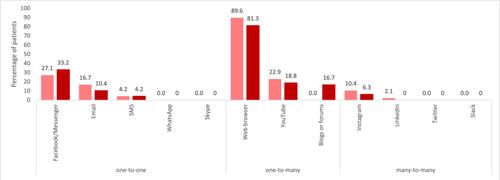
Data on adult outpatients with HS from the Department of Dermatology at Bispebjerg Hospital from February to September 2020 was obtained through clinical examination and a survey about ICT usage. ICTs were categorized into three groups (Figure 1).
Of 48 HS patients included, 79.2% were female, the mean age was 38.4 (SD = 11.1) years, and all patients had internet access (Table 1). Daily, patients generally used one-to-one and one-to-many ICT platforms most often (both 93.8%), followed by many-to-many ICTs (47.9%). Web browsers (91.7%), Facebook/Messenger (81.3%), and SMS (81.3%) had the most daily users. There was a numerical, but statistically nonsignificant, difference between Hurley stages of users of many-to-many ICTs (42.4% of Hurley II + III versus. 60% of Hurley I, p = 0.26). We found no association between the daily use of ICTs and VAS bother score,3 family history of HS, number of boils in the last month, and IHS4.4 There was a statistically significant association between daily ICT use and median disease duration for many-to-many ICTs (p = 0.03), but not for one-to-one and one-to-many (Table 1). One-to-many was the preferred ICT category for obtaining general health information (89.6%) and for HS-related information (81.3%). Information obtained through one-to-one ICTs was more frequently rated as very interesting and of good quality for general health information (53.3%) and HS-related information (50%) compared to one-to-many (48.8%; 45.9%).
When asked about their interest in receiving HS-related information through various ICTs, 68.1% of patients with HS expressed high interest (either ‘very’ or ‘extremely’ interested) in one-to-one ICT, followed by one-to-many (58.7%), and many-to-many (17%). Patients favoured receiving HS disease-related information via email (62.5%) among all available ICT options.
Similar results have been reported in a global study that utilized the same ICT usage survey with patients with chronic urticaria.5 The authors found a preference for web browsers (74.6%) as the primary ICT tool for urticaria information. This might indicate the patients' inclination toward acquiring health-related information from search engines and a vast source of information, including accredited medical organizations. The second most favoured ICT tool for patients with chronic urticaria was YouTube, while for patients with HS, Facebook/Messenger emerged as their second most favoured ICT platform. The preference for different ICTs might be attributed to patients seeking patient organizations on Facebook in Denmark which currently has more than 3000 members. These organizations serve as forums where individuals share experiences, treatments, and practical insights, including advice on bandages and various techniques to alleviate symptoms. When examining a broader perspective of social media use for health information it is reported that addressing and mitigating risks (e.g., misinformation) associated with technology use is crucial for maximizing its potential.6
Our findings indicate that adults with HS predominantly utilize web browsers as their primary ICT platform to gather information about their condition. However, only half rated the information as interesting and of good quality. These results could aid in crafting future HS-related informational sites of high quality tailored to the preferred ICT choices of patients with HS.
With no relation to the present manuscript, Simon F. Thomsen has received research support from Janssen, LEO Pharma, Novartis, Sanofi and UCB, and has been a speaker/consultant for AbbVie, Almirall, Eli Lilly, Galderma, Janssen, LEO Pharma, Novartis, Pfizer, Sanofi, Symphogen, UCB, and Union Therapeutics. Marcus Maurer has no conflicts of interest in relation to this manuscript. Outside of it, Marcus Maurer is or recently was a speaker and/or advisor for and/or has received research funding from Allakos, Almirall, Alvotech, Amgen, Aquestive, Aralez, AstraZeneca, Bayer, Celldex, Celltrion, Evommune, GSK, Ipsen, Janssen, Kyowa Kirin, Leo Pharma, Lilly, Menarini, Mitsubishi Tanabe Pharma, Moxie, Noucor, Novartis, Orion, Pfizer, Resoncance Medicine, Sanofi/Regeneron, Septerna, Third Harmonic Bio, ValenzaBio, Yuhan Corporation, and Zurabio. Outside the submitted work, Alexander Egeberg has received research funding from Almirall, Pfizer, Eli Lilly, Novartis, Bristol-Myers Squibb, AbbVie, Janssen Pharmaceuticals, Boehringer Ingelheim, the Danish National Psoriasis Foundation, the Simon Spies Foundation, and the Kgl Hofbundtmager Aage Bang Foundation, and honoraria as consultant and/or speaker from Amgen, AbbVie, Almirall, Leo Pharma, Zuellig Pharma Ltd., Galápagos NV, Sun Pharmaceuticals, Samsung Bioepis Co., Ltd., Pfizer, Eli Lilly and Company, Novartis, Union Therapeutics, Galderma, Dermavant, UCB, Mylan, Bristol-Myers Squibb, McNeil Consumer Healthcare, Horizon Therapeutics, Boehringer Ingelheim, and Janssen Pharmaceuticals. Jacob P. Thyssen is an advisor for AbbVie, Almirall, Arena Pharmaceuticals, Coloplast, OM Pharma, Aslan Pharmaceuticals, Union Therapeutics, Eli Lilly & Co, LEO Pharma, Pfizer, Regeneron, and Sanofi-Genzyme, a speaker for AbbVie, Almirall, Eli Lilly & Co, LEO Pharma, Pfizer, Regeneron, and Sanofi-Genzyme, and received research grants from Pfizer, Regeneron, and Sanofi-Genzyme. Dr. Thyssen is a full-time employee at Leo Pharma. The remaining authors report no conflict of interest.
Nadja H. Pedersen and Valdemar W. Nielsen had full access to all data in the study and take responsibility for the integrity of the data and the accuracy of the data analysis. Simon F. Thomsen, Valdemar W. Nielsen and Nadja H. Pedersen: Study concept and design. All authors: Acquisition, analysis, and interpretation of data. Nadja H. Pedersen: Drafting of the manuscript. All authors: Critical revision of the manuscript for important intellectual content. Nadja H. Pedersen and Valdemar W. Nielsen: Statistical analysis. Obtained funding: None. All authors: Administrative, technical, or material support. Simon F. Thomsen: Study supervision.
Ethical approval is not required for non-interventional studies in Denmark. All patients in this manuscript have given written informed consent for participation in the study and the use of their deidentified, anonymized, aggregated data and their case details for publication.




 京公网安备 11010802042870号
京ICP备2023020795号-1
京公网安备 11010802042870号
京ICP备2023020795号-1

 分享
分享

 求助内容:
求助内容: 应助结果提醒方式:
 扫码关注我们
