Jihee Cho , Rakesh Parida , Changhyun Lim , Jin Yong Lee , Jong Seung Kim , Sanghee Kim
{"title":"用于荧光识别硫酸氢的芘-钙[4]三唑鎓共轭物","authors":"Jihee Cho , Rakesh Parida , Changhyun Lim , Jin Yong Lee , Jong Seung Kim , Sanghee Kim","doi":"10.1039/d4qo00704b","DOIUrl":null,"url":null,"abstract":"<div><div>A new fluorescent sensor was developed, in which pyrene is conjugated to calix[4]triazolium <em>via</em> an ester linker, and its ability to bind anions was investigated. Interestingly, addition of HSO<sub>4</sub><sup>−</sup> to <strong>Py-CT4</strong> resulted in increased fluorescence, but other anions had little effect. This phenomenon is attributed to the formation of a 1 : 1 stoichiometric <strong>Py-CT4</strong>–HSO<sub>4</sub><sup>−</sup> complex that interferes with the photoinduced electron transfer (PET) process. The selectivity of <strong>Py-CT4</strong> for HSO<sub>4</sub><sup>−</sup> is the result of appropriate spatial complementarity to, and hydrogen bond interaction with, HSO<sub>4</sub><sup>−</sup>. The binding mode and fluorescence changes caused by the PET process can be explained well by density functional theory (DFT) calculations.</div></div>","PeriodicalId":94379,"journal":{"name":"Organic chemistry frontiers : an international journal of organic chemistry","volume":"11 15","pages":"Pages 4258-4263"},"PeriodicalIF":0.0000,"publicationDate":"2024-07-23","publicationTypes":"Journal Article","fieldsOfStudy":null,"isOpenAccess":false,"openAccessPdf":"","citationCount":"0","resultStr":"{\"title\":\"A pyrene–calix[4]triazolium conjugate for fluorescence recognition of hydrogen sulfate†\",\"authors\":\"Jihee Cho , Rakesh Parida , Changhyun Lim , Jin Yong Lee , Jong Seung Kim , Sanghee Kim\",\"doi\":\"10.1039/d4qo00704b\",\"DOIUrl\":null,\"url\":null,\"abstract\":\"<div><div>A new fluorescent sensor was developed, in which pyrene is conjugated to calix[4]triazolium <em>via</em> an ester linker, and its ability to bind anions was investigated. Interestingly, addition of HSO<sub>4</sub><sup>−</sup> to <strong>Py-CT4</strong> resulted in increased fluorescence, but other anions had little effect. This phenomenon is attributed to the formation of a 1 : 1 stoichiometric <strong>Py-CT4</strong>–HSO<sub>4</sub><sup>−</sup> complex that interferes with the photoinduced electron transfer (PET) process. The selectivity of <strong>Py-CT4</strong> for HSO<sub>4</sub><sup>−</sup> is the result of appropriate spatial complementarity to, and hydrogen bond interaction with, HSO<sub>4</sub><sup>−</sup>. The binding mode and fluorescence changes caused by the PET process can be explained well by density functional theory (DFT) calculations.</div></div>\",\"PeriodicalId\":94379,\"journal\":{\"name\":\"Organic chemistry frontiers : an international journal of organic chemistry\",\"volume\":\"11 15\",\"pages\":\"Pages 4258-4263\"},\"PeriodicalIF\":0.0000,\"publicationDate\":\"2024-07-23\",\"publicationTypes\":\"Journal Article\",\"fieldsOfStudy\":null,\"isOpenAccess\":false,\"openAccessPdf\":\"\",\"citationCount\":\"0\",\"resultStr\":null,\"platform\":\"Semanticscholar\",\"paperid\":null,\"PeriodicalName\":\"Organic chemistry frontiers : an international journal of organic chemistry\",\"FirstCategoryId\":\"1085\",\"ListUrlMain\":\"https://www.sciencedirect.com/org/science/article/pii/S2052412924004121\",\"RegionNum\":0,\"RegionCategory\":null,\"ArticlePicture\":[],\"TitleCN\":null,\"AbstractTextCN\":null,\"PMCID\":null,\"EPubDate\":\"2024/6/13 0:00:00\",\"PubModel\":\"Epub\",\"JCR\":\"\",\"JCRName\":\"\",\"Score\":null,\"Total\":0}","platform":"Semanticscholar","paperid":null,"PeriodicalName":"Organic chemistry frontiers : an international journal of organic chemistry","FirstCategoryId":"1085","ListUrlMain":"https://www.sciencedirect.com/org/science/article/pii/S2052412924004121","RegionNum":0,"RegionCategory":null,"ArticlePicture":[],"TitleCN":null,"AbstractTextCN":null,"PMCID":null,"EPubDate":"2024/6/13 0:00:00","PubModel":"Epub","JCR":"","JCRName":"","Score":null,"Total":0}
A pyrene–calix[4]triazolium conjugate for fluorescence recognition of hydrogen sulfate†
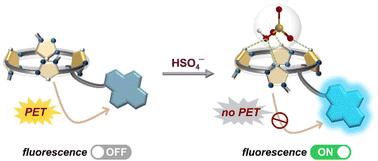
A new fluorescent sensor was developed, in which pyrene is conjugated to calix[4]triazolium via an ester linker, and its ability to bind anions was investigated. Interestingly, addition of HSO4− to Py-CT4 resulted in increased fluorescence, but other anions had little effect. This phenomenon is attributed to the formation of a 1 : 1 stoichiometric Py-CT4–HSO4− complex that interferes with the photoinduced electron transfer (PET) process. The selectivity of Py-CT4 for HSO4− is the result of appropriate spatial complementarity to, and hydrogen bond interaction with, HSO4−. The binding mode and fluorescence changes caused by the PET process can be explained well by density functional theory (DFT) calculations.




 京公网安备 11010802042870号
京ICP备2023020795号-1
京公网安备 11010802042870号
京ICP备2023020795号-1

 分享
分享

 求助内容:
求助内容: 应助结果提醒方式:
 扫码关注我们
