Yueyue Xing , Tianyu Bo , Nan Zhang , Meiqi Wu , Jiawei Wang , Shigang Shen , Yafang Wang , Changying Song , Tiesheng Shi , Shuying Huo
{"title":"苯硒酸用作氧化和脱保护试剂,用于合成受多个二硫键和硫醚桥约束的多环肽","authors":"Yueyue Xing , Tianyu Bo , Nan Zhang , Meiqi Wu , Jiawei Wang , Shigang Shen , Yafang Wang , Changying Song , Tiesheng Shi , Shuying Huo","doi":"10.1039/d4qo00589a","DOIUrl":null,"url":null,"abstract":"<div><div>Peptides constrained by multiple disulfide bonds (MDBs) or by thioether bridges play a critical role in improving the biological and pharmaceutical activities of peptide drugs. The synthesis of correct MDBs and thioether-bridged bicyclic peptides still remains a significant challenge. In this work, benzeneseleninic acid (BSA) acting as both an oxidant and a deprotecting reagent for the synthesis of MDB- and thioether-bridged bicyclic peptides has been investigated. Disulfide bonds in peptides can be formed by direct oxidation of two sulfhydryl groups by BSA in neutral media or <em>via</em> two concerted steps, namely deprotecting two acetamidomethyl (Acm) groups and oxidation by BSA in acidic media. As such, two disulfide bonds in α-conotoxin SI, apamin, α-conotoxin IMI and a peptide containing a methionine residue were synthesized regioselectively by the use of the BSA oxidation and deprotection reaction (BSA-ODr). By utilization of the BSA deprotection property, bicyclic peptides were synthesized based on the crosslinking of xylylene dibromide with sulfhydryl groups. Furthermore, two disulfide bonds in α-conotoxin SI and three disulfide bonds in conotoxin mr3e, enterotoxin STp, μ-conotoxin KIIIA, linaclotide and ziconotide were also synthesized regioselectively through oxidation of fully reduced peptides by BSA. All the reactions were carried out under mild conditions in a one-pot manner and peptides with satisfactory yields were achieved. In addition, the BSA-ODr is compatible with methionine residues in the peptides. Moreover, the relative positions of two Acm-protected cysteines and two free cysteines have no impact on the BSA-ODr approach for the construction of two disulfide bonds in peptides. The oxidative folding strategies based on BSA can be executed in peptide manufacture. BSA is readily accessible conferring efficient BSA-ODr and oxidative folding methodologies for the synthesis of MBDs and thioether bridges in peptides.</div></div>","PeriodicalId":94379,"journal":{"name":"Organic chemistry frontiers : an international journal of organic chemistry","volume":"11 16","pages":"Pages 4423-4435"},"PeriodicalIF":0.0000,"publicationDate":"2024-06-18","publicationTypes":"Journal Article","fieldsOfStudy":null,"isOpenAccess":false,"openAccessPdf":"","citationCount":"0","resultStr":"{\"title\":\"Benzeneseleninic acid used as an oxidizing and deprotecting reagent for the synthesis of multi-cyclic peptides constrained by multiple disulfide bonds and thioether bridges†\",\"authors\":\"Yueyue Xing , Tianyu Bo , Nan Zhang , Meiqi Wu , Jiawei Wang , Shigang Shen , Yafang Wang , Changying Song , Tiesheng Shi , Shuying Huo\",\"doi\":\"10.1039/d4qo00589a\",\"DOIUrl\":null,\"url\":null,\"abstract\":\"<div><div>Peptides constrained by multiple disulfide bonds (MDBs) or by thioether bridges play a critical role in improving the biological and pharmaceutical activities of peptide drugs. The synthesis of correct MDBs and thioether-bridged bicyclic peptides still remains a significant challenge. In this work, benzeneseleninic acid (BSA) acting as both an oxidant and a deprotecting reagent for the synthesis of MDB- and thioether-bridged bicyclic peptides has been investigated. Disulfide bonds in peptides can be formed by direct oxidation of two sulfhydryl groups by BSA in neutral media or <em>via</em> two concerted steps, namely deprotecting two acetamidomethyl (Acm) groups and oxidation by BSA in acidic media. As such, two disulfide bonds in α-conotoxin SI, apamin, α-conotoxin IMI and a peptide containing a methionine residue were synthesized regioselectively by the use of the BSA oxidation and deprotection reaction (BSA-ODr). By utilization of the BSA deprotection property, bicyclic peptides were synthesized based on the crosslinking of xylylene dibromide with sulfhydryl groups. Furthermore, two disulfide bonds in α-conotoxin SI and three disulfide bonds in conotoxin mr3e, enterotoxin STp, μ-conotoxin KIIIA, linaclotide and ziconotide were also synthesized regioselectively through oxidation of fully reduced peptides by BSA. All the reactions were carried out under mild conditions in a one-pot manner and peptides with satisfactory yields were achieved. In addition, the BSA-ODr is compatible with methionine residues in the peptides. Moreover, the relative positions of two Acm-protected cysteines and two free cysteines have no impact on the BSA-ODr approach for the construction of two disulfide bonds in peptides. The oxidative folding strategies based on BSA can be executed in peptide manufacture. BSA is readily accessible conferring efficient BSA-ODr and oxidative folding methodologies for the synthesis of MBDs and thioether bridges in peptides.</div></div>\",\"PeriodicalId\":94379,\"journal\":{\"name\":\"Organic chemistry frontiers : an international journal of organic chemistry\",\"volume\":\"11 16\",\"pages\":\"Pages 4423-4435\"},\"PeriodicalIF\":0.0000,\"publicationDate\":\"2024-06-18\",\"publicationTypes\":\"Journal Article\",\"fieldsOfStudy\":null,\"isOpenAccess\":false,\"openAccessPdf\":\"\",\"citationCount\":\"0\",\"resultStr\":null,\"platform\":\"Semanticscholar\",\"paperid\":null,\"PeriodicalName\":\"Organic chemistry frontiers : an international journal of organic chemistry\",\"FirstCategoryId\":\"1085\",\"ListUrlMain\":\"https://www.sciencedirect.com/org/science/article/pii/S2052412924004522\",\"RegionNum\":0,\"RegionCategory\":null,\"ArticlePicture\":[],\"TitleCN\":null,\"AbstractTextCN\":null,\"PMCID\":null,\"EPubDate\":\"\",\"PubModel\":\"\",\"JCR\":\"\",\"JCRName\":\"\",\"Score\":null,\"Total\":0}","platform":"Semanticscholar","paperid":null,"PeriodicalName":"Organic chemistry frontiers : an international journal of organic chemistry","FirstCategoryId":"1085","ListUrlMain":"https://www.sciencedirect.com/org/science/article/pii/S2052412924004522","RegionNum":0,"RegionCategory":null,"ArticlePicture":[],"TitleCN":null,"AbstractTextCN":null,"PMCID":null,"EPubDate":"","PubModel":"","JCR":"","JCRName":"","Score":null,"Total":0}
引用次数: 0
摘要
受二硫键(MDB)或硫醚桥约束的多环肽对提高肽类药物的生物和药物活性起着至关重要的作用。正确合成二硫键和硫醚桥双环肽仍然是一项重大挑战。本研究以苯硒酸 (BA) 作为氧化剂和脱保护试剂,对多肽二硫键和硫醚桥双环肽的合成进行了研究。肽二硫键可以通过 BA 在中性介质中直接氧化两个巯基形成,也可以通过两个协同步骤形成,即在酸性介质中去保护两个乙酰氨基甲基(Acm)基团和 BA 氧化。因此,利用 BA 氧化和脱保护反应(BA-ODr),可以选择性地合成 a-conotoxin SI、阿帕明、a-conotoxin IMI 和含有蛋氨酸残基的肽中的两个二硫键。此外,两个受 Acm 保护的半胱氨酸和两个游离半胱氨酸的相对位置对 BA-ODr 在肽中构建两个二硫键的方法没有影响。利用 BA 脱保护反应,在二溴二苯基与巯基交联的基础上合成了双环肽,并获得了满意的收率。此外,通过 BA 氧化完全还原的肽,还以合理的产率选择性地合成了 a-conotoxin SI 中的两个二硫键和 conotoxin mr3e、肠毒素 STp、μ-conotoxin KIIIA、linaclotide 和 ziconotide 中的三个二硫键。BA 易于获得,因此可以采用高效的 BA-ODr 和氧化折叠策略来制备肽中的 MBD 和硫醚桥。
Benzeneseleninic acid used as an oxidizing and deprotecting reagent for the synthesis of multi-cyclic peptides constrained by multiple disulfide bonds and thioether bridges†
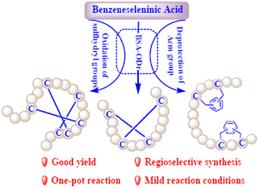
Peptides constrained by multiple disulfide bonds (MDBs) or by thioether bridges play a critical role in improving the biological and pharmaceutical activities of peptide drugs. The synthesis of correct MDBs and thioether-bridged bicyclic peptides still remains a significant challenge. In this work, benzeneseleninic acid (BSA) acting as both an oxidant and a deprotecting reagent for the synthesis of MDB- and thioether-bridged bicyclic peptides has been investigated. Disulfide bonds in peptides can be formed by direct oxidation of two sulfhydryl groups by BSA in neutral media or via two concerted steps, namely deprotecting two acetamidomethyl (Acm) groups and oxidation by BSA in acidic media. As such, two disulfide bonds in α-conotoxin SI, apamin, α-conotoxin IMI and a peptide containing a methionine residue were synthesized regioselectively by the use of the BSA oxidation and deprotection reaction (BSA-ODr). By utilization of the BSA deprotection property, bicyclic peptides were synthesized based on the crosslinking of xylylene dibromide with sulfhydryl groups. Furthermore, two disulfide bonds in α-conotoxin SI and three disulfide bonds in conotoxin mr3e, enterotoxin STp, μ-conotoxin KIIIA, linaclotide and ziconotide were also synthesized regioselectively through oxidation of fully reduced peptides by BSA. All the reactions were carried out under mild conditions in a one-pot manner and peptides with satisfactory yields were achieved. In addition, the BSA-ODr is compatible with methionine residues in the peptides. Moreover, the relative positions of two Acm-protected cysteines and two free cysteines have no impact on the BSA-ODr approach for the construction of two disulfide bonds in peptides. The oxidative folding strategies based on BSA can be executed in peptide manufacture. BSA is readily accessible conferring efficient BSA-ODr and oxidative folding methodologies for the synthesis of MBDs and thioether bridges in peptides.




 京公网安备 11010802042870号
京ICP备2023020795号-1
京公网安备 11010802042870号
京ICP备2023020795号-1

 分享
分享

 求助内容:
求助内容: 应助结果提醒方式:
 扫码关注我们
