{"title":"通过铁催化的 LMCT 脱羧过程光诱导合成氟烷基喹啉酮类化合物","authors":"Zhuoheng Song , Lin Guo , Chao Yang , Wujiong Xia","doi":"10.1039/d4qo00707g","DOIUrl":null,"url":null,"abstract":"<div><div>Herein, we report a practical synthetic method for the efficient preparation of fluoroalkylated quinoline-2,4-diones using <em>N</em>-(2-cyanophenyl)-<em>N</em>-methylacrylamides as substrates, fluoroalkyl carboxylic acids as reactants, and Fe(OH)(OAc)<sub>2</sub> as a catalyst. This reaction started with a photo-driven ligand-to-metal charge transfer (LMCT) process to decarboxylate the reactant and produce fluoroalkyl radicals, which then underwent radical cascade cyclization with the substrate. The target products were obtained in 55–91% yields. A gram scale experiment was also completed using a continuous-flow photocatalytic device.</div></div>","PeriodicalId":94379,"journal":{"name":"Organic chemistry frontiers : an international journal of organic chemistry","volume":"11 16","pages":"Pages 4436-4441"},"PeriodicalIF":0.0000,"publicationDate":"2024-06-18","publicationTypes":"Journal Article","fieldsOfStudy":null,"isOpenAccess":false,"openAccessPdf":"","citationCount":"0","resultStr":"{\"title\":\"Photo-induced synthesis of fluoroalkylated quinolinones via an iron-catalyzed LMCT decarboxylation process†\",\"authors\":\"Zhuoheng Song , Lin Guo , Chao Yang , Wujiong Xia\",\"doi\":\"10.1039/d4qo00707g\",\"DOIUrl\":null,\"url\":null,\"abstract\":\"<div><div>Herein, we report a practical synthetic method for the efficient preparation of fluoroalkylated quinoline-2,4-diones using <em>N</em>-(2-cyanophenyl)-<em>N</em>-methylacrylamides as substrates, fluoroalkyl carboxylic acids as reactants, and Fe(OH)(OAc)<sub>2</sub> as a catalyst. This reaction started with a photo-driven ligand-to-metal charge transfer (LMCT) process to decarboxylate the reactant and produce fluoroalkyl radicals, which then underwent radical cascade cyclization with the substrate. The target products were obtained in 55–91% yields. A gram scale experiment was also completed using a continuous-flow photocatalytic device.</div></div>\",\"PeriodicalId\":94379,\"journal\":{\"name\":\"Organic chemistry frontiers : an international journal of organic chemistry\",\"volume\":\"11 16\",\"pages\":\"Pages 4436-4441\"},\"PeriodicalIF\":0.0000,\"publicationDate\":\"2024-06-18\",\"publicationTypes\":\"Journal Article\",\"fieldsOfStudy\":null,\"isOpenAccess\":false,\"openAccessPdf\":\"\",\"citationCount\":\"0\",\"resultStr\":null,\"platform\":\"Semanticscholar\",\"paperid\":null,\"PeriodicalName\":\"Organic chemistry frontiers : an international journal of organic chemistry\",\"FirstCategoryId\":\"1085\",\"ListUrlMain\":\"https://www.sciencedirect.com/org/science/article/pii/S205241292400500X\",\"RegionNum\":0,\"RegionCategory\":null,\"ArticlePicture\":[],\"TitleCN\":null,\"AbstractTextCN\":null,\"PMCID\":null,\"EPubDate\":\"\",\"PubModel\":\"\",\"JCR\":\"\",\"JCRName\":\"\",\"Score\":null,\"Total\":0}","platform":"Semanticscholar","paperid":null,"PeriodicalName":"Organic chemistry frontiers : an international journal of organic chemistry","FirstCategoryId":"1085","ListUrlMain":"https://www.sciencedirect.com/org/science/article/pii/S205241292400500X","RegionNum":0,"RegionCategory":null,"ArticlePicture":[],"TitleCN":null,"AbstractTextCN":null,"PMCID":null,"EPubDate":"","PubModel":"","JCR":"","JCRName":"","Score":null,"Total":0}
Photo-induced synthesis of fluoroalkylated quinolinones via an iron-catalyzed LMCT decarboxylation process†
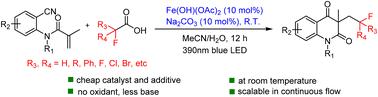
Herein, we report a practical synthetic method for the efficient preparation of fluoroalkylated quinoline-2,4-diones using N-(2-cyanophenyl)-N-methylacrylamides as substrates, fluoroalkyl carboxylic acids as reactants, and Fe(OH)(OAc)2 as a catalyst. This reaction started with a photo-driven ligand-to-metal charge transfer (LMCT) process to decarboxylate the reactant and produce fluoroalkyl radicals, which then underwent radical cascade cyclization with the substrate. The target products were obtained in 55–91% yields. A gram scale experiment was also completed using a continuous-flow photocatalytic device.




 京公网安备 11010802042870号
京ICP备2023020795号-1
京公网安备 11010802042870号
京ICP备2023020795号-1

 分享
分享

 求助内容:
求助内容: 应助结果提醒方式:
 扫码关注我们
