{"title":"通过铀-有机框架中的铀酰辅助光催化氧还原反应过程高效、选择性地产生 H2O2","authors":"Jianxin Song, Chao Liang, Baoyu Li, Xuemin Wang, Min Lei, Lisha Jiang, Zhenyu Li, Yugang Zhang, Jian Xie, Zuju Ma, Xing Dai, Yanlong Wang, Shuao Wang, Wei Liu","doi":"10.1007/s11426-023-1987-0","DOIUrl":null,"url":null,"abstract":"<div><p>Harnessing solar energy by photocatalytically converting oxygen and water into high-value-added H<sub>2</sub>O<sub>2</sub> is a promising way of alleviating both environmental and energy issues. It is worth noting that suppressing detrimental side reactions, such as the generation of •O<sub>2</sub><sup>−</sup>, is a critical approach to enhancing H<sub>2</sub>O<sub>2</sub> production. Herein, a 2-fold interpenetrating 3D uranium-organic framework (YTU-W-1) was developed and introduced for photocatalytic H<sub>2</sub>O<sub>2</sub> production. The material demonstrates a different photocatalytic mechanism when employing uranyl as an initiator, as compared with the conventional semiconductor photocatalytic pathway involving photo-generated charge carriers. Benefiting from the strong hydrogen abstraction effect of the U≡O<sup>•</sup> and the direct one-step oxygen reduction pathway, YTU-W-1 exhibits enhanced photocatalytic performance for H<sub>2</sub>O<sub>2</sub> production with yield efficiency of 221 µmol h<sup>−1</sup> g<sup>−1</sup>. Furthermore, YTU-W-1 displays a high H<sub>2</sub>O<sub>2</sub> selectivity of 68%, confirmed by rotating ring-disk electrode (RRDE) measurement. DFT calculations were used to elucidate the critical role of uranyl in the photocatalytic oxygen reduction reaction for H<sub>2</sub>O<sub>2</sub> production. This research introduces an innovative approach to photo driven H<sub>2</sub>O<sub>2</sub> production, underscoring the potential for heterogeneous catalysts to engage in photocatalytic reactions independently of photo-generated charge carriers.</p><div><figure><div><div><picture><source><img></source></picture></div></div></figure></div></div>","PeriodicalId":772,"journal":{"name":"Science China Chemistry","volume":"67 7","pages":"2274 - 2281"},"PeriodicalIF":9.7000,"publicationDate":"2024-06-06","publicationTypes":"Journal Article","fieldsOfStudy":null,"isOpenAccess":false,"openAccessPdf":"https://link.springer.com/content/pdf/10.1007/s11426-023-1987-0.pdf","citationCount":"0","resultStr":"{\"title\":\"Efficient and selective H2O2 production through uranyl-assisted photocatalytic oxygen reduction reaction process in a uranium-organic framework\",\"authors\":\"Jianxin Song, Chao Liang, Baoyu Li, Xuemin Wang, Min Lei, Lisha Jiang, Zhenyu Li, Yugang Zhang, Jian Xie, Zuju Ma, Xing Dai, Yanlong Wang, Shuao Wang, Wei Liu\",\"doi\":\"10.1007/s11426-023-1987-0\",\"DOIUrl\":null,\"url\":null,\"abstract\":\"<div><p>Harnessing solar energy by photocatalytically converting oxygen and water into high-value-added H<sub>2</sub>O<sub>2</sub> is a promising way of alleviating both environmental and energy issues. It is worth noting that suppressing detrimental side reactions, such as the generation of •O<sub>2</sub><sup>−</sup>, is a critical approach to enhancing H<sub>2</sub>O<sub>2</sub> production. Herein, a 2-fold interpenetrating 3D uranium-organic framework (YTU-W-1) was developed and introduced for photocatalytic H<sub>2</sub>O<sub>2</sub> production. The material demonstrates a different photocatalytic mechanism when employing uranyl as an initiator, as compared with the conventional semiconductor photocatalytic pathway involving photo-generated charge carriers. Benefiting from the strong hydrogen abstraction effect of the U≡O<sup>•</sup> and the direct one-step oxygen reduction pathway, YTU-W-1 exhibits enhanced photocatalytic performance for H<sub>2</sub>O<sub>2</sub> production with yield efficiency of 221 µmol h<sup>−1</sup> g<sup>−1</sup>. Furthermore, YTU-W-1 displays a high H<sub>2</sub>O<sub>2</sub> selectivity of 68%, confirmed by rotating ring-disk electrode (RRDE) measurement. DFT calculations were used to elucidate the critical role of uranyl in the photocatalytic oxygen reduction reaction for H<sub>2</sub>O<sub>2</sub> production. This research introduces an innovative approach to photo driven H<sub>2</sub>O<sub>2</sub> production, underscoring the potential for heterogeneous catalysts to engage in photocatalytic reactions independently of photo-generated charge carriers.</p><div><figure><div><div><picture><source><img></source></picture></div></div></figure></div></div>\",\"PeriodicalId\":772,\"journal\":{\"name\":\"Science China Chemistry\",\"volume\":\"67 7\",\"pages\":\"2274 - 2281\"},\"PeriodicalIF\":9.7000,\"publicationDate\":\"2024-06-06\",\"publicationTypes\":\"Journal Article\",\"fieldsOfStudy\":null,\"isOpenAccess\":false,\"openAccessPdf\":\"https://link.springer.com/content/pdf/10.1007/s11426-023-1987-0.pdf\",\"citationCount\":\"0\",\"resultStr\":null,\"platform\":\"Semanticscholar\",\"paperid\":null,\"PeriodicalName\":\"Science China Chemistry\",\"FirstCategoryId\":\"1\",\"ListUrlMain\":\"https://link.springer.com/article/10.1007/s11426-023-1987-0\",\"RegionNum\":1,\"RegionCategory\":\"化学\",\"ArticlePicture\":[],\"TitleCN\":null,\"AbstractTextCN\":null,\"PMCID\":null,\"EPubDate\":\"\",\"PubModel\":\"\",\"JCR\":\"Q1\",\"JCRName\":\"CHEMISTRY, MULTIDISCIPLINARY\",\"Score\":null,\"Total\":0}","platform":"Semanticscholar","paperid":null,"PeriodicalName":"Science China Chemistry","FirstCategoryId":"1","ListUrlMain":"https://link.springer.com/article/10.1007/s11426-023-1987-0","RegionNum":1,"RegionCategory":"化学","ArticlePicture":[],"TitleCN":null,"AbstractTextCN":null,"PMCID":null,"EPubDate":"","PubModel":"","JCR":"Q1","JCRName":"CHEMISTRY, MULTIDISCIPLINARY","Score":null,"Total":0}
Efficient and selective H2O2 production through uranyl-assisted photocatalytic oxygen reduction reaction process in a uranium-organic framework
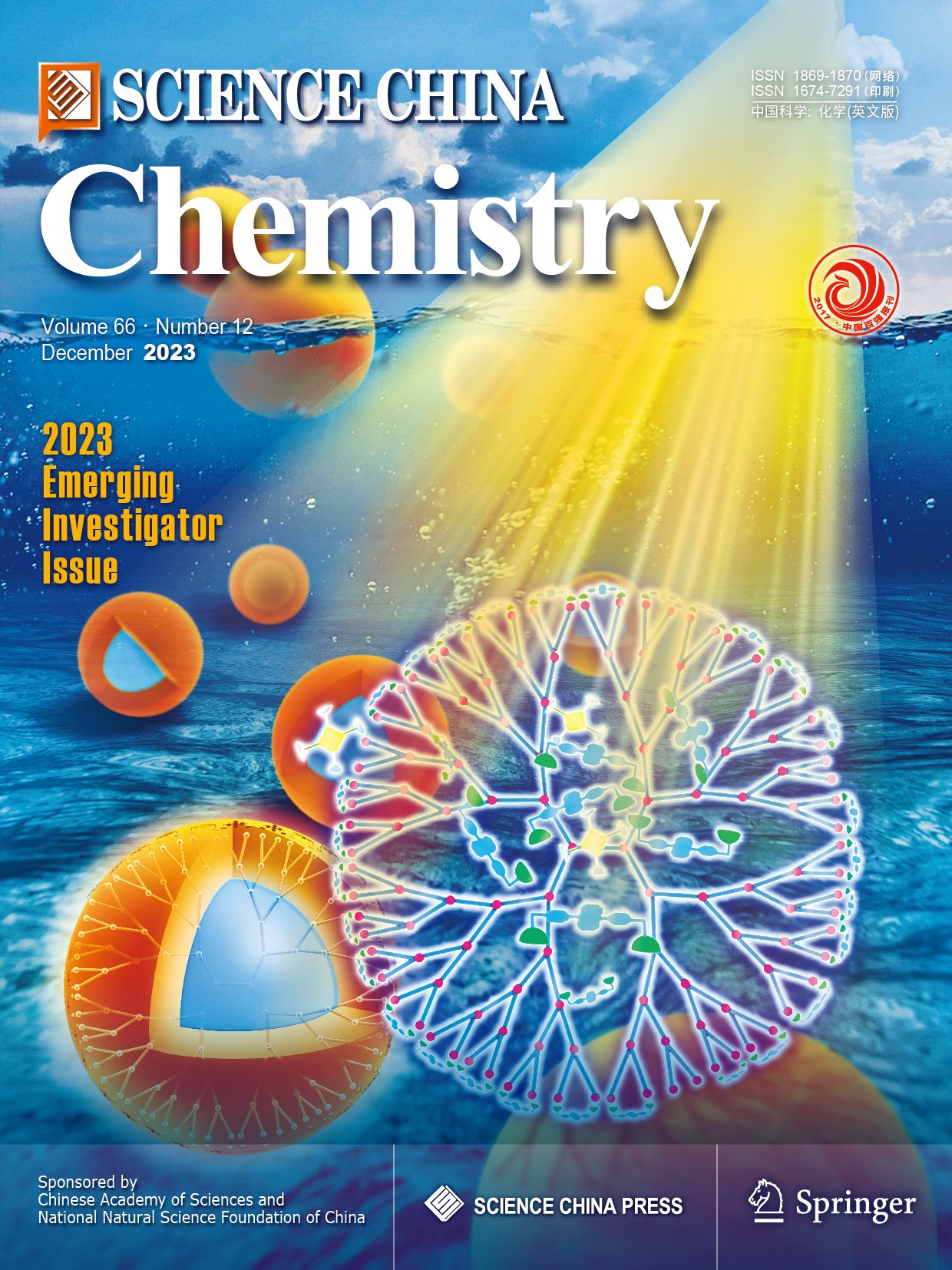
Harnessing solar energy by photocatalytically converting oxygen and water into high-value-added H2O2 is a promising way of alleviating both environmental and energy issues. It is worth noting that suppressing detrimental side reactions, such as the generation of •O2−, is a critical approach to enhancing H2O2 production. Herein, a 2-fold interpenetrating 3D uranium-organic framework (YTU-W-1) was developed and introduced for photocatalytic H2O2 production. The material demonstrates a different photocatalytic mechanism when employing uranyl as an initiator, as compared with the conventional semiconductor photocatalytic pathway involving photo-generated charge carriers. Benefiting from the strong hydrogen abstraction effect of the U≡O• and the direct one-step oxygen reduction pathway, YTU-W-1 exhibits enhanced photocatalytic performance for H2O2 production with yield efficiency of 221 µmol h−1 g−1. Furthermore, YTU-W-1 displays a high H2O2 selectivity of 68%, confirmed by rotating ring-disk electrode (RRDE) measurement. DFT calculations were used to elucidate the critical role of uranyl in the photocatalytic oxygen reduction reaction for H2O2 production. This research introduces an innovative approach to photo driven H2O2 production, underscoring the potential for heterogeneous catalysts to engage in photocatalytic reactions independently of photo-generated charge carriers.
期刊介绍:
Science China Chemistry, co-sponsored by the Chinese Academy of Sciences and the National Natural Science Foundation of China and published by Science China Press, publishes high-quality original research in both basic and applied chemistry. Indexed by Science Citation Index, it is a premier academic journal in the field.
Categories of articles include:
Highlights. Brief summaries and scholarly comments on recent research achievements in any field of chemistry.
Perspectives. Concise reports on thelatest chemistry trends of interest to scientists worldwide, including discussions of research breakthroughs and interpretations of important science and funding policies.
Reviews. In-depth summaries of representative results and achievements of the past 5–10 years in selected topics based on or closely related to the research expertise of the authors, providing a thorough assessment of the significance, current status, and future research directions of the field.




 京公网安备 11010802042870号
京ICP备2023020795号-1
京公网安备 11010802042870号
京ICP备2023020795号-1

 分享
分享
 求助内容:
求助内容: 应助结果提醒方式:
 扫码关注我们
