Hassan Y. Ali, Salih A. Rushdi, Hayder A. Alhameedi
{"title":"微生物燃料电池:它们的形状、设计和运输方法(微型评论)","authors":"Hassan Y. Ali, Salih A. Rushdi, Hayder A. Alhameedi","doi":"10.1134/S1070427224010142","DOIUrl":null,"url":null,"abstract":"<p>Over the past century, and particularly in the last two decades, there has been a massive increase in the need for efficient and sustainable methods of generating energy from waste items. Due to the exponential rise in effluent-laden wastewater from businesses, the food and agriculture sectors, and the environment, wastewater treatment has also received a lot of attention in recent years. Numerous wastewater treatment methods have been developed throughout the years, but most of them fall short in terms of energy recovery rates, durability, and cost-effectiveness. Since microbial fuel cells carry out bio-electrochemical reactions on organic, biodegradable substances to oxidize them and produce electricity that can be used, they can be a significant help in addressing both of these problems at once. In this overview, we go over the elements that determine the microbial fuel cell’s performance, how they work, how protons and electrons are transferred, the many forms that were created in terms of advantages and disadvantages, and the fuel that these cells run on.</p>","PeriodicalId":757,"journal":{"name":"Russian Journal of Applied Chemistry","volume":"97 1","pages":"183 - 197"},"PeriodicalIF":0.6000,"publicationDate":"2024-06-06","publicationTypes":"Journal Article","fieldsOfStudy":null,"isOpenAccess":false,"openAccessPdf":"","citationCount":"0","resultStr":"{\"title\":\"Microbial Fuel Cells: Their Shapes, Designs, and Transportation Methods (Mini Review)\",\"authors\":\"Hassan Y. Ali, Salih A. Rushdi, Hayder A. Alhameedi\",\"doi\":\"10.1134/S1070427224010142\",\"DOIUrl\":null,\"url\":null,\"abstract\":\"<p>Over the past century, and particularly in the last two decades, there has been a massive increase in the need for efficient and sustainable methods of generating energy from waste items. Due to the exponential rise in effluent-laden wastewater from businesses, the food and agriculture sectors, and the environment, wastewater treatment has also received a lot of attention in recent years. Numerous wastewater treatment methods have been developed throughout the years, but most of them fall short in terms of energy recovery rates, durability, and cost-effectiveness. Since microbial fuel cells carry out bio-electrochemical reactions on organic, biodegradable substances to oxidize them and produce electricity that can be used, they can be a significant help in addressing both of these problems at once. In this overview, we go over the elements that determine the microbial fuel cell’s performance, how they work, how protons and electrons are transferred, the many forms that were created in terms of advantages and disadvantages, and the fuel that these cells run on.</p>\",\"PeriodicalId\":757,\"journal\":{\"name\":\"Russian Journal of Applied Chemistry\",\"volume\":\"97 1\",\"pages\":\"183 - 197\"},\"PeriodicalIF\":0.6000,\"publicationDate\":\"2024-06-06\",\"publicationTypes\":\"Journal Article\",\"fieldsOfStudy\":null,\"isOpenAccess\":false,\"openAccessPdf\":\"\",\"citationCount\":\"0\",\"resultStr\":null,\"platform\":\"Semanticscholar\",\"paperid\":null,\"PeriodicalName\":\"Russian Journal of Applied Chemistry\",\"FirstCategoryId\":\"92\",\"ListUrlMain\":\"https://link.springer.com/article/10.1134/S1070427224010142\",\"RegionNum\":4,\"RegionCategory\":\"化学\",\"ArticlePicture\":[],\"TitleCN\":null,\"AbstractTextCN\":null,\"PMCID\":null,\"EPubDate\":\"\",\"PubModel\":\"\",\"JCR\":\"Q4\",\"JCRName\":\"CHEMISTRY, APPLIED\",\"Score\":null,\"Total\":0}","platform":"Semanticscholar","paperid":null,"PeriodicalName":"Russian Journal of Applied Chemistry","FirstCategoryId":"92","ListUrlMain":"https://link.springer.com/article/10.1134/S1070427224010142","RegionNum":4,"RegionCategory":"化学","ArticlePicture":[],"TitleCN":null,"AbstractTextCN":null,"PMCID":null,"EPubDate":"","PubModel":"","JCR":"Q4","JCRName":"CHEMISTRY, APPLIED","Score":null,"Total":0}
Microbial Fuel Cells: Their Shapes, Designs, and Transportation Methods (Mini Review)
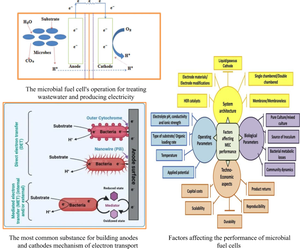
Over the past century, and particularly in the last two decades, there has been a massive increase in the need for efficient and sustainable methods of generating energy from waste items. Due to the exponential rise in effluent-laden wastewater from businesses, the food and agriculture sectors, and the environment, wastewater treatment has also received a lot of attention in recent years. Numerous wastewater treatment methods have been developed throughout the years, but most of them fall short in terms of energy recovery rates, durability, and cost-effectiveness. Since microbial fuel cells carry out bio-electrochemical reactions on organic, biodegradable substances to oxidize them and produce electricity that can be used, they can be a significant help in addressing both of these problems at once. In this overview, we go over the elements that determine the microbial fuel cell’s performance, how they work, how protons and electrons are transferred, the many forms that were created in terms of advantages and disadvantages, and the fuel that these cells run on.
期刊介绍:
Russian Journal of Applied Chemistry (Zhurnal prikladnoi khimii) was founded in 1928. It covers all application problems of modern chemistry, including the structure of inorganic and organic compounds, kinetics and mechanisms of chemical reactions, problems of chemical processes and apparatus, borderline problems of chemistry, and applied research.





 京公网安备 11010802042870号
京ICP备2023020795号-1
京公网安备 11010802042870号
京ICP备2023020795号-1

 分享
分享

 求助内容:
求助内容: 应助结果提醒方式:
 扫码关注我们
