{"title":"在 HLA 匹配的异基因造血干细胞移植中,对于移植前肺功能障碍的受者,BM 优于 PBSC","authors":"","doi":"10.1016/j.jcyt.2024.06.006","DOIUrl":null,"url":null,"abstract":"<div><h3>Background aims</h3><div>Pre-transplant lung dysfunction is known to be a risk factor for non-relapse mortality (NRM) after allogeneic hematopoietic cell transplantation (allo-HCT). It is unclear which cell source gives better outcomes for patients with pulmonary dysfunction.</div></div><div><h3>Methods</h3><div>We analyzed 3289 adult patients with standard-risk disease who had received HLA-matched allo-HCT, and compared outcomes between those who received peripheral blood stem cell (PBSC) vs. bone marrow (BM) in two cohorts based on the presence of a lung score by the Hematopoietic Cell Transplantation-specific Comorbidity Index (HCT-CI): the Lung-scored (LS) and non-LS cohorts.</div></div><div><h3>Results</h3><div><span>In the LS cohort, the 2-year overall survival (OS) in the BM group tended to be higher than that in the PBSC group (72.4% vs. 61.4%; P = 0.044). In the non-LS cohort, there was no significant difference between the two groups (71.7% vs. 73.2%; P = 0.13). Multivariate analyses confirmed that PBSC was significantly associated with inferior </span>OS<span> in the LS cohort (hazard ratio [HR], 1.66; 95% CI, 1.09-2.54; P = 0.019). On the other hand, the cell source did not affect OS in the non-LS cohort (HR, 0.92; 95% CI, 0.76-1.12; P = 0.41). We found that PBSC was associated with an increased risk of NRM in the LS cohort (HR, 2.17; 95% CI, 1.16-4.05; P = 0.016), while the cell source did not significantly affect NRM in the non-LS cohort. PBSC was not identified as a risk factor for relapse in either cohort.</span></div></div><div><h3>Conclusions</h3><div>Our results suggest that BM might be beneficial for recipients with lung dysfunction in HLA-matched allo-HCT.</div></div>","PeriodicalId":50597,"journal":{"name":"Cytotherapy","volume":"26 11","pages":"Pages 1353-1361"},"PeriodicalIF":3.2000,"publicationDate":"2024-11-01","publicationTypes":"Journal Article","fieldsOfStudy":null,"isOpenAccess":false,"openAccessPdf":"","citationCount":"0","resultStr":"{\"title\":\"Superiority of BM over PBSC for recipients with pre-transplant lung dysfunction in HLA-matched allogeneic HCT\",\"authors\":\"\",\"doi\":\"10.1016/j.jcyt.2024.06.006\",\"DOIUrl\":null,\"url\":null,\"abstract\":\"<div><h3>Background aims</h3><div>Pre-transplant lung dysfunction is known to be a risk factor for non-relapse mortality (NRM) after allogeneic hematopoietic cell transplantation (allo-HCT). It is unclear which cell source gives better outcomes for patients with pulmonary dysfunction.</div></div><div><h3>Methods</h3><div>We analyzed 3289 adult patients with standard-risk disease who had received HLA-matched allo-HCT, and compared outcomes between those who received peripheral blood stem cell (PBSC) vs. bone marrow (BM) in two cohorts based on the presence of a lung score by the Hematopoietic Cell Transplantation-specific Comorbidity Index (HCT-CI): the Lung-scored (LS) and non-LS cohorts.</div></div><div><h3>Results</h3><div><span>In the LS cohort, the 2-year overall survival (OS) in the BM group tended to be higher than that in the PBSC group (72.4% vs. 61.4%; P = 0.044). In the non-LS cohort, there was no significant difference between the two groups (71.7% vs. 73.2%; P = 0.13). Multivariate analyses confirmed that PBSC was significantly associated with inferior </span>OS<span> in the LS cohort (hazard ratio [HR], 1.66; 95% CI, 1.09-2.54; P = 0.019). On the other hand, the cell source did not affect OS in the non-LS cohort (HR, 0.92; 95% CI, 0.76-1.12; P = 0.41). We found that PBSC was associated with an increased risk of NRM in the LS cohort (HR, 2.17; 95% CI, 1.16-4.05; P = 0.016), while the cell source did not significantly affect NRM in the non-LS cohort. PBSC was not identified as a risk factor for relapse in either cohort.</span></div></div><div><h3>Conclusions</h3><div>Our results suggest that BM might be beneficial for recipients with lung dysfunction in HLA-matched allo-HCT.</div></div>\",\"PeriodicalId\":50597,\"journal\":{\"name\":\"Cytotherapy\",\"volume\":\"26 11\",\"pages\":\"Pages 1353-1361\"},\"PeriodicalIF\":3.2000,\"publicationDate\":\"2024-11-01\",\"publicationTypes\":\"Journal Article\",\"fieldsOfStudy\":null,\"isOpenAccess\":false,\"openAccessPdf\":\"\",\"citationCount\":\"0\",\"resultStr\":null,\"platform\":\"Semanticscholar\",\"paperid\":null,\"PeriodicalName\":\"Cytotherapy\",\"FirstCategoryId\":\"3\",\"ListUrlMain\":\"https://www.sciencedirect.com/science/article/pii/S1465324924007576\",\"RegionNum\":3,\"RegionCategory\":\"医学\",\"ArticlePicture\":[],\"TitleCN\":null,\"AbstractTextCN\":null,\"PMCID\":null,\"EPubDate\":\"2024/6/12 0:00:00\",\"PubModel\":\"Epub\",\"JCR\":\"Q2\",\"JCRName\":\"BIOTECHNOLOGY & APPLIED MICROBIOLOGY\",\"Score\":null,\"Total\":0}","platform":"Semanticscholar","paperid":null,"PeriodicalName":"Cytotherapy","FirstCategoryId":"3","ListUrlMain":"https://www.sciencedirect.com/science/article/pii/S1465324924007576","RegionNum":3,"RegionCategory":"医学","ArticlePicture":[],"TitleCN":null,"AbstractTextCN":null,"PMCID":null,"EPubDate":"2024/6/12 0:00:00","PubModel":"Epub","JCR":"Q2","JCRName":"BIOTECHNOLOGY & APPLIED MICROBIOLOGY","Score":null,"Total":0}
引用次数: 0
摘要
背景目的移植前肺功能障碍是异基因造血细胞移植(allo-HCT)后非复发死亡率(NRM)的一个风险因素。我们分析了3289名接受HLA配型异体造血干细胞移植的标准风险疾病成年患者,并比较了接受外周血干细胞(PBSC)与骨髓(BM)移植的患者的治疗效果。结果在LS队列中,骨髓干细胞组的2年总生存率(OS)往往高于PBSC组(72.4% vs. 61.4%; P = 0.044)。在非LS队列中,两组间无明显差异(71.7% vs. 73.2%;P = 0.13)。多变量分析证实,在LS队列中,PBSC与较差的OS显著相关(危险比[HR],1.66;95% CI,1.09-2.54;P = 0.019)。另一方面,细胞来源对非LS队列的OS没有影响(HR,0.92;95% CI,0.76-1.12;P = 0.41)。我们发现,在LS队列中,PBSC与NRM风险增加有关(HR,2.17;95% CI,1.16-4.05;P = 0.016),而在非LS队列中,细胞来源对NRM无显著影响。结论我们的研究结果表明,在 HLA 匹配的异体肝移植中,BM 可能对肺功能障碍的受者有益。
Superiority of BM over PBSC for recipients with pre-transplant lung dysfunction in HLA-matched allogeneic HCT
Background aims
Pre-transplant lung dysfunction is known to be a risk factor for non-relapse mortality (NRM) after allogeneic hematopoietic cell transplantation (allo-HCT). It is unclear which cell source gives better outcomes for patients with pulmonary dysfunction.
Methods
We analyzed 3289 adult patients with standard-risk disease who had received HLA-matched allo-HCT, and compared outcomes between those who received peripheral blood stem cell (PBSC) vs. bone marrow (BM) in two cohorts based on the presence of a lung score by the Hematopoietic Cell Transplantation-specific Comorbidity Index (HCT-CI): the Lung-scored (LS) and non-LS cohorts.
Results
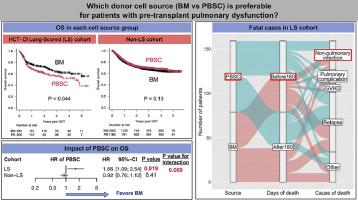
In the LS cohort, the 2-year overall survival (OS) in the BM group tended to be higher than that in the PBSC group (72.4% vs. 61.4%; P = 0.044). In the non-LS cohort, there was no significant difference between the two groups (71.7% vs. 73.2%; P = 0.13). Multivariate analyses confirmed that PBSC was significantly associated with inferior OS in the LS cohort (hazard ratio [HR], 1.66; 95% CI, 1.09-2.54; P = 0.019). On the other hand, the cell source did not affect OS in the non-LS cohort (HR, 0.92; 95% CI, 0.76-1.12; P = 0.41). We found that PBSC was associated with an increased risk of NRM in the LS cohort (HR, 2.17; 95% CI, 1.16-4.05; P = 0.016), while the cell source did not significantly affect NRM in the non-LS cohort. PBSC was not identified as a risk factor for relapse in either cohort.
Conclusions
Our results suggest that BM might be beneficial for recipients with lung dysfunction in HLA-matched allo-HCT.
期刊介绍:
The journal brings readers the latest developments in the fast moving field of cellular therapy in man. This includes cell therapy for cancer, immune disorders, inherited diseases, tissue repair and regenerative medicine. The journal covers the science, translational development and treatment with variety of cell types including hematopoietic stem cells, immune cells (dendritic cells, NK, cells, T cells, antigen presenting cells) mesenchymal stromal cells, adipose cells, nerve, muscle, vascular and endothelial cells, and induced pluripotential stem cells. We also welcome manuscripts on subcellular derivatives such as exosomes. A specific focus is on translational research that brings cell therapy to the clinic. Cytotherapy publishes original papers, reviews, position papers editorials, commentaries and letters to the editor. We welcome "Protocols in Cytotherapy" bringing standard operating procedure for production specific cell types for clinical use within the reach of the readership.




 京公网安备 11010802042870号
京ICP备2023020795号-1
京公网安备 11010802042870号
京ICP备2023020795号-1

 分享
分享
 求助内容:
求助内容: 应助结果提醒方式:
 扫码关注我们
