Theory versus practice: are insecticide mixtures in Arizona cotton used for resistance management?†
BACKGROUND
Resistance management in pesticide use is critical, yet grower practices, especially pesticide mixing motivations, diverge from theoretical frameworks. This study analyzes 30 years of Arizona cotton growers’ practices and pest manager insights to understand mixing trends.
RESULTS
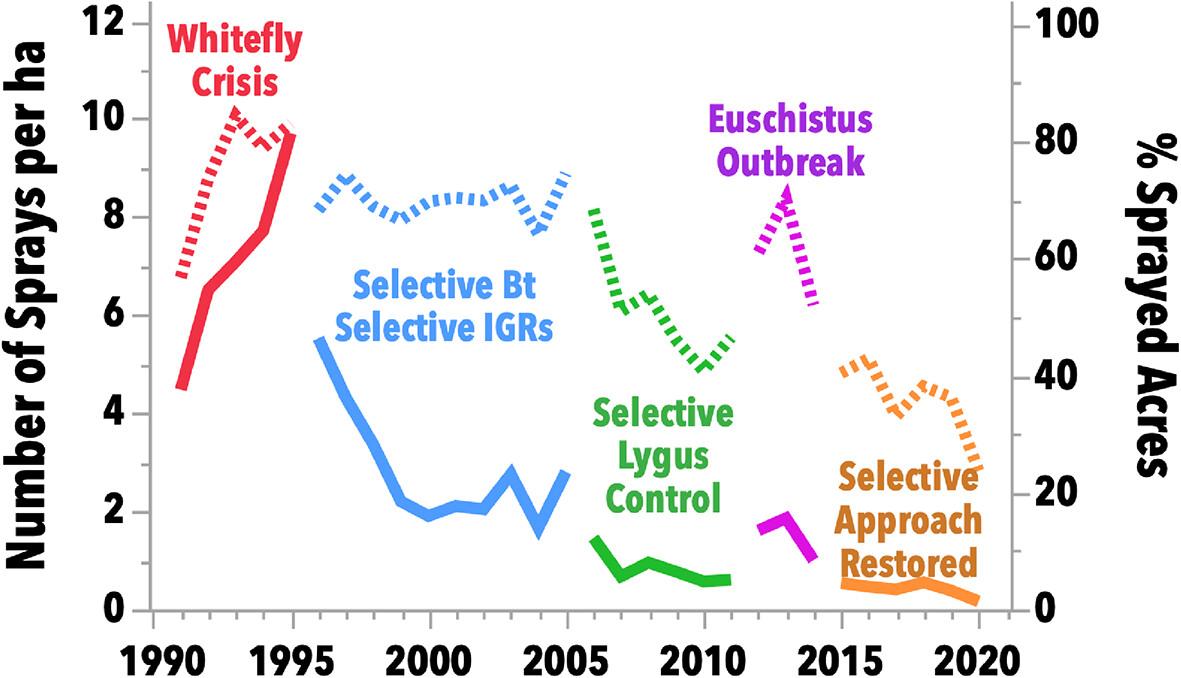
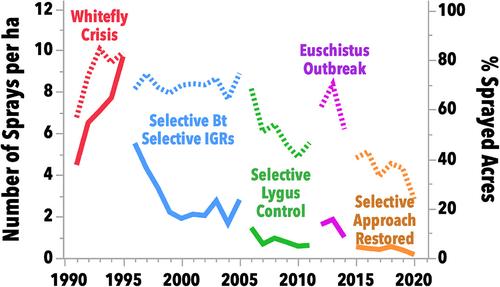
Growers predominantly mix pesticides for spectrum or efficacy, not resistance management. This highlights a gap between theory and practice, emphasizing the complexity of real-world dynamics. A shift over time towards selective insecticides and integrated pest management (IPM), supported by extension education, has reduced reliance on broad-spectrum insecticides and increased opportunities to conserve the natural enemies of key pests. This reduced the frequency of insecticide use, a mutual goal of both IPM and resistance management. The availability and adoption of selective products with diverse modes of action, along with the resulting increases in biological control and refuges, likely has delayed or prevented resistances without emphasis on using mixtures specifically for resistance management. In a disrupted system exclusively dependent on broad-spectrum insecticides (1991–1995), 75% ± 5% of cotton area was sprayed with mixtures of these materials. With the availability of selective insecticides, few broad-spectrum products are used today and mixtures of insecticides are sprayed on only 36% ± 3% of the cotton area (2015–2020).
期刊介绍:
Pest Management Science is the international journal of research and development in crop protection and pest control. Since its launch in 1970, the journal has become the premier forum for papers on the discovery, application, and impact on the environment of products and strategies designed for pest management.
Published for SCI by John Wiley & Sons Ltd.







 京公网安备 11010802042870号
京ICP备2023020795号-1
京公网安备 11010802042870号
京ICP备2023020795号-1

 分享
分享
 求助内容:
求助内容: 应助结果提醒方式:
 扫码关注我们
